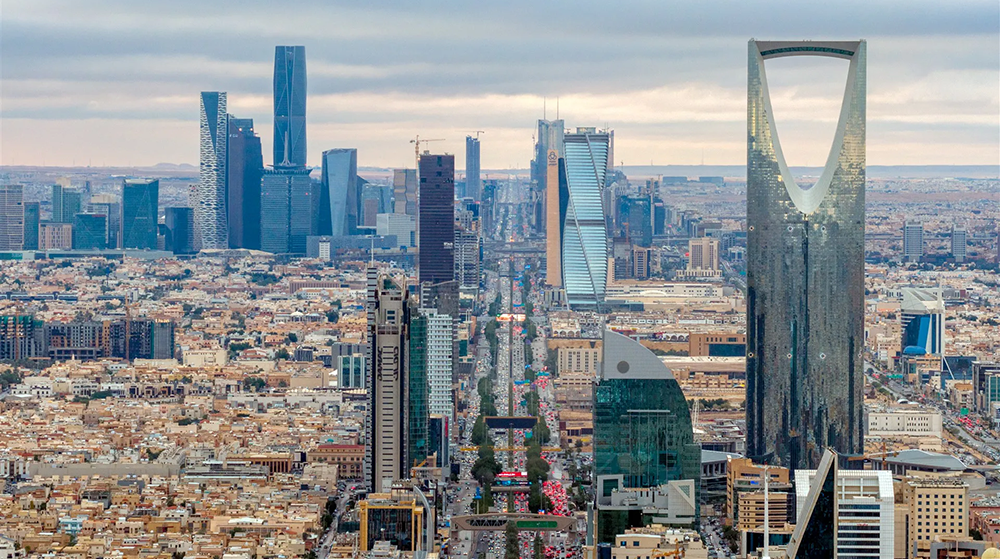
A view of Riyadh skyline.
Saudi Arabia’s real estate price index rose 1.3% year-on-year (YoY) in Q2 2026 to 106.3 points, compared with 105.0 points in Q2 2025, based on 2023 as the base year, data issued by the General Authority for Statistics (GASTAT) showed. 
The increase was mainly driven by a 2.6% rise in residential property prices, which carry the largest weight in the index at 72.7%.
GASTAT stated that a new index methodology was adopted in Q3 2024, in cooperation with the Real Estate General Authority (REGA), the Ministry of Justice, and the Saudi Central Bank (SAMA), setting 2023 as the base year.
The real estate index gauges three sectors. The residential sector includes residential land plots, villas, apartments, and floors, while the commercial sector covers commercial land plots, buildings, galleries and shops. The agricultural sector includes agricultural land.
GASTAT said the residential sector rose 2.6% YoY in Q2 2026 due to a 6.3% rise in residential land prices, a 1.1% drop in apartment prices, and a 0.4% increase in residential floor prices.
Meanwhile, the commercial sector, which represents 25.4% of the index weight, decreased by 3.2% YoY, as commercial land prices declined 3.5% YoY as of Q2 2026.
The agricultural sector rose 11.3% YoY to 114.2 points during the same quarter.
As for real estate prices by region, Al Jouf recorded the highest annual rise of 10.4%, followed by Northern Borders at 4.6%, then Riyadh and Makkah at 4.2 and 0.4%, respectively.
In contrast, Hail recorded the largest decline at 10.1%, followed by Qassim at 5.4%, and then Madinah at 4.5%.
Saudi Real Estate Price Index by Region
Region
Price Index (Points)
YoY Change (%)
Al-Jouf
107.0
10.4%
Northern Borders
103.9
4.6%
Riyadh
116.0
4.2%
Makkah
102.4
0.4%
Jazan
98.8
(0.4%)
Najran
100.1
(0.5%)
Aseer
87.8
(1.4%)
Tabuk
102.6
(1.7%)
Eastern Province
95.7
(2.5%)
Al-Baha
77.9
(2.8%)
Madinah
91.7
(4.5%)
Qassim
92.2
(5.4%)
Hail
92.3
(10.1%)
A view of Riyadh skyline.
Saudi Arabia’s real estate price index rose 1.3% year-on-year (YoY) in Q2 2026 to 106.3 points, compared with 105.0 points in Q2 2025, based on 2023 as the base year, data issued by the General Authority for Statistics (GASTAT) showed.
The increase was mainly driven by a 2.6% rise in residential property prices, which carry the largest weight in the index at 72.7%.
GASTAT stated that a new index methodology was adopted in Q3 2024, in cooperation with the Real Estate General Authority (REGA), the Ministry of Justice, and the Saudi Central Bank (SAMA), setting 2023 as the base year.
The real estate index gauges three sectors. The residential sector includes residential land plots, villas, apartments, and floors, while the commercial sector covers commercial land plots, buildings, galleries and shops. The agricultural sector includes agricultural land.
GASTAT said the residential sector rose 2.6% YoY in Q2 2026 due to a 6.3% rise in residential land prices, a 1.1% drop in apartment prices, and a 0.4% increase in residential floor prices.
Meanwhile, the commercial sector, which represents 25.4% of the index weight, decreased by 3.2% YoY, as commercial land prices declined 3.5% YoY as of Q2 2026.
The agricultural sector rose 11.3% YoY to 114.2 points during the same quarter.
As for real estate prices by region, Al Jouf recorded the highest annual rise of 10.4%, followed by Northern Borders at 4.6%, then Riyadh and Makkah at 4.2 and 0.4%, respectively.
In contrast, Hail recorded the largest decline at 10.1%, followed by Qassim at 5.4%, and then Madinah at 4.5%.
Saudi Real Estate Price Index by Region
Region
Price Index (Points)
YoY Change (%)
Al-Jouf
107.0
10.4%
Northern Borders
103.9
4.6%
Riyadh
116.0
4.2%
Makkah
102.4
0.4%
Jazan
98.8
(0.4%)
Najran
100.1
(0.5%)
Aseer
87.8
(1.4%)
Tabuk
102.6
(1.7%)
Eastern Province
95.7
(2.5%)
Al-Baha
77.9
(2.8%)
Madinah
91.7
(4.5%)
Qassim
92.2
(5.4%)
Hail
92.3
(10.1%)