Tadawul trading screen
Expectations for Saudi Arabia’s economic growth in 2026 vary among major local and international institutions, amid geopolitical developments and their impact on oil production and prices and global trade, while available forecasts point to stronger growth momentum in 2027. 
Forecasts for the Kingdom’s real GDP growth in 2026 range from 0.2% by Riyad Capital to 4.4% by SP Global Ratings. Fitch Ratings expects growth of 0.6%, the International Monetary Fund (IMF) 1.7%, the World Bank 3.1%, and the Organisation for Economic Co-operation and Development (OECD) 3.2%.
For 2027, available forecasts range from 3.7% by the Ministry of Finance to 7.8% by Riyad Capital. The OECD expects the Saudi economy to grow 4.3%, the World Bank 4.9%, and the IMF 5.5%.
Saudi economic growth forecasts for 2026 and 2027
Entity
2026
2027
Ministry of Finance
4.6 %
3.7 %
SP
4.4 %
—
World Bank
3.1 %
4.9 %
OECD
3.2 %
4.3 %
IMF
1.7 %
5.5 %
Fitch
0.6 %
—
Riyad Capital
0.2 %
7.8 %
The Ministry of Finance forecast in December 2025 that the Kingdom’s real GDP would grow 4.6% in 2026, before slowing to 3.7% in 2027, according to its estimates in the preliminary statement for the 2026 state budget.
In a report issued in March 2026, SP forecast real GDP growth of about 4.4% in 2026, noting that the non-oil sector continues to strengthen its role as a key driver of economic growth.
In May 2026, Moody’s expected the Kingdom’s economic diversification to continue advancing in the coming years, driven by structural reforms and government investment. It also forecast non-oil private-sector GDP growth of between 4% and 5% as regional geopolitical tensions ease.
In June 2026, the OECD forecast Saudi GDP growth of 3.2% in 2026, rising to 4.3% in 2027. The organization said the escalating conflict in the Middle East had become a key factor shaping the global economic outlook, causing an energy shock and inflationary pressures, with negative effects on growth expected.
The OECD also presented two scenarios for the development of the conflict. One assumes that energy production and trade in Gulf economies would gradually return to pre-conflict levels from mid-2026, while the other assumes continued disruptions to energy production and exports through 2027.
In June 2026, the World Bank cut its forecast for Saudi economic growth this year to 3.1%, from 4.3% in its January forecast, while raising its 2027 growth forecast to 4.9% from 4.4% previously, before growth slows to 3.7% in 2028.
The bank said the closure of the Strait of Hormuz caused severe disruption to energy markets, forecasting an average Brent crude price of $94 a barrel in 2026. It also noted that the slowdown in Saudi economic growth was less pronounced than in other economies in the region, supported by the Kingdom’s ability to reroute its oil exports through the East-West pipeline.
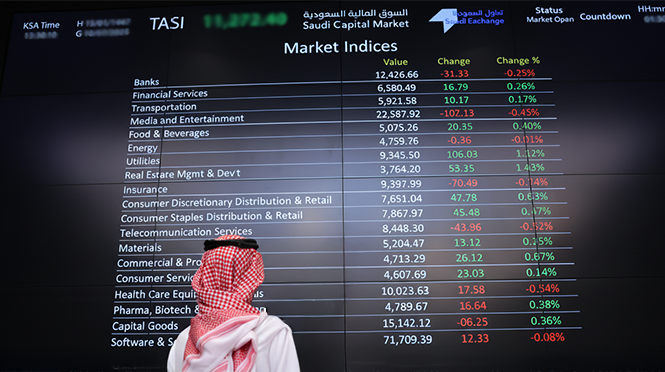
Tadawul trading screen
Expectations for Saudi Arabia’s economic growth in 2026 vary among major local and international institutions, amid geopolitical developments and their impact on oil production and prices and global trade, while available forecasts point to stronger growth momentum in 2027.
Forecasts for the Kingdom’s real GDP growth in 2026 range from 0.2% by Riyad Capital to 4.4% by SP Global Ratings. Fitch Ratings expects growth of 0.6%, the International Monetary Fund (IMF) 1.7%, the World Bank 3.1%, and the Organisation for Economic Co-operation and Development (OECD) 3.2%.
For 2027, available forecasts range from 3.7% by the Ministry of Finance to 7.8% by Riyad Capital. The OECD expects the Saudi economy to grow 4.3%, the World Bank 4.9%, and the IMF 5.5%.
Saudi economic growth forecasts for 2026 and 2027
Entity
2026
2027
Ministry of Finance
4.6 %
3.7 %
SP
4.4 %
—
World Bank
3.1 %
4.9 %
OECD
3.2 %
4.3 %
IMF
1.7 %
5.5 %
Fitch
0.6 %
—
Riyad Capital
0.2 %
7.8 %
The Ministry of Finance forecast in December 2025 that the Kingdom’s real GDP would grow 4.6% in 2026, before slowing to 3.7% in 2027, according to its estimates in the preliminary statement for the 2026 state budget.
In a report issued in March 2026, SP forecast real GDP growth of about 4.4% in 2026, noting that the non-oil sector continues to strengthen its role as a key driver of economic growth.
In May 2026, Moody’s expected the Kingdom’s economic diversification to continue advancing in the coming years, driven by structural reforms and government investment. It also forecast non-oil private-sector GDP growth of between 4% and 5% as regional geopolitical tensions ease.
In June 2026, the OECD forecast Saudi GDP growth of 3.2% in 2026, rising to 4.3% in 2027. The organization said the escalating conflict in the Middle East had become a key factor shaping the global economic outlook, causing an energy shock and inflationary pressures, with negative effects on growth expected.
The OECD also presented two scenarios for the development of the conflict. One assumes that energy production and trade in Gulf economies would gradually return to pre-conflict levels from mid-2026, while the other assumes continued disruptions to energy production and exports through 2027.
In June 2026, the World Bank cut its forecast for Saudi economic growth this year to 3.1%, from 4.3% in its January forecast, while raising its 2027 growth forecast to 4.9% from 4.4% previously, before growth slows to 3.7% in 2028.
The bank said the closure of the Strait of Hormuz caused severe disruption to energy markets, forecasting an average Brent crude price of $94 a barrel in 2026. It also noted that the slowdown in Saudi economic growth was less pronounced than in other economies in the region, supported by the Kingdom’s ability to reroute its oil exports through the East-West pipeline.