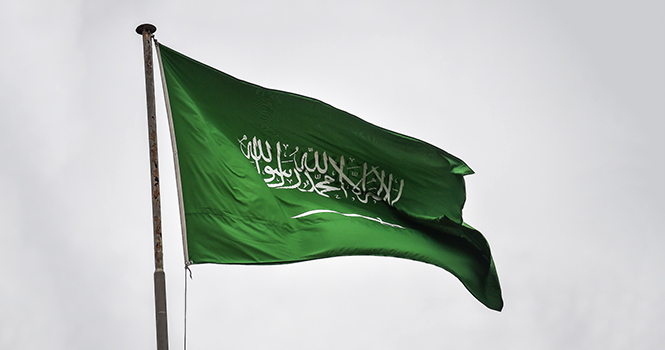
The Kingdom of Saudi Arabia’s flag
The International Monetary Fund (IMF) expects Saudi Arabia’s economy to grow by 3.1% in 2026, down 1.4% compared with its January forecast. 
It noted that the Kingdom is among the least affected countries by the Iran conflict, supported by the availability of alternative export routes.
The IMF has revised Saudi Arabia’s 2027 growth forecast upward by 0.9% to 4.5%, assuming that energy production and transport activities return to normal levels in the coming months, according to the April 2026 World Economic Outlook report.
The Fund also projected a contraction in GDP growth for 2026 across three Gulf countries—Bahrain, Kuwait, and Qatar—without providing specific figures, while Oman, Saudi Arabia, and the United Arab Emirates are expected to be the least affected.
It added that in the Middle East and Central Asia, growth is expected to decline from 3.6% in 2025 to 1.9% in 2026, before rebounding to 4.6% in 2027, as the region experiences the most direct impact of the conflict followed by a recovery phase.
The IMF also lowered its real GDP growth forecast for the Middle East and North Africa (MENA) region to 1.1% in 2026, down 2.8% from its January projection.
It further stated that growth is expected to recover to 4.8% in 2027, assuming that energy production and transport activity in the region return to normal over the coming months.
It noted that this assumption may need to be revised if the conflict persists.
The Kingdom of Saudi Arabia’s flag
The International Monetary Fund (IMF) expects Saudi Arabia’s economy to grow by 3.1% in 2026, down 1.4% compared with its January forecast.
It noted that the Kingdom is among the least affected countries by the Iran conflict, supported by the availability of alternative export routes.
The IMF has revised Saudi Arabia’s 2027 growth forecast upward by 0.9% to 4.5%, assuming that energy production and transport activities return to normal levels in the coming months, according to the April 2026 World Economic Outlook report.
The Fund also projected a contraction in GDP growth for 2026 across three Gulf countries—Bahrain, Kuwait, and Qatar—without providing specific figures, while Oman, Saudi Arabia, and the United Arab Emirates are expected to be the least affected.
It added that in the Middle East and Central Asia, growth is expected to decline from 3.6% in 2025 to 1.9% in 2026, before rebounding to 4.6% in 2027, as the region experiences the most direct impact of the conflict followed by a recovery phase.
The IMF also lowered its real GDP growth forecast for the Middle East and North Africa (MENA) region to 1.1% in 2026, down 2.8% from its January projection.
It further stated that growth is expected to recover to 4.8% in 2027, assuming that energy production and transport activity in the region return to normal over the coming months.
It noted that this assumption may need to be revised if the conflict persists.