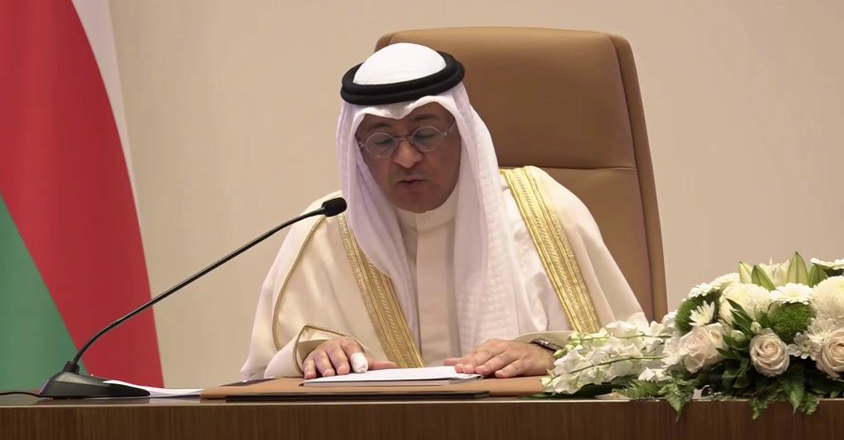
Jasem Mohamed AlBudaiwi, Secretary-General of the Gulf Cooperation Council (GCC)
The overall completion rate of the GCC Railway Project has reached 55.9%, said Jasem Mohamed AlBudaiwi, Secretary-General of the Gulf Cooperation Council (GCC). 
Full operation is targeted for December 2030, in line with an agreed work plan and timeline, he added.
The agreement, signed today, Nov. 8, establishes a common framework governing member states’ obligation in implementing and operating the project in an integrated manner and ensuring its alignment with national railway networks, AlBudaiwi noted at the press conference on the General Agreement on the GCC Railway Project.
He added that the project reflects member states’ ambition to build an integrated GCC transport network connecting all GCC countries. It will facilitate the movement of citizens and residents and improve its efficiency, while boosting intra-GCC trade and freight transport by linking economic and industrial centers, ports, and logistics hubs across member states.
AlBudaiwi stressed the importance of the role played by the GCC Railway Authority (GCCRA) in coordinating with member states, monitoring project implementation, and aligning connectivity and operational requirements with national networks.
He also noted the General Secretariat’s commitment to continuing to support these efforts, overcome challenges, and accelerate progress.
According to Argaam data, under the GCC plan, the railway line will extend 2,117 kilometers, starting from Kuwait and passing through Dammam in Saudi Arabia, then reaching Bahrain via a planned bridge. It will then continue from Dammam to Qatar, the UAE, and finally Muscat via Sohar in Oman.
The estimated total cost of the GCC Railway Project, also known as the Gulf Railway, is approximately $15.4 billion to $16 billion for the core infrastructure.
Jasem Mohamed AlBudaiwi, Secretary-General of the Gulf Cooperation Council (GCC)
The overall completion rate of the GCC Railway Project has reached 55.9%, said Jasem Mohamed AlBudaiwi, Secretary-General of the Gulf Cooperation Council (GCC).
Full operation is targeted for December 2030, in line with an agreed work plan and timeline, he added.
The agreement, signed today, Nov. 8, establishes a common framework governing member states’ obligation in implementing and operating the project in an integrated manner and ensuring its alignment with national railway networks, AlBudaiwi noted at the press conference on the General Agreement on the GCC Railway Project.
He added that the project reflects member states’ ambition to build an integrated GCC transport network connecting all GCC countries. It will facilitate the movement of citizens and residents and improve its efficiency, while boosting intra-GCC trade and freight transport by linking economic and industrial centers, ports, and logistics hubs across member states.
AlBudaiwi stressed the importance of the role played by the GCC Railway Authority (GCCRA) in coordinating with member states, monitoring project implementation, and aligning connectivity and operational requirements with national networks.
He also noted the General Secretariat’s commitment to continuing to support these efforts, overcome challenges, and accelerate progress.
According to Argaam data, under the GCC plan, the railway line will extend 2,117 kilometers, starting from Kuwait and passing through Dammam in Saudi Arabia, then reaching Bahrain via a planned bridge. It will then continue from Dammam to Qatar, the UAE, and finally Muscat via Sohar in Oman.
The estimated total cost of the GCC Railway Project, also known as the Gulf Railway, is approximately $15.4 billion to $16 billion for the core infrastructure.