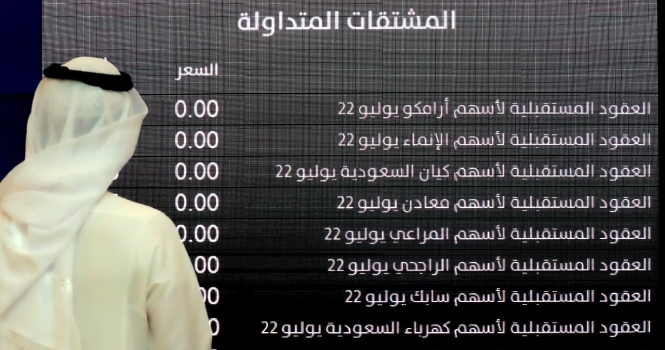
Tadawul trading screen
Saudi Arabia’s financial derivatives market entered a new phase of development with the implementation of a package of structural enhancements aimed at boosting liquidity, improving trading efficiency, and optimizing capital utilization. The move is expected to broaden the market’s participant base and enhance its overall effectiveness. 
Saudi Exchange (Tadawul) and the Securities Clearing Center Co. (Muqassa) began implementing the new enhancements to MT30 Index Futures and Single Stock Futures on Aug. 19. The changes cover several aspects of the market, including market making, fees, margin requirements, and clearing mechanisms.
The move comes nearly six years after the launch of Saudi Arabia’s financial derivatives market, which officially began operations on Aug. 30, 2020, with the listing of MT30 Index Futures as the market’s first derivatives product.
Speaking to Argaam, several analysts said the latest enhancements address a number of factors that have constrained market growth in recent years, most notably liquidity, market depth, trading costs, and capital efficiency.
Liquidity weakness, not lack of products
Mohammed Al Suwayed, CEO of Razeen Capital, said the latest amendments target the core challenges facing the derivatives market, particularly by strengthening market makers’ obligations, enabling multiple market makers, and reducing fees, alongside improving margin and clearing mechanisms.
He added that the main obstacle to the market’s development was not a lack of products, but rather limited liquidity and market depth, which contributed to wider bid-ask spreads, higher trading costs, and less efficient capital utilization.
Al Suwayed noted that the success of the enhancements should not be assessed solely based on the activity generated during the initial phase. Instead, it should be measured by the market’s ability to sustain liquidity and depth levels after the incentives and exemptions expire.
Dr. Abdullah Alsalloum, Professor of Finance at Imam Mohammad Ibn Saud Islamic University
Dr. Abdullah Alsalloum, Professor of Finance at Imam Mohammad Ibn Saud Islamic University, said the derivatives market remains relatively young compared with other markets. As a result, its growth requires an integrated ecosystem, starting with a clear legislative and regulatory framework, followed by contracts that are suitable and diverse enough to meet the needs of different market participants, as well as lower costs and more efficient margin requirements.
He added that derivatives derive their value from underlying assets, meaning that greater liquidity in the stocks or indices underlying these contracts helps drive demand for them. Conversely, limited trading activity in the underlying asset can pose challenges to pricing these instruments and developing the market.
Demand exists, but liquidity limited its potential
Al Suwayed said there is latent economic demand for financial derivatives, particularly among asset managers, funds, family offices, and institutions seeking to hedge and manage their exposure to the Saudi market.
He added that the need for these products does not necessarily translate into an active market. When liquidity is limited, bid-ask spreads are wide, and the cost of entering and exiting positions is high, investors may prefer to sell the underlying stocks themselves rather than use derivatives for hedging.
He noted that the current phase will provide a clearer test of underlying demand after removing a significant portion of the constraints related to costs and operational infrastructure.
Qaiser Noor, Managing Director of Strategy at RSM, said the challenge facing the market since its launch was more a matter of how its various components were built than a structural weakness in demand. The market expanded its product offering and clearing infrastructure faster than it developed the continuous layer of liquidity and two-way pricing on which derivatives markets rely.
He added that demand was not the primary issue in a market where daily trading value in the cash equity market exceeds SAR 5.7 billion and foreign investors hold more than SAR 457 billion in assets. Rather, the missing element was continuous bid and ask prices, combined with trading costs and capital efficiency that would allow transactions to be executed repeatedly.
Market makers key to enhancements
Noor said the updated market-making framework was, in his view, the most impactful enhancement among the measures that took effect on Aug. 19. He noted that Saudi Exchange signed agreements with SNB Capital on behalf of five derivatives market makers, with market-making activities commencing in August 2026.
He added that other measures improve the economic viability of market making, including raising the minimum price fluctuation for Single Stock Futures from SAR 0.05 to SAR 0.10, equivalent to SAR 10 per contract. Single Stock Futures are also now available on 10 of Saudi Arabia’s largest companies by market capitalization across several sectors.
He said continuous bid and ask prices make it easier to execute hedging, spread, and arbitrage strategies, while lower fees and margin enhancements amplify the impact of market making rather than substitute for it.
Alsalloum said the enhancements across the market ecosystem send a positive signal about improving the attractiveness and economic viability of derivatives for different categories of participants. He added that the effective activation of market makers’ role could be one of the most influential factors in delivering tangible improvements in liquidity and activity.
Fees cut by up to 91%
On trading costs, Noor said fees had been a genuine barrier to market growth. He noted that trading fees for MT30 Index Futures were reduced from SAR 25 to SAR 7 per side, representing a 72% reduction.
He added that the contract’s final settlement fee was cut from SAR 30 to SAR 2.8, a reduction of nearly 91%. Meanwhile, trading fees for Single Stock Futures were changed from a rate equivalent to 2.5 basis points to a flat fee of SAR 1.4, while settlement fees were reduced from 3 basis points to SAR 0.504.
He explained that the round-trip cost of entering and exiting an MT30 Index Futures position is now about SAR 14 in trading fees, against a notional contract value of nearly SAR 100,000, compared with about 5 basis points previously. In addition, waivers on trading and final settlement fees for one year will further reduce costs during the market activation phase.
He stressed that the benefit of the enhancements extends beyond the fee-waiver period. Once the waivers expire in August 2027, participants will revert to a permanent fee structure that remains below previous levels, supporting longer-term sustainability of market activity.
Capital efficiency critical for institutions
Noor said improved margin efficiency could be one of the most impactful changes in attracting institutional participants. Greater scope for netting margin requirements across positions and different maturities allows offsetting positions and hedged portfolios to be assessed based on net risk rather than on a gross basis.
He added that this reduces the amount of collateral required for each unit of exposure, which is particularly important for asset managers using hedging strategies, as well as proprietary trading firms whose returns depend heavily on the efficient use of capital.
He noted that removing margin multipliers for certain investor categories also helps align capital requirements with actual risk levels. The MT30 contract multiplier is SAR 100, meaning one contract represents approximately SAR 100,000 in notional value when the index stands at 1,000 points. This makes any improvement in margin requirements increasingly significant as larger portfolios are built.
Noor added that the benefits of the enhancements extend beyond lower capital requirements to greater transparency and operational readiness for institutions. Muqassa’s margin calculator allows participants to estimate margin requirements in advance across different listed derivatives products.
He also noted that integration with the FIS platform gives members instant access to trade, collateral, and margin requirement data, supporting institutional readiness and improving risk management and operational efficiency.
Alsalloum said improved margin efficiency and lower trading costs significantly enhance the attractiveness of derivatives for institutions and asset managers. Lower margin requirements allow them to build hedging positions without having to tie up a large portion of their liquidity, improving capital efficiency across portfolios.
He added that lower trading, clearing, and settlement fees reduce overall costs, particularly for institutions that rebalance positions frequently. They also improve the economics of market making by reducing the cost of holding positions and executing trades, supporting more competitive bid and ask quotes.
He noted, however, that lower fees and improved margin efficiency alone will not guarantee market growth. Sustained liquidity, active market makers, and contracts tailored to the needs of different portfolios and hedging strategies will also be required.
What will signal the success of enhancements?
Al Suwayed said assessing the success of the new measures requires looking beyond trading volume. Open interest is one of the key indicators, as it shows whether actual positions are being held for hedging or investment purposes.
He added that other indicators to monitor include bid-ask spreads, order-book depth, the consistency of activity across different maturities, and increased participation by institutions, asset managers, family offices, and professional traders. Trading volume growth and a broader participant base would follow as additional indicators.
He said higher trading volumes indicate a more active market, but rising open interest, deeper liquidity, and narrower bid-ask spreads are the indicators that demonstrate whether the market has become more effective in practice.
Noor described the initial indicators following the implementation of the enhancements as encouraging. As of Aug. 25, 2026, MT30 Index Futures and Single Stock Futures had recorded more than 1,000 trades combined, representing over 5,000 contracts with a trading value exceeding SAR 220 million.
He added that bid-ask spreads and liquidity depth will provide the first test of the effectiveness of the market-making framework, while open interest is the most important indicator for determining whether investors are building and holding actual positions rather than simply executing short-term trades.
He said the expansion of the participant base is the most important structural indicator over the medium term. Market participants should also monitor the rollover of positions on quarterly expiry dates and whether these transactions can be executed efficiently with limited price spreads.
Alsalloum said the key measures of success include higher trading volumes, a larger investor base, improved liquidity, narrower bid-ask spreads, greater use of derivatives for hedging and risk management, and broader participation by institutions and foreign investors.
He added that the most important measure will be whether these improvements are sustained over the medium and long term after temporary waivers and incentives expire. If the market maintains liquidity, grows open interest, and broadens its participant base after the one-year full waiver of trading and final settlement fees expires, this would indicate genuine and sustainable demand rather than temporary activity driven solely by lower costs.
Index options could be the next step
On potential future product expansion, Al Suwayed said the success of the current enhancements could pave the way for broader products such as index options. However, he believes the priority at this stage should not be to increase the number of products.
He added that the focus should instead be on building genuine liquidity and depth in existing futures contracts, noting that listing a product is different from building an active and sustainable market for it.
He said that if the current phase succeeds in building a deep market for MT30 Index Futures and Single Stock Futures, index options would be a natural and useful next step for institutions seeking to manage risk and volatility more precisely.
Noor said the Saudi market has already made progress in this area, with Single Stock Options listed since 2023 on Saudi Aramco, Al Rajhi Bank, stc, and SABIC. This means the regulatory and operational infrastructure for clearing and settling options is already in place.
He added that expanding options will first require a deep and continuous price curve in the futures market, along with specialized options market makers, greater margin efficiency for multi-instrument positions, enhanced broker readiness, and continued participant education.
Institutions and market makers to lead initial phase
Al Suwayed said institutions, market makers, and professional traders should lead the initial phase of derivatives market growth, given that these instruments are primarily used for risk management and improving capital efficiency—applications that are more prevalent among institutions and portfolio managers.
He added that retail investors could become an important part of the market over time, but higher retail participation should not be the primary measure of market success.
He noted that a healthy market starts with market makers providing liquidity, institutions with hedging and exposure-management needs, and professional traders supporting arbitrage and price discovery, before the participant base gradually expands.
He stressed that the true test of the current phase will be whether derivatives become a natural risk-management tool in the Saudi market. When a fund manager can reduce portfolio exposure through futures contracts rather than being forced to sell the underlying stocks, that represents a genuine change in the market structure rather than simply the addition of a new product.
Tadawul trading screen
Saudi Arabia’s financial derivatives market entered a new phase of development with the implementation of a package of structural enhancements aimed at boosting liquidity, improving trading efficiency, and optimizing capital utilization. The move is expected to broaden the market’s participant base and enhance its overall effectiveness.
Saudi Exchange (Tadawul) and the Securities Clearing Center Co. (Muqassa) began implementing the new enhancements to MT30 Index Futures and Single Stock Futures on Aug. 19. The changes cover several aspects of the market, including market making, fees, margin requirements, and clearing mechanisms.
The move comes nearly six years after the launch of Saudi Arabia’s financial derivatives market, which officially began operations on Aug. 30, 2020, with the listing of MT30 Index Futures as the market’s first derivatives product.
Speaking to Argaam, several analysts said the latest enhancements address a number of factors that have constrained market growth in recent years, most notably liquidity, market depth, trading costs, and capital efficiency.
Liquidity weakness, not lack of products
Mohammed Al Suwayed, CEO of Razeen Capital, said the latest amendments target the core challenges facing the derivatives market, particularly by strengthening market makers’ obligations, enabling multiple market makers, and reducing fees, alongside improving margin and clearing mechanisms.
He added that the main obstacle to the market’s development was not a lack of products, but rather limited liquidity and market depth, which contributed to wider bid-ask spreads, higher trading costs, and less efficient capital utilization.
Al Suwayed noted that the success of the enhancements should not be assessed solely based on the activity generated during the initial phase. Instead, it should be measured by the market’s ability to sustain liquidity and depth levels after the incentives and exemptions expire.
Dr. Abdullah Alsalloum, Professor of Finance at Imam Mohammad Ibn Saud Islamic University
Dr. Abdullah Alsalloum, Professor of Finance at Imam Mohammad Ibn Saud Islamic University, said the derivatives market remains relatively young compared with other markets. As a result, its growth requires an integrated ecosystem, starting with a clear legislative and regulatory framework, followed by contracts that are suitable and diverse enough to meet the needs of different market participants, as well as lower costs and more efficient margin requirements.
He added that derivatives derive their value from underlying assets, meaning that greater liquidity in the stocks or indices underlying these contracts helps drive demand for them. Conversely, limited trading activity in the underlying asset can pose challenges to pricing these instruments and developing the market.
Demand exists, but liquidity limited its potential
Al Suwayed said there is latent economic demand for financial derivatives, particularly among asset managers, funds, family offices, and institutions seeking to hedge and manage their exposure to the Saudi market.
He added that the need for these products does not necessarily translate into an active market. When liquidity is limited, bid-ask spreads are wide, and the cost of entering and exiting positions is high, investors may prefer to sell the underlying stocks themselves rather than use derivatives for hedging.
He noted that the current phase will provide a clearer test of underlying demand after removing a significant portion of the constraints related to costs and operational infrastructure.
Qaiser Noor, Managing Director of Strategy at RSM, said the challenge facing the market since its launch was more a matter of how its various components were built than a structural weakness in demand. The market expanded its product offering and clearing infrastructure faster than it developed the continuous layer of liquidity and two-way pricing on which derivatives markets rely.
He added that demand was not the primary issue in a market where daily trading value in the cash equity market exceeds SAR 5.7 billion and foreign investors hold more than SAR 457 billion in assets. Rather, the missing element was continuous bid and ask prices, combined with trading costs and capital efficiency that would allow transactions to be executed repeatedly.
Market makers key to enhancements
Noor said the updated market-making framework was, in his view, the most impactful enhancement among the measures that took effect on Aug. 19. He noted that Saudi Exchange signed agreements with SNB Capital on behalf of five derivatives market makers, with market-making activities commencing in August 2026.
He added that other measures improve the economic viability of market making, including raising the minimum price fluctuation for Single Stock Futures from SAR 0.05 to SAR 0.10, equivalent to SAR 10 per contract. Single Stock Futures are also now available on 10 of Saudi Arabia’s largest companies by market capitalization across several sectors.
He said continuous bid and ask prices make it easier to execute hedging, spread, and arbitrage strategies, while lower fees and margin enhancements amplify the impact of market making rather than substitute for it.
Alsalloum said the enhancements across the market ecosystem send a positive signal about improving the attractiveness and economic viability of derivatives for different categories of participants. He added that the effective activation of market makers’ role could be one of the most influential factors in delivering tangible improvements in liquidity and activity.
Fees cut by up to 91%
On trading costs, Noor said fees had been a genuine barrier to market growth. He noted that trading fees for MT30 Index Futures were reduced from SAR 25 to SAR 7 per side, representing a 72% reduction.
He added that the contract’s final settlement fee was cut from SAR 30 to SAR 2.8, a reduction of nearly 91%. Meanwhile, trading fees for Single Stock Futures were changed from a rate equivalent to 2.5 basis points to a flat fee of SAR 1.4, while settlement fees were reduced from 3 basis points to SAR 0.504.
He explained that the round-trip cost of entering and exiting an MT30 Index Futures position is now about SAR 14 in trading fees, against a notional contract value of nearly SAR 100,000, compared with about 5 basis points previously. In addition, waivers on trading and final settlement fees for one year will further reduce costs during the market activation phase.
He stressed that the benefit of the enhancements extends beyond the fee-waiver period. Once the waivers expire in August 2027, participants will revert to a permanent fee structure that remains below previous levels, supporting longer-term sustainability of market activity.
Capital efficiency critical for institutions
Noor said improved margin efficiency could be one of the most impactful changes in attracting institutional participants. Greater scope for netting margin requirements across positions and different maturities allows offsetting positions and hedged portfolios to be assessed based on net risk rather than on a gross basis.
He added that this reduces the amount of collateral required for each unit of exposure, which is particularly important for asset managers using hedging strategies, as well as proprietary trading firms whose returns depend heavily on the efficient use of capital.
He noted that removing margin multipliers for certain investor categories also helps align capital requirements with actual risk levels. The MT30 contract multiplier is SAR 100, meaning one contract represents approximately SAR 100,000 in notional value when the index stands at 1,000 points. This makes any improvement in margin requirements increasingly significant as larger portfolios are built.
Noor added that the benefits of the enhancements extend beyond lower capital requirements to greater transparency and operational readiness for institutions. Muqassa’s margin calculator allows participants to estimate margin requirements in advance across different listed derivatives products.
He also noted that integration with the FIS platform gives members instant access to trade, collateral, and margin requirement data, supporting institutional readiness and improving risk management and operational efficiency.
Alsalloum said improved margin efficiency and lower trading costs significantly enhance the attractiveness of derivatives for institutions and asset managers. Lower margin requirements allow them to build hedging positions without having to tie up a large portion of their liquidity, improving capital efficiency across portfolios.
He added that lower trading, clearing, and settlement fees reduce overall costs, particularly for institutions that rebalance positions frequently. They also improve the economics of market making by reducing the cost of holding positions and executing trades, supporting more competitive bid and ask quotes.
He noted, however, that lower fees and improved margin efficiency alone will not guarantee market growth. Sustained liquidity, active market makers, and contracts tailored to the needs of different portfolios and hedging strategies will also be required.
What will signal the success of enhancements?
Al Suwayed said assessing the success of the new measures requires looking beyond trading volume. Open interest is one of the key indicators, as it shows whether actual positions are being held for hedging or investment purposes.
He added that other indicators to monitor include bid-ask spreads, order-book depth, the consistency of activity across different maturities, and increased participation by institutions, asset managers, family offices, and professional traders. Trading volume growth and a broader participant base would follow as additional indicators.
He said higher trading volumes indicate a more active market, but rising open interest, deeper liquidity, and narrower bid-ask spreads are the indicators that demonstrate whether the market has become more effective in practice.
Noor described the initial indicators following the implementation of the enhancements as encouraging. As of Aug. 25, 2026, MT30 Index Futures and Single Stock Futures had recorded more than 1,000 trades combined, representing over 5,000 contracts with a trading value exceeding SAR 220 million.
He added that bid-ask spreads and liquidity depth will provide the first test of the effectiveness of the market-making framework, while open interest is the most important indicator for determining whether investors are building and holding actual positions rather than simply executing short-term trades.
He said the expansion of the participant base is the most important structural indicator over the medium term. Market participants should also monitor the rollover of positions on quarterly expiry dates and whether these transactions can be executed efficiently with limited price spreads.
Alsalloum said the key measures of success include higher trading volumes, a larger investor base, improved liquidity, narrower bid-ask spreads, greater use of derivatives for hedging and risk management, and broader participation by institutions and foreign investors.
He added that the most important measure will be whether these improvements are sustained over the medium and long term after temporary waivers and incentives expire. If the market maintains liquidity, grows open interest, and broadens its participant base after the one-year full waiver of trading and final settlement fees expires, this would indicate genuine and sustainable demand rather than temporary activity driven solely by lower costs.
Index options could be the next step
On potential future product expansion, Al Suwayed said the success of the current enhancements could pave the way for broader products such as index options. However, he believes the priority at this stage should not be to increase the number of products.
He added that the focus should instead be on building genuine liquidity and depth in existing futures contracts, noting that listing a product is different from building an active and sustainable market for it.
He said that if the current phase succeeds in building a deep market for MT30 Index Futures and Single Stock Futures, index options would be a natural and useful next step for institutions seeking to manage risk and volatility more precisely.
Noor said the Saudi market has already made progress in this area, with Single Stock Options listed since 2023 on Saudi Aramco, Al Rajhi Bank, stc, and SABIC. This means the regulatory and operational infrastructure for clearing and settling options is already in place.
He added that expanding options will first require a deep and continuous price curve in the futures market, along with specialized options market makers, greater margin efficiency for multi-instrument positions, enhanced broker readiness, and continued participant education.
Institutions and market makers to lead initial phase
Al Suwayed said institutions, market makers, and professional traders should lead the initial phase of derivatives market growth, given that these instruments are primarily used for risk management and improving capital efficiency—applications that are more prevalent among institutions and portfolio managers.
He added that retail investors could become an important part of the market over time, but higher retail participation should not be the primary measure of market success.
He noted that a healthy market starts with market makers providing liquidity, institutions with hedging and exposure-management needs, and professional traders supporting arbitrage and price discovery, before the participant base gradually expands.
He stressed that the true test of the current phase will be whether derivatives become a natural risk-management tool in the Saudi market. When a fund manager can reduce portfolio exposure through futures contracts rather than being forced to sell the underlying stocks, that represents a genuine change in the market structure rather than simply the addition of a new product.