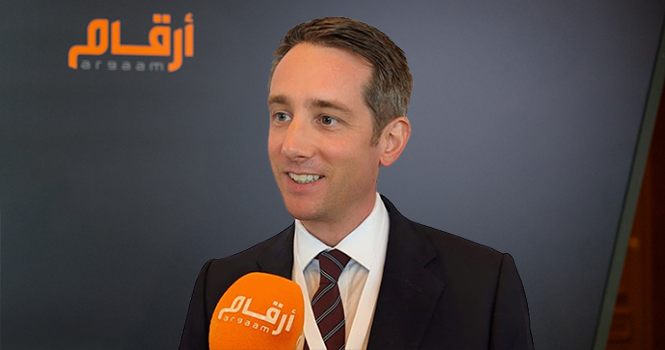
Andrew Naylor, Head of Middle East and Public Policy at the World Gold Council (WGC)
Naylor said the decline was broad-based, with jewelry demand dropping 32% in China, 19% in India, and 23% in the Middle East, reflecting consumers’ sensitivity to the sharp rise in gold prices. 
Despite lower sales volumes, jewelry spending reached a record $47 billion in Q1 2026, reflecting that consumers have not turned away from gold but have become more selective in their purchases.
He added that some demand in markets such as China and India shifted to gold bars and coins, highlighting gold’s dual role as both jewelry and an investment asset.
Naylor described that the recent pullback following gold’s record high of $5,405 per ounce in January 2026 as a normal correction after a strong rally, not a structural reversal in the market.
He attributed the previous rally to strong investment inflows, escalating geopolitical tensions, persistent inflationary pressures, and robust central bank demand, adding that these drivers remain firmly in place.
He also noted that the recent volatility was expected amid elevated global uncertainty and should be viewed as a limited correction within a fundamentally supported market, rather than the start of a new downtrend.
On official-sector demand, Naylor cited the WGC’s annual central bank gold reserves survey, which found that 89% of reserve managers expect global central banks to increase their gold holdings over the next 12 months.
He added that a record 45% of reserve managers said their own institutions plan to raise gold holdings over the coming year, while 84% expect gold to account for a larger share of total reserves over the next five years, up from 76% in last year’s survey.
Gold has recently overtaken US government bonds as the most important reserve asset for many central banks, reflecting growing confidence in its role as a long-term store of value. These findings point to continued strong central bank demand in H2 2026.
He stressed that the WGC does not provide guidance or forecasts on future gold demand or price trends.
First-quarter data reaffirm gold’s enduring cultural and financial significance, he pointed out, noting that higher prices typically affect sales volumes rather than consumers’ perception of gold.
According to the WGC’s gold mid-year outlook 2026, gold is entering a pivotal phase in H2 2026 as geopolitical developments, the global interest-rate outlook, and investor sentiment continue to drive the market.
The report said rising geopolitical risks, particularly tensions between the US and Iran, were the biggest driver of gold’s performance in H1 2026, alongside investor positioning and profit-taking. It added that the opportunity cost of holding gold was influenced by changing expectations for interest rates and the US dollar.
Most of gold’s price movements occurred during Asian and US trading sessions, highlighting the growing influence of Asian investors on global gold pricing, the report noted.
Assuming current conditions persist, the WGC expects gold to trade within a 5% range up or down around $4,100 per ounce through year-end.
It added that a renewed rally would likely require worsening geopolitical or economic conditions or a shift in interest-rate expectations.
The report also said gold would likely need clear signs of a global economic slowdown to rise above $4,500 per ounce, while a stronger US dollar, higher-than-expected interest rates, and improving risk appetite remain the main downside risks for prices.
Andrew Naylor, Head of Middle East and Public Policy at the World Gold Council (WGC)
Naylor said the decline was broad-based, with jewelry demand dropping 32% in China, 19% in India, and 23% in the Middle East, reflecting consumers’ sensitivity to the sharp rise in gold prices.
Despite lower sales volumes, jewelry spending reached a record $47 billion in Q1 2026, reflecting that consumers have not turned away from gold but have become more selective in their purchases.
He added that some demand in markets such as China and India shifted to gold bars and coins, highlighting gold’s dual role as both jewelry and an investment asset.
Naylor described that the recent pullback following gold’s record high of $5,405 per ounce in January 2026 as a normal correction after a strong rally, not a structural reversal in the market.
He attributed the previous rally to strong investment inflows, escalating geopolitical tensions, persistent inflationary pressures, and robust central bank demand, adding that these drivers remain firmly in place.
He also noted that the recent volatility was expected amid elevated global uncertainty and should be viewed as a limited correction within a fundamentally supported market, rather than the start of a new downtrend.
On official-sector demand, Naylor cited the WGC’s annual central bank gold reserves survey, which found that 89% of reserve managers expect global central banks to increase their gold holdings over the next 12 months.
He added that a record 45% of reserve managers said their own institutions plan to raise gold holdings over the coming year, while 84% expect gold to account for a larger share of total reserves over the next five years, up from 76% in last year’s survey.
Gold has recently overtaken US government bonds as the most important reserve asset for many central banks, reflecting growing confidence in its role as a long-term store of value. These findings point to continued strong central bank demand in H2 2026.
He stressed that the WGC does not provide guidance or forecasts on future gold demand or price trends.
First-quarter data reaffirm gold’s enduring cultural and financial significance, he pointed out, noting that higher prices typically affect sales volumes rather than consumers’ perception of gold.
According to the WGC’s gold mid-year outlook 2026, gold is entering a pivotal phase in H2 2026 as geopolitical developments, the global interest-rate outlook, and investor sentiment continue to drive the market.
The report said rising geopolitical risks, particularly tensions between the US and Iran, were the biggest driver of gold’s performance in H1 2026, alongside investor positioning and profit-taking. It added that the opportunity cost of holding gold was influenced by changing expectations for interest rates and the US dollar.
Most of gold’s price movements occurred during Asian and US trading sessions, highlighting the growing influence of Asian investors on global gold pricing, the report noted.
Assuming current conditions persist, the WGC expects gold to trade within a 5% range up or down around $4,100 per ounce through year-end.
It added that a renewed rally would likely require worsening geopolitical or economic conditions or a shift in interest-rate expectations.
The report also said gold would likely need clear signs of a global economic slowdown to rise above $4,500 per ounce, while a stronger US dollar, higher-than-expected interest rates, and improving risk appetite remain the main downside risks for prices.