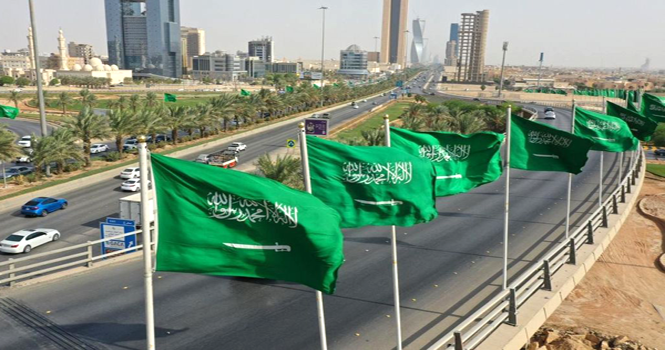
The Kingdom of Saudi Arabia’s flag
Credit ratings issued by major global rating agencies have reaffirmed Saudi Arabia’s creditworthiness, backed by a solid financial position and strong reserves. 
Saudi Arabia maintained robust credit ratings in 2025, with a stable outlook from the leading agencies:
Kingdom’s Credit Ratings in 2025
Rating agency
Credit rating
Outlook
Moody’s
Aa3
Stable
Fitch
A+
Stable
SP
A+/A-1
Stable
The Kingdom’s credit strength is underpinned by solid financial indicators, including growth in non-oil revenues, relatively low public debt levels compared to G20 countries, and strong financial reserves.
Financial reserves reached approximately SAR 1.7 trillion, marking their highest level in five years. Meanwhile, non-oil government revenues rose to SAR 505 billion, reflecting a 170% increase compared to 2016.
Public debt remained below 50% of GDP, in line with a strategy aimed at maintaining debt sustainability and stability.
Financial Indicators Credit Drivers
Financial Indicators
2025
Notes
Financial reserves
SAR 1.7 trillion
(highest in 5 years)
Non-oil revenues
SAR 505 bln
(+170% vs. 2016)
Public debt ratio
Below 50%
The Kingdom is implementing a strategy of balance between spending and debt stability.
Economic liquidity
SAR 3.16 trillion
Reached a record high, thus boosting fiscal solvency
The report also highlighted several structural reforms that have strengthened the Kingdom’s credit profile:
Efficient fiscal management: Improved budget efficiency and a disciplined expansionary fiscal policy balancing growth and sustainability.
Economic diversification: Non-oil activities now contribute 55% of real GDP, reducing dependence on oil cycles.
Competitive environment: The Kingdom ranked 17th globally in the IMD World Competitiveness Ranking, thus boosting foreign direct investment attractiveness.
Sustainable development spending: Strategic allocation of funding toward high-impact economic and social sectors to ensure long-term benefits for future generations.
The Kingdom of Saudi Arabia’s flag
Credit ratings issued by major global rating agencies have reaffirmed Saudi Arabia’s creditworthiness, backed by a solid financial position and strong reserves.
Saudi Arabia maintained robust credit ratings in 2025, with a stable outlook from the leading agencies:
Kingdom’s Credit Ratings in 2025
Rating agency
Credit rating
Outlook
Moody’s
Aa3
Stable
Fitch
A+
Stable
SP
A+/A-1
Stable
The Kingdom’s credit strength is underpinned by solid financial indicators, including growth in non-oil revenues, relatively low public debt levels compared to G20 countries, and strong financial reserves.
Financial reserves reached approximately SAR 1.7 trillion, marking their highest level in five years. Meanwhile, non-oil government revenues rose to SAR 505 billion, reflecting a 170% increase compared to 2016.
Public debt remained below 50% of GDP, in line with a strategy aimed at maintaining debt sustainability and stability.
Financial Indicators Credit Drivers
Financial Indicators
2025
Notes
Financial reserves
SAR 1.7 trillion
(highest in 5 years)
Non-oil revenues
SAR 505 bln
(+170% vs. 2016)
Public debt ratio
Below 50%
The Kingdom is implementing a strategy of balance between spending and debt stability.
Economic liquidity
SAR 3.16 trillion
Reached a record high, thus boosting fiscal solvency
The report also highlighted several structural reforms that have strengthened the Kingdom’s credit profile:
Efficient fiscal management: Improved budget efficiency and a disciplined expansionary fiscal policy balancing growth and sustainability.
Economic diversification: Non-oil activities now contribute 55% of real GDP, reducing dependence on oil cycles.
Competitive environment: The Kingdom ranked 17th globally in the IMD World Competitiveness Ranking, thus boosting foreign direct investment attractiveness.
Sustainable development spending: Strategic allocation of funding toward high-impact economic and social sectors to ensure long-term benefits for future generations.