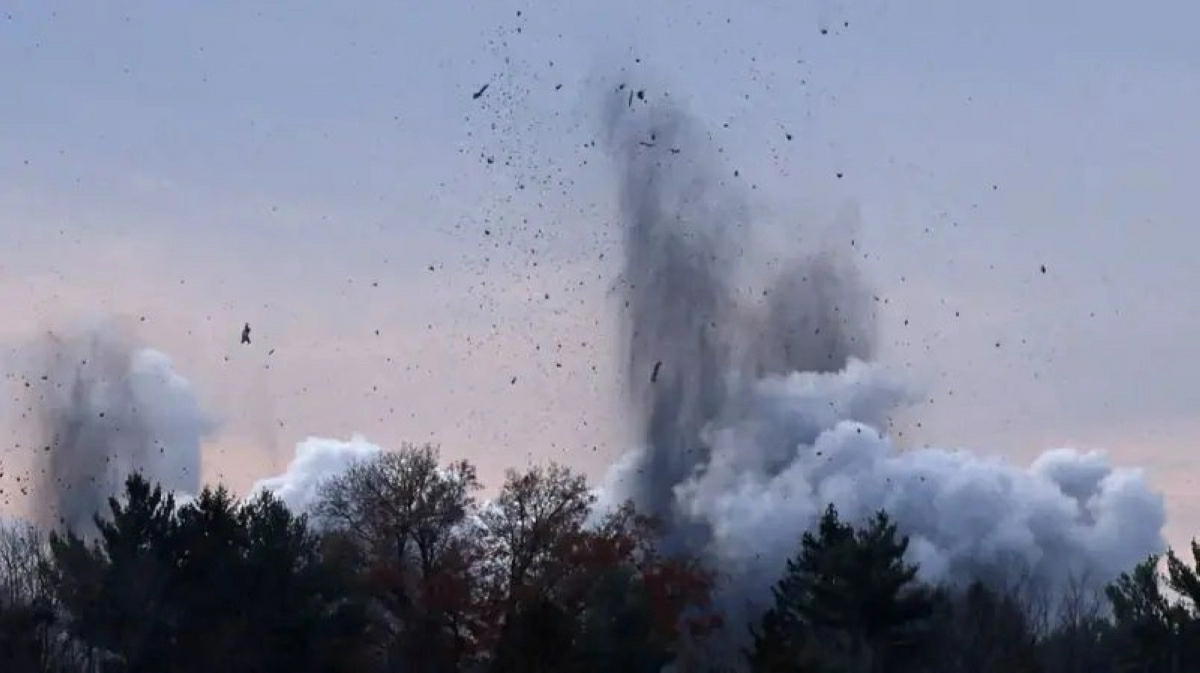
MIDDLETOWN, Iowa — The US Army blew up the nation’s entire stockpile of lead azide, a chemical used to make explosives, ending a brief legal battle spurred by concerns that toxic dust from the fallout would endanger residents, livestock and farmland.The Army said the first checks show Wednesday’s controlled detonation in Iowa didn’t spread toxic dust to nearby homes and farms.Adam Telle, acting secretary of the US Army, said the detonation was a “HUGE success” and praised the soldiers who helped carry it out.”We are watching EPA’s [Environmental Protection Agency] MASSIVE sensor array throughout the area closely, and there are no readings so far above 0.0″, Telle wrote on X.Environmental groups have raised concerns that the explosions would release particles that could eventually land on homes, crops and livestock far beyond the detonation site, potentially travelling more than 160km (100 miles).Before the detonations at the Iowa Army Ammunition Plant, outgoing Republican Governor Kim Reynolds declared a disaster emergency across three counties in southeastern Iowa – Des Moines, Lee and Van Buren – activating state and county emergency response plans.Earthen barriers were put up and foam and water were poured onto a pair of bunkers holding the 5 tons (4,500 kilograms) of lead azide, and officials said those measures appear to have absorbed much of the blast.EPA air monitors detected no lead in the air around the Iowa Army Ammunition Plant in Middletown, and an alert sent to cellphones late Wednesday afternoon said it was safe to resume normal activities. FEMA also issued an all-clear around the plant, the US Army reported.Still, government agencies and independent researchers plan to do extensive environmental testing for lead — a heavy metal that’s especially dangerous to children and pregnant women — in the weeks ahead on water sources, farms, homes and playgrounds.The Army said the safest option had been detonating the stockpile right away because it was degrading and might explode uncontrollably at any time as the weather got colder.Some experts cautioned that it’s too early to know whether communities are in the clear.But Maj. Gen. Eric Shirley, who led the Army operation, said the risk was “reduced as close to zero as it’s absolutely humanly possible.”Since the military announced and then delayed plans for the detonation over the past two weeks, residents and environmental groups have voiced concerns about potential health and environmental impacts and about a lack of information about what to expect.The Army scheduled the detonation for Wednesday because the winds were blowing to the southwest and away from populated areas including Burlington, a city of just under 25,000 people along the Mississippi River.The two controlled blasts destroyed all 68 barrels and didn’t set off any secondary explosions, Shirley said.Acting Secretary of the Army Adam Telle along with the Republican governors of Iowa and Missouri also said it appeared to be a success and that the explosion was well-contained.Government officials had encouraged residents closest to the site and in range of the plume to evacuate, and others to stay indoors.Schools not already closed for the upcoming Thanksgiving holiday canceled classes and many businesses closed. Some residents sealed their windows and doors as a precaution.A court ruling this week put the detonation, originally planned for last Friday, back on track. The Army changed the date amid public backlash and to allow more time for safety measures and favorable wind.The Army set up “blast barriers,” with concrete and sand barriers two stories high. Ballistic gels, foams and water were added to absorb the dust.Environmental groups who sued to halt the detonation said on Wednesday that legal action and public pressure forced the Army to take more protective measures.Had the blasts happened last week as planned, many safeguards along with clearer evacuation plans and expansive monitoring wouldn’t have been in place, they said.
Keep Up to Date with our Weekly Newsletter