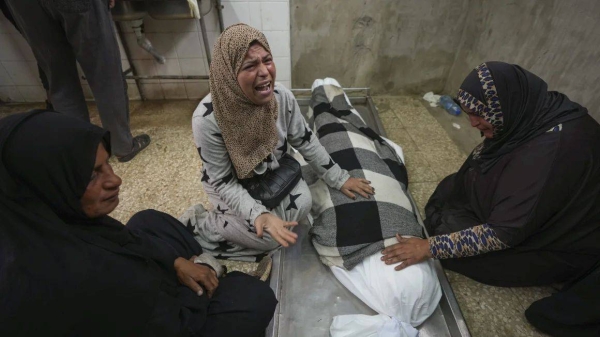
DUBAI — The United States said it had launched a new wave of air strikes against Iran on Wednesday evening as President Donald Trump warned Tehran it “better behave”.TheUS Central Command said American forces targeted Iranian command centers, air defence sites, missile and drone capabilities, and coastal surveillance facilities in several locations, including Bandar Abbas.The US military said “Iranian military capabilities used to threaten vessels” moving through the Strait of Hormuz had been targeted, and that it had separately fired on a ship attempting to violate its renewed blockade of Iran’s ports.Iranian media reported explosions were heard on Qeshm Island, Bandar Abbas and Chabahar. The Mehr news agency says air defence systems have been activated in the Iranian capital, Tehran, to “counter hostile threats”.The Fars news agency says residents in the western city of Khorramabad have reported hearing the sound of at least two explosions. The city is located about 490km (304 miles) southwest of the Iranian capital, Tehran.According to Al Jazeera, there were explosions in Qeshm Island, the largest island in the vicinity of the Strait of Hormuz, as well as in Bandar Abbas. Explosions were heard in Sirik, another important port city which oversees the Strait of Hormuz.”We’ve also got reports of explosions in southeastern parts of the country in Sistan Province, including Chabahar and Konarak, and also in Rask City,” Al Jazeera said.In Ahvaz, several explosions were reported over the past few hours, in one of which a hospital was targeted or at least impacted. As a result, the hospital was evacuated. Also the child cancer treatment department of the hospital was damaged in the attack.The Iranian health ministry also gave the latest casualty figures since the initiation of this recent round of attacks, saying that so far more than 300 people have been injured, and at least 35 people have been killed.The US military said it disabled an oil tanker attempting to sail toward an Iranian port in the Strait of Hormuz by firing Hellfire missiles.The Central Command said it had redirected two commercial vessels since reimposing its blockade on Iranian ports on Tuesday evening, which stops vessels from transiting to and from Iranian ports and coastal areas.It came after Iran claimed it had struck US military targets in the region, including in Bahrain and Kuwait, as a fifth day of renewed hostilities strained their preliminary deal to end the war.The latest waves of strikes on Iran aimed at forcing open the Strait of Hormuz are also targeting Iranian military capabilities Washington would want to destroy before executing more complex operations against Tehran, Reuters reported citing three US officials.The officials, who were granted anonymity to discuss military matters, said the strikes effectively strengthen additional military options for Donald Trump, who has kept the world guessing about his next steps after notifying Congress last weekend of a formal resumption of conflict with Iran.Now in its fifth month, the Iran war continues to rage after the unraveling of a memorandum of understanding that was meant to stop the fighting and pave the way for a peace agreement.Despite heavy blows to Iran’s military since the start of the US and Israeli campaign on February 28, Tehran retains significant drone and missile capability and has attacked passing tankers as well as its Gulf neighbors.The US military has said its latest bombings have targeted Iranian air defense systems, coastal radar, missile and drone sites as well as small boats and other maritime assets.Iran’s top negotiator, Mohammad Bagher Ghalibaf, meanwhile told state media Tehran had “no reason” to abide by the deal if it did benefit from it.Trump had threatened late on Tuesday to attack bridges and power plants should Iran not return to talks next week.Asked by reporters late on Wednesday whether he would give a deadline before doing so, he responded: “I don’t like giving deadlines, but they pretty much know, they know the story… they better behave.”He later told delegates at a defense summit that Iran was “not happy right now”.”They want to settle so badly. They don’t like what we’re doing,” he said. “We’ll find out whether we want to settle with them or if we just finish it off.”Ghalibaf however said Iran’s national security depended on Tehran maintaining “Iranian arrangements” in the strait.He added that negotiation, along with war, was part of Iran’s strategy of resistance as it engaged an “existential” conflict with the US.The latest US strikes marked the second wave its military said it had carried out during daylight hours on Wednesday. It said it had “further degraded Iran’s ability to attack commercial shipping in the Strait of Hormuz” earlier in the day.A 90-minute wave was used to target Iran’s coastal defenses and cruise missile storage and launch sites on Greater Tunb Island, US Central Command added. In response to the renewal of the US blockade, Iran’s Revolutionary Guard Corps (IRGC) warned the US that it should “expect the closure of other oil and gas export routes that serve the interests of the United States and its allies”. It did not elaborate on which routes could be affected.Ongoing US-Iran hostilities have underscored the strategic importance of the Strait to the global economy, with a sharp rise in oil prices triggered by tanker traffic virtually stalling through the key shipping lane.
Keep Up to Date with our Weekly Newsletter