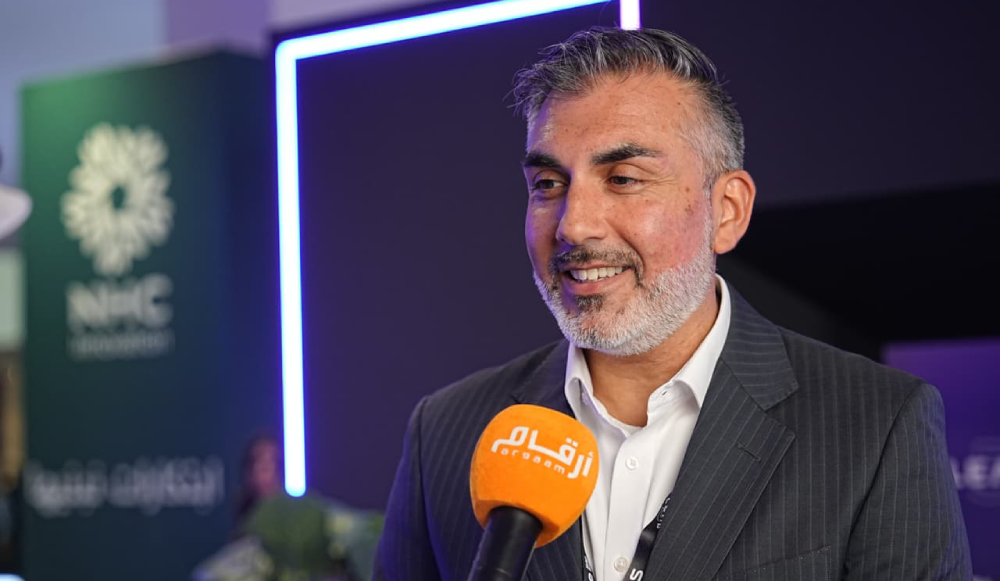
Sukhdev Hansra, Head of Asset Management at Sukna Capital
The potential SME lending opportunity in Saudi Arabia is estimated at $100 billion, said Sukhdev Hansra, Head of Asset Management at Sukna Capital, in an interview with Argaam on the sidelines of the LEAP 2026. 
SME financing in Saudi Arabia remains below levels seen in several global markets, with SME lending accounting for around 8% of lending portfolios in the Kingdom, Hansra said.
SME financing accounts for around 20% of banks’ lending portfolios in the US, while the average is 20% to 40% in Europe and Asia.
The market has a financing gap between the early stages, when companies rely more heavily on venture capital, and the stage when they become more mature and can secure bank financing, he said.
Companies may initially obtain funding through pre-seed, seed, and subsequent investment rounds, but eventually reach a stage where they need debt instruments alongside equity before generating sufficient cash flow to qualify for bank financing.
Increasing SME financing is an important factor in supporting the sector’s growth, particularly as Saudi Arabia seeks to strengthen the role of SMEs under the objectives of Vision 2030.
Company growth does not depend on a single type of capital, with the market requiring a mix of venture capital, equity, and debt instruments, as well as hybrid financing that falls between debt and equity, Hansra said.
Some technology companies may face difficulties securing bank financing during their growth stages due to their limited operating history or insufficient cash flow generation.
On the potential for increased mergers or the closure of some startups, Hansra said markets naturally go through different cycles of growth, slowdown, and restructuring.
Debt instruments can play a role in financing companies during growth stages and restructuring processes, as well as in mergers and acquisitions transactions.
He concluded that developing the SME sector requires multiple sources of financing that meet companies’ needs at different stages of growth, until they reach maturity and become increasingly able to rely on bank financing.
Sukhdev Hansra, Head of Asset Management at Sukna Capital
The potential SME lending opportunity in Saudi Arabia is estimated at $100 billion, said Sukhdev Hansra, Head of Asset Management at Sukna Capital, in an interview with Argaam on the sidelines of the LEAP 2026.
SME financing in Saudi Arabia remains below levels seen in several global markets, with SME lending accounting for around 8% of lending portfolios in the Kingdom, Hansra said.
SME financing accounts for around 20% of banks’ lending portfolios in the US, while the average is 20% to 40% in Europe and Asia.
The market has a financing gap between the early stages, when companies rely more heavily on venture capital, and the stage when they become more mature and can secure bank financing, he said.
Companies may initially obtain funding through pre-seed, seed, and subsequent investment rounds, but eventually reach a stage where they need debt instruments alongside equity before generating sufficient cash flow to qualify for bank financing.
Increasing SME financing is an important factor in supporting the sector’s growth, particularly as Saudi Arabia seeks to strengthen the role of SMEs under the objectives of Vision 2030.
Company growth does not depend on a single type of capital, with the market requiring a mix of venture capital, equity, and debt instruments, as well as hybrid financing that falls between debt and equity, Hansra said.
Some technology companies may face difficulties securing bank financing during their growth stages due to their limited operating history or insufficient cash flow generation.
On the potential for increased mergers or the closure of some startups, Hansra said markets naturally go through different cycles of growth, slowdown, and restructuring.
Debt instruments can play a role in financing companies during growth stages and restructuring processes, as well as in mergers and acquisitions transactions.
He concluded that developing the SME sector requires multiple sources of financing that meet companies’ needs at different stages of growth, until they reach maturity and become increasingly able to rely on bank financing.