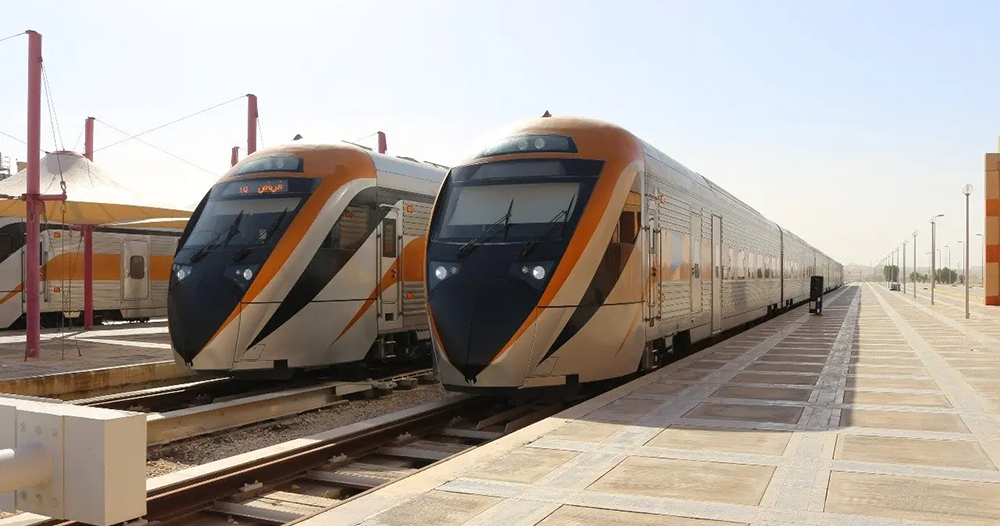
The total number of passengers travelling by rail within and between cities in Saudi Arabia rose to 156.4 million in 2025, compared with 42.7 million in 2024, marking an annual increase of 266%.
This increase was driven by a 368% leap in the number of passengers travelling on urban rail services to 145.4 million, compared with 31.1 million in 2024, according to data released by the General Authority for Statistics (GASTAT).
By contrast, the number of intercity rail passengers fell 6% to 10.9 million, from 11.6 million a year earlier.
Rail Passengers Within and Between Saudi Cities (mln)
Indicator
2024
2025
Change
Urban rail passengers
31.08
145.43
368%
Intercity rail passengers
11.59
10.94
(6%)
Total passengers within and between cities
42.67
156.37
266%
Historical Growth in Rail Passengers in Saudi Arabia
Year
Passengers
Change
2017
5.67
—
2018
6.54
15%
2019
7.48
14%
2020
2.42
(68%)
2021
7.34
203%
2022
22.78
210%
2023
30.29
33%
2024
42.67
41%
2025
156.37
266%
The increase in passenger numbers in 2025 was mainly driven by higher ridership on the Riyadh Metro, which began operations in December 2024, as well as growth in passenger numbers on the automated train at King Abdulaziz International Airport (KAIA).
The Riyadh Metro ranked first in terms of passenger numbers in 2025, carrying around 105.4 million passengers, followed by the automated train at KAIA with 34.7 million passengers, and the Haramain High-Speed Railway (HHR) with 8.5 million passengers.
Passenger Numbers by Train
Train
2024
2025
Annual change
Share of total
Riyadh Metro
5.40
105.43
1,853%
67.4%
KAIA automated train
20.39
34.72
70%
22.2%
HHR
9.21
8.53
(7%)
5.5%
PNU Train
3.07
3.40
11%
2.2%
Al-Mashaaer Train
2.22
1.87
(15%)
1.2%
East Train
1.49
1.48
(1%)
0.9%
North Train
0.88
0.93
5%
0.6%
Total
42.67
156.37
266%
100%
Rail Passenger Transport Performance
Rail passenger transport performance in Saudi Arabia reached around 3.60 billion passenger-kilometers in 2025, compared with 3.72 billion passenger-kilometers in 2024, down 3%.
HHR accounted for the largest share of total passenger-kilometers, at 76%, despite a 6% decline in its performance to around 2.74 billion passenger-kilometers.
Meanwhile, passenger-kilometers on the East Train rose 8%, while those on the North Train increased 7%.
Passenger Transport Performance by Train (mln passenger-kilometers)
Train
2024
2025
Change
HHR
2,919.8
2,743.0
(6%)
East Train
458.0
496.0
8%
North Train
346.5
370.3
7%
Total
3,724.3
3,609.3
(3%)
Rail Freight
Freight volumes transported across Saudi Arabia’s railway network, comprising the North and East trains, reached around 16.1 million tons in 2025.
The North Train accounted for the largest share of freight volumes, carrying around 14.4 million tons, while the East Train transported around 1.7 million tons.
The East Train also transported around 915,400 standard containers.
Freight Volumes on the North and East Trains by Commodity in 2025
Train
Commodity
Freight volume (‘000 tons)
North Train
Phosphate
5,109.0
Bauxite
5,032.6
Phosphoric acid
2,569.9
Molten sulfur
1,685.5
East Train
Limestone
782.8
Grains
756.9
Grains
117.0
Total
16,053.7
Train Operational Performance
Passenger trains operated around 1.4 million trips in 2025, covering a total distance of 42.3 million kilometers. The Riyadh Metro accounted for 949,400 trips, covering a total distance of 26.8 million kilometers.
Rail Passenger Trips and Distance Covered by Train in 2025
Train
Location
Trips (‘000)
Distance covered (mln km)
Riyadh Metro
Within cities
949.4
26.80
KAIA automated train
Within cities
392.2
0.34
HHR
Between cities
35.2
11.20
East Train
Between cities
5.4
2.15
North Train
Between cities
2.3
1.12
Al-Mashaaer Train
Within cities
2.2
0.05
PNU Train*
Within cities
—
0.67
Total
1,386.5
42.32
Freight trains operated 8,885 trips, covering around 6.1 million kilometers. The East Train accounted for 5,918 trips.
Rail Freight Trips and Distance Covered by Train in 2025
Train
Location
No. of trips
Distance covered (mln km)
East Train
Between cities
5,918
2.44
North Train
Between cities
2,967
3.68
Total
8,885
6.12