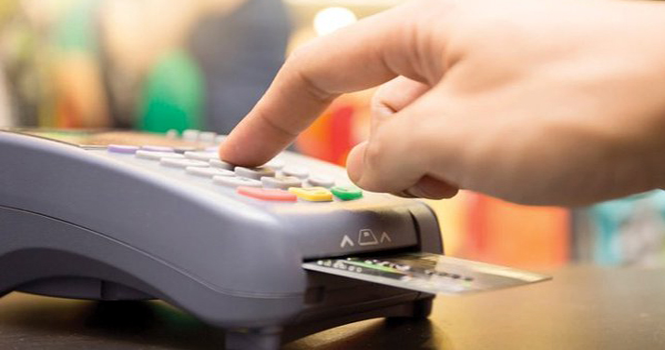
POS device
Point-of-sale (POS) transactions in Saudi Arabia reached nearly SAR 12.6 billion in the week ended Oct. 17, compared to about SAR 13.5 billion a week earlier. 
The number of POS transactions reached about 246.4 million in the week ended Oct. 17, compared to nearly 253.4 million in the previous week, according to data issued by the Saudi Central Bank (SAMA).
POS transactions represent consumer expenditure through debit and credit cards at major shopping centers, retail outlets, pharmacies, and others.
The data shows that POS sales increase in the weeks that coincide with the disbursement of salaries to government employees (on the 27th of each month), as well as during school vacations and the weeks preceding Eid Al-Fitr and Eid Al-Adha. Conversely, sales decline in the weeks preceding salary disbursements and those coinciding with the start of the school year after vacations.
The four-week moving average of POS sales stood at about SAR 14 billion. Based on the four-week moving average, POS sales increased in 2025 compared to 2024, 2023, and 2022.
The average value of sales ranged between SAR 11.4 billion and SAR 15.3 billion in 2025, compared to SAR 11.5 billion to SAR 13.8 billion in 2024, SAR 10.4 billion to SAR 12.7 billion in 2023, and SAR 9.4 billion to SAR 11.6 billion in 2022.
By segment, consumer spending in the week ended Oct. 17 was concentrated in food and beverages (FB), accounting for 17.6% of total spending, or SAR 2.22 billion, followed by restaurants and cafes, which accounted for 13.1%, or SAR 1.65 billion.
Riyadh led Saudi cities in terms of consumer spending in the week ended Oct. 17, with approximately SAR 4.41 billion, accounting for 35.0% of total sales. Jeddah followed with SAR 1.67 billion, representing 13.3%.
According to the latest data from SAMA, e-payments in the retail (individuals) sector accounted for 85% of total payments made by individuals in the Kingdom in 2025, exceeding the target set by the Financial Sector Development Program, one of Saudi Vision 2030’s programs, which aimed to increase the share of e-payments to 70% by 2025.
Over the past few years, Saudi Arabia has witnessed remarkable progress and rapid growth in e-payment adoption, thanks to the myriad strategic efforts and initiatives launched by SAMA, in cooperation with the financial sector, to support the growth of the payments sector and stimulate the use of various e-payment methods in the Kingdom.
E-Payment Ratio in Retail Sector (Individuals)
Year
Ratio
2021
57%
2022
62%
2023
70%
2024
79%
2025
85%
POS device
Point-of-sale (POS) transactions in Saudi Arabia reached nearly SAR 12.6 billion in the week ended Oct. 17, compared to about SAR 13.5 billion a week earlier.
The number of POS transactions reached about 246.4 million in the week ended Oct. 17, compared to nearly 253.4 million in the previous week, according to data issued by the Saudi Central Bank (SAMA).
POS transactions represent consumer expenditure through debit and credit cards at major shopping centers, retail outlets, pharmacies, and others.
The data shows that POS sales increase in the weeks that coincide with the disbursement of salaries to government employees (on the 27th of each month), as well as during school vacations and the weeks preceding Eid Al-Fitr and Eid Al-Adha. Conversely, sales decline in the weeks preceding salary disbursements and those coinciding with the start of the school year after vacations.
The four-week moving average of POS sales stood at about SAR 14 billion. Based on the four-week moving average, POS sales increased in 2025 compared to 2024, 2023, and 2022.
The average value of sales ranged between SAR 11.4 billion and SAR 15.3 billion in 2025, compared to SAR 11.5 billion to SAR 13.8 billion in 2024, SAR 10.4 billion to SAR 12.7 billion in 2023, and SAR 9.4 billion to SAR 11.6 billion in 2022.
By segment, consumer spending in the week ended Oct. 17 was concentrated in food and beverages (FB), accounting for 17.6% of total spending, or SAR 2.22 billion, followed by restaurants and cafes, which accounted for 13.1%, or SAR 1.65 billion.
Riyadh led Saudi cities in terms of consumer spending in the week ended Oct. 17, with approximately SAR 4.41 billion, accounting for 35.0% of total sales. Jeddah followed with SAR 1.67 billion, representing 13.3%.
According to the latest data from SAMA, e-payments in the retail (individuals) sector accounted for 85% of total payments made by individuals in the Kingdom in 2025, exceeding the target set by the Financial Sector Development Program, one of Saudi Vision 2030’s programs, which aimed to increase the share of e-payments to 70% by 2025.
Over the past few years, Saudi Arabia has witnessed remarkable progress and rapid growth in e-payment adoption, thanks to the myriad strategic efforts and initiatives launched by SAMA, in cooperation with the financial sector, to support the growth of the payments sector and stimulate the use of various e-payment methods in the Kingdom.
E-Payment Ratio in Retail Sector (Individuals)
Year
Ratio
2021
57%
2022
62%
2023
70%
2024
79%
2025
85%