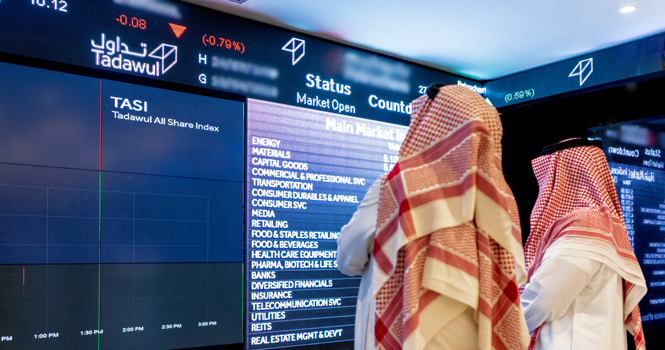
Tadawul trading screen
Eighteen companies and banks listed on the Saudi Exchange (Tadawul) announced updates today, Nov. 26, regarding the draft Domestic Minimum Top-up Tax (DMTT) system, including whether the tax provisions apply to them and the expected financial impact. 
The disclosures showed that 19 companies and banks meet or expect to meet the criteria for being subject to the DMTT, while eight companies said the tax does not apply to them or do not expect to fall within its scope. The Saudi Investment Bank (SAIB) is still assessing whether the draft provisions apply to it.
Nineteen companies and banks are currently assessing the potential financial impact of the tax. MBC Group, Seera and SAIB, meanwhile, said they do not expect a material impact on their net profits.
ADES does not expect any additional material financial impact on its consolidated financial results. Americana, meanwhile, announced that it falls within the scope of the proposed system, but does not expect a material impact on its consolidated effective tax rate.
Details of Companies’ and Banks’ Disclosures
Company/Bank
Applicability of the tax
Expected financial impact
Al Rajhi Bank
Meets the criteria
Under assessment
SNB
Meets the criteria
Under assessment
SAB
Meets the criteria
Under assessment
BSF
Meets the criteria
Under assessment
SAIB
Assessing whether the tax applies
Does not expect a material impact on net profit
Mobily
Assessing whether the tax applies
Under assessment
Sipchem
Expects to be subject to the tax
Under assessment
SENAAT
Expects to be subject to the tax
Under assessment
solutions
Falls within the scope of the draft tax in its current form
Under assessment
Saudi Chemical
Meets the criteria
Under assessment
MBC
Meets the criteria
Does not expect a material impact on net profit
Savola
Expects to be subject to the tax
Under assessment
flynas
Expects to be subject to the tax
Under assessment
NADEC
Meets the criteria
Under assessment
Al Mawarid
Does not expect to be subject to the regime
Does not expect a material impact
L’azurde
Does not meet the minimum revenue threshold
Does not expect a material impact
Fakeeh Care
Does not expect to be subject to the tax
Not determined
Aldrees
The tax does not apply
No material impact
According to Argaam data, the Zakat, Tax and Customs Authority (ZATCA) recently announced that the Domestic Minimum Top-up Tax would take effect on Jan. 1, 2027, for constituent entities of multinational enterprise groups with annual consolidated revenue of at least EUR 750 million, or its equivalent in Saudi riyals.
The authority added that this revenue threshold must have been met in at least two of the four fiscal years preceding the fiscal year in which the tax takes effect, based on the consolidated financial statements of the ultimate parent entity.
The draft regime provides for a top-up tax where the effective tax rate of multinational groups within its scope falls below the minimum rate of 15%, broadly in line with the OECD’s Pillar II rules.
Tadawul trading screen
Eighteen companies and banks listed on the Saudi Exchange (Tadawul) announced updates today, Nov. 26, regarding the draft Domestic Minimum Top-up Tax (DMTT) system, including whether the tax provisions apply to them and the expected financial impact.
The disclosures showed that 19 companies and banks meet or expect to meet the criteria for being subject to the DMTT, while eight companies said the tax does not apply to them or do not expect to fall within its scope. The Saudi Investment Bank (SAIB) is still assessing whether the draft provisions apply to it.
Nineteen companies and banks are currently assessing the potential financial impact of the tax. MBC Group, Seera and SAIB, meanwhile, said they do not expect a material impact on their net profits.
ADES does not expect any additional material financial impact on its consolidated financial results. Americana, meanwhile, announced that it falls within the scope of the proposed system, but does not expect a material impact on its consolidated effective tax rate.
Details of Companies’ and Banks’ Disclosures
Company/Bank
Applicability of the tax
Expected financial impact
Al Rajhi Bank
Meets the criteria
Under assessment
SNB
Meets the criteria
Under assessment
SAB
Meets the criteria
Under assessment
BSF
Meets the criteria
Under assessment
SAIB
Assessing whether the tax applies
Does not expect a material impact on net profit
Mobily
Assessing whether the tax applies
Under assessment
Sipchem
Expects to be subject to the tax
Under assessment
SENAAT
Expects to be subject to the tax
Under assessment
solutions
Falls within the scope of the draft tax in its current form
Under assessment
Saudi Chemical
Meets the criteria
Under assessment
MBC
Meets the criteria
Does not expect a material impact on net profit
Savola
Expects to be subject to the tax
Under assessment
flynas
Expects to be subject to the tax
Under assessment
NADEC
Meets the criteria
Under assessment
Al Mawarid
Does not expect to be subject to the regime
Does not expect a material impact
L’azurde
Does not meet the minimum revenue threshold
Does not expect a material impact
Fakeeh Care
Does not expect to be subject to the tax
Not determined
Aldrees
The tax does not apply
No material impact
According to Argaam data, the Zakat, Tax and Customs Authority (ZATCA) recently announced that the Domestic Minimum Top-up Tax would take effect on Jan. 1, 2027, for constituent entities of multinational enterprise groups with annual consolidated revenue of at least EUR 750 million, or its equivalent in Saudi riyals.
The authority added that this revenue threshold must have been met in at least two of the four fiscal years preceding the fiscal year in which the tax takes effect, based on the consolidated financial statements of the ultimate parent entity.
The draft regime provides for a top-up tax where the effective tax rate of multinational groups within its scope falls below the minimum rate of 15%, broadly in line with the OECD’s Pillar II rules.