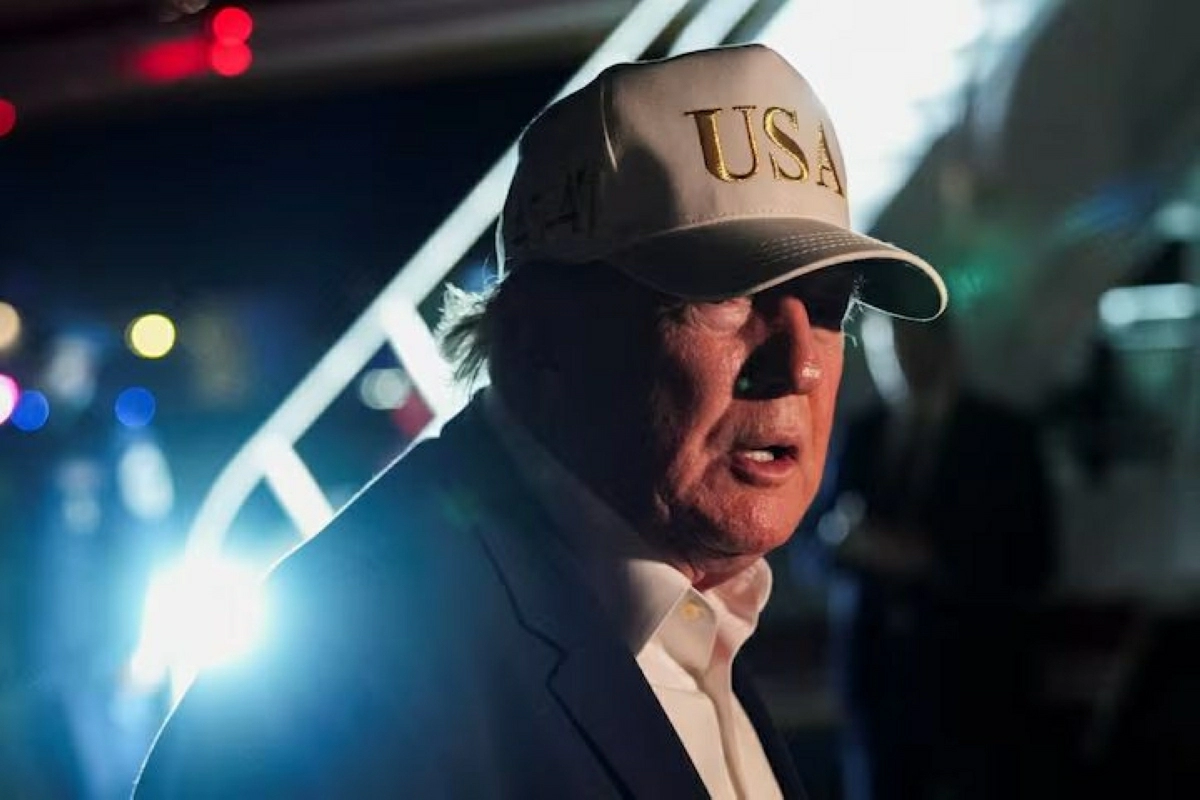
WASHINGTON — US President Donald Trump has said he believes the US war on Iran is “effectively over” but Washington was ready to resume military strikes if necessary.In a briefing on Monday after meeting Qatar’s prime minister at the White House, Trump reiterated his position that the United States had destroyed Iran’s military. But his remarks suggested he faces pressure from allies in the Middle East to bring hostilities to a close. Qatar and Saudi Arabia were eager for a peaceful solution to the Iran conflict, Trump said.”Qatar would rather see a peaceful solution and Saudi Arabia would rather see a peaceful solution” but “we’re ready to go anytime we want” with strikes, he told Reuters.Trump added in a post on Truth Social that a resumption of US military strikes on Iran was “quite unlikely,” saying that Gulf powers wanted to keep the status quo.“Iran militarily is effectively over,” he said. “We’re just keeping it the status quo, and we’re doing that really at the behest of countries that are their neighbors.”He added that Iran has been “decapitated” but said he is still looking to make sure there’s a long-term solution to ensuring that Iran’s nuclear program is defanged.“I had an excellent conversation with Sheikh Mohammed bin Abdulrahman bin Jassim Al Thani,” Trump said on Truth Social, adding that “much was discussed with respect to the Islamic Republic of Iran.”“We are seeing positive momentum toward an end to this conflict, and will ensure that America’s interests are at all times protected,” Trump said.Trump’s comments echoed early statements to CNN over the weekend when he said it was “highly unlikely” fighting would resume.Sheikh Mohammed said he had positive discussions with Trump and Vice President JD Vance on Monday.“We discussed the situation in the region and ways to progress the US-Iran talks. Grateful for the positive discussions on reaching a deal and bringing peace to the region,” he said on X.Trump said the “status quo” would involve continuing the US naval blockade against Iranian ports, as well as the newly announced Task Force Iron Gate, which seeks to cut off trade by land and through the Caspian Sea.“In other words, a continuation of the greatest naval blockade in the history of our country. Probably in the history of the world,” he said.Trump also indicated in his briefing that the US was willing to resume fighting, should the need arise.“Taking military action doesn’t seem to be a very necessary thing, but we’re locked and loaded, ready to go for any reason that changes,” he said.“Israel and the entire Middle East are protected from Iranian danger and threats, and we’re seeing momentum toward the end of this conflict. I think it’s going to be ending fairly soon.”Iranian officials, meanwhile, dismissed Trump’s latest remarks as a distraction.Iran’ssecurity council chief Mohsen Rezaei said on X the US should “stop manufacturing fake news about imaginary talks” and that it was “time to surrender to the seven conditions Iran has repeatedly set out.”“The war on Iran has already wrecked the US government. But Washington flails like a desperate gambler,” Rezaei wrote.Separately, Iran’s President Masoud Pezeshkian said that the country’s Supreme Leader Mojtaba Khamenei had called for an end to the situation, which he described as “neither war nor peace”.Pezeshkian added that Iran was open to further negotiations but would not be coerced, according to Iranian media. “We will not surrender to force and bullying,” he said.The Qatari prime minister, who also serves as foreign minister, has been acting as an intermediary between Washington and Tehran.In Monday’s closed-door meeting, he reportedly presented Trump with a two-day proposal from Iran to end the war.Afterward, reporters asked Trump in the briefing room, “Why not just declare an end to the conflict and be done with it?”Trump replied by framing the continued US blockade as a question of regional security. He also called for a “long-term solution”, rather than a short-term one.“We have some great allies there, and we have to make sure they’re not hurt, and they would be hurt,” he said.
Keep Up to Date with our Weekly Newsletter