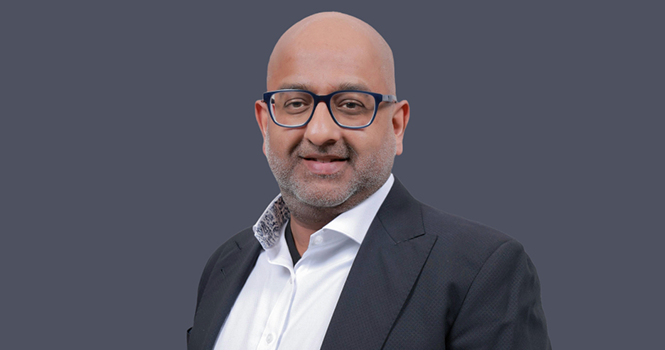
Ruban Deep Singh Bilen, CEO of Consolidated Grunenfelder Saady Holding Co. (CGS)
Ruban Deep Singh Bilen, CEO of Consolidated Grunenfelder Saady Holding Co. (CGS), said that the company ended this fiscal year with a backlog amounting to SAR 300 million, an increase of 58% compared to SAR 190 million in 2025. 
These orders provide strong revenue visibility into FY 2027 and beyond, he added.
In an interview with Argaam, the CEO indicated that the stationary refrigeration and customized solutions segments currently represent about 40% of total revenues, as part of the company’s strategy to diversify sources of income. He pointed out that the company’s debt-free balance sheet and cash liquidity of SAR 87.7 million provide it with financial flexibility to deal with any additional disruptions.
Regarding financial results, Bilen explained that EBITDA and EBITDA margin improved during the fourth quarter of the fiscal year ended 31 March 2026, compared to the same period a year earlier, despite net profit being affected by a number of non-recurring factors.
The regional geopolitical events weighed on chassis availability and led to delays in certain stages of project deliveries during the fourth quarter. The 2026 revenues would have exceeded 2025 levels had it not been for these factors,” said the top executive.
Below is the interview in detail:
1. What is your comment on the factors that led to the decline in net profit in Q4 2026 to approximately SAR 13.6 million, compared to around SAR 17.0 million in the same period last year, despite revenues remaining broadly stable?
Firstly, it is important to acknowledge that both EBITDA and EBITDA margin improved in Q4 FY26 compared to the same prior year period on a very similar revenue base reflecting a stronger underlying operational performance.
The net profit decline visible in Q4 was driven by three distinct and largely non-recurring factors:
– Absence of foreign exchange gains: Q4 2025 benefited from approximately 10% depreciation of the Euro against the SAR, generating a meaningful FX tailwind that did not repeat in Q4 FY26.
– Post-IPO tax base adjustment: Following the IPO and the associated reduction in foreign shareholding, a portion of the deferred tax asset was derecognized, resulting in a higher effective tax charge in the period. This is a one-time accounting effect tied directly to the listing.
– Higher non-cash depreciation: higher depreciation from right-of-use assets lease accounting added to the below-the-line charges.
2. How did geopolitical tensions and supply chain disruptions specifically affect Q4 performance? Was the impact limited to delays in the availability of chassis in the refrigerated transport segment, or did it also extend to delays in delivering refrigeration projects? What was the estimated value of revenues that could have been recognized had these delays not occurred?
The company mentioned that regional events affected chassis availability during the latter part of Q4 and caused delays in some project delivery milestones.
The regional geopolitical events created two distinct and simultaneous disruption channels in Q4-FY26:
• Stationary Refrigeration – the delayed completion of certain project delivery milestones due to shipping constraints, pushed associated revenues out of FY26 into FY27.
• Automotive Solutions – the disruptions constrained chassis availability, impacting our customers’ ability to deliver to CGS so that we could fulfill our scope of work, adding a drag on Automotive revenues late in Q4.
In quantifying the impact we can confirm that, excluding the effect of these disruptions, FY26 revenue would have exceeded FY25 levels – meaning the regional events were the decisive factor that turned what would have been a positive year into a reported revenue decline.
3. Was the revenue mix in Q4 less profitable than usual? Which segments contributed the most to revenues during Q4?
Margin levels by segment were in line with expectations. However, it was the revenue mix itself that impacted overall gross margin level for the group. Automotive solutions remained the single largest contributor to revenue. However, its relative contribution was lower than in the comparable prior-year period, while stationary refrigeration which carries a lower margin profile accounted for a meaningfully larger share of the revenue mix.
Stationary Refrigeration remains a strategic segment for us supporting the revenue diversification strategy in our portfolio and is a key enabler for growth of aftermarket service revenue stream for the future. The full-year gross margin contracted from 22.9% to 21.8%, entirely driven by this mix effect.
At the same time, Stationary Refrigeration and Customized Solutions strongly grew year -on-year, which is consistent with our focused strategy of diversifying our revenue base. Together, these two segments now represent close to 40% of total revenue.
4. What caused the significant increase in doubtful debt provisions from approximately SAR 253,000 to SAR 2.77 million?
The overall health of our receivables was robust despite tightening liquidity in the marketplace witnessed in H2 2026; this is demonstrated by 80% of our receivables sitting in the current category with only 20% in the overdue category. This is the same ratio as at the end of FY25.
The impact on doubtful debts came from the aging within the overdue category with collections taking longer than during past periods resulting in higher provision requirements based on the overall increase in days outstanding. Additionally, the increasing share of revenue from stationary refrigeration and customized solutions, which typically involve milestone-based billing on longer-cycle projects, naturally creates a different receivable ageing dynamic versus automotive’s more transactional billing.
We do not see any fundamental change in the risk profile of our client base and believe this impact is mainly timing related and should be recovered to the PL in future periods.
5. You mentioned that the market share in the refrigerated transport segment returned to its normal levels after an exceptional FY2025. What is your current market share?
We do not disclose specific market share levels for competitive reasons. What we can confirm is that FY26 saw a decline below our historical average, directly against a FY25 comparison period where market share was at the higher end of our historical range. The movement primarily reflects the normal cyclical nature of our business:
• Win rates and customer investment cycles are inherently variable year-to-year. CGS does not operate in a market where market share is static – tendering outcomes, customer procurement timing, and seasonal demand patterns all introduce natural variation.
• FY25 represented an exceptionally high market share year.
• The decline was compounded by softer overall customer sentiment in the latter part of the fiscal year.
Looking forward, the long-term structural demand drivers for Automotive Solutions remain compelling: population growth, Saudi Arabia’s Food Security Plan (backed by SAR 37.5 billion in commitments), rising cold-chain regulation requirements including SFDA’s October 2025 changes, and continued food-waste reduction initiatives.
6. What is the size of orders or revenues whose execution was delayed in Q4 and carried forward to upcoming periods?
We can confirm that without external factors impacting the planned execution, FY26 revenue would have slightly exceeded FY25 levels.
We would also like to highlight that the company achieved a record backlog of about SAR 300 million, providing strong revenue visibility into FY27 and beyond.
7. What was the size of the backlog at the end of 2026, and how is it distributed across segments? What percentage of the SAR 300 million backlog is expected to be converted into revenues during FY2027?
Total backlog at 31 March 2026 was approximately SAR 300 million, up from approximately SAR 190 million in FY25 — growth of roughly 58% year-on-year. We can confirm that the significant increase YoY was driven by customized solutions and will deliver revenue across both FY27 and FY28.
8. What are management’s targets for Q1 FY2027 performance? Does the company expect an improvement in revenues and margins compared to Q4, supported by the backlog and the carry-forward of some orders, or could supply chain pressures and project execution timing continue to weigh on performance?
Based on the business cycles of our customer base, particularly influenced by Automotive solutions, H2 has historically always been a stronger period for revenue performance compared to H1.
We do not anticipate this pattern to change in FY27, so we would not be anticipating growth in Q1 FY27 revenue compared to Q4 FY26. Furthermore, the complexity created by the current geopolitical situation will be an additional factor when comparing quarterly performance trends.
Nevertheless, our debt-free balance sheet with SAR 87.7 million in cash, a current ratio of 2.49x, and no financial leverage gives us significant financial resilience to manage through further disruption without compromising delivery commitments or returns.
Ruban Deep Singh Bilen, CEO of Consolidated Grunenfelder Saady Holding Co. (CGS)
Ruban Deep Singh Bilen, CEO of Consolidated Grunenfelder Saady Holding Co. (CGS), said that the company ended this fiscal year with a backlog amounting to SAR 300 million, an increase of 58% compared to SAR 190 million in 2025.
These orders provide strong revenue visibility into FY 2027 and beyond, he added.
In an interview with Argaam, the CEO indicated that the stationary refrigeration and customized solutions segments currently represent about 40% of total revenues, as part of the company’s strategy to diversify sources of income. He pointed out that the company’s debt-free balance sheet and cash liquidity of SAR 87.7 million provide it with financial flexibility to deal with any additional disruptions.
Regarding financial results, Bilen explained that EBITDA and EBITDA margin improved during the fourth quarter of the fiscal year ended 31 March 2026, compared to the same period a year earlier, despite net profit being affected by a number of non-recurring factors.
The regional geopolitical events weighed on chassis availability and led to delays in certain stages of project deliveries during the fourth quarter. The 2026 revenues would have exceeded 2025 levels had it not been for these factors,” said the top executive.
Below is the interview in detail:
1. What is your comment on the factors that led to the decline in net profit in Q4 2026 to approximately SAR 13.6 million, compared to around SAR 17.0 million in the same period last year, despite revenues remaining broadly stable?
Firstly, it is important to acknowledge that both EBITDA and EBITDA margin improved in Q4 FY26 compared to the same prior year period on a very similar revenue base reflecting a stronger underlying operational performance.
The net profit decline visible in Q4 was driven by three distinct and largely non-recurring factors:
– Absence of foreign exchange gains: Q4 2025 benefited from approximately 10% depreciation of the Euro against the SAR, generating a meaningful FX tailwind that did not repeat in Q4 FY26.
– Post-IPO tax base adjustment: Following the IPO and the associated reduction in foreign shareholding, a portion of the deferred tax asset was derecognized, resulting in a higher effective tax charge in the period. This is a one-time accounting effect tied directly to the listing.
– Higher non-cash depreciation: higher depreciation from right-of-use assets lease accounting added to the below-the-line charges.
2. How did geopolitical tensions and supply chain disruptions specifically affect Q4 performance? Was the impact limited to delays in the availability of chassis in the refrigerated transport segment, or did it also extend to delays in delivering refrigeration projects? What was the estimated value of revenues that could have been recognized had these delays not occurred?
The company mentioned that regional events affected chassis availability during the latter part of Q4 and caused delays in some project delivery milestones.
The regional geopolitical events created two distinct and simultaneous disruption channels in Q4-FY26:
• Stationary Refrigeration – the delayed completion of certain project delivery milestones due to shipping constraints, pushed associated revenues out of FY26 into FY27.
• Automotive Solutions – the disruptions constrained chassis availability, impacting our customers’ ability to deliver to CGS so that we could fulfill our scope of work, adding a drag on Automotive revenues late in Q4.
In quantifying the impact we can confirm that, excluding the effect of these disruptions, FY26 revenue would have exceeded FY25 levels – meaning the regional events were the decisive factor that turned what would have been a positive year into a reported revenue decline.
3. Was the revenue mix in Q4 less profitable than usual? Which segments contributed the most to revenues during Q4?
Margin levels by segment were in line with expectations. However, it was the revenue mix itself that impacted overall gross margin level for the group. Automotive solutions remained the single largest contributor to revenue. However, its relative contribution was lower than in the comparable prior-year period, while stationary refrigeration which carries a lower margin profile accounted for a meaningfully larger share of the revenue mix.
Stationary Refrigeration remains a strategic segment for us supporting the revenue diversification strategy in our portfolio and is a key enabler for growth of aftermarket service revenue stream for the future. The full-year gross margin contracted from 22.9% to 21.8%, entirely driven by this mix effect.
At the same time, Stationary Refrigeration and Customized Solutions strongly grew year -on-year, which is consistent with our focused strategy of diversifying our revenue base. Together, these two segments now represent close to 40% of total revenue.
4. What caused the significant increase in doubtful debt provisions from approximately SAR 253,000 to SAR 2.77 million?
The overall health of our receivables was robust despite tightening liquidity in the marketplace witnessed in H2 2026; this is demonstrated by 80% of our receivables sitting in the current category with only 20% in the overdue category. This is the same ratio as at the end of FY25.
The impact on doubtful debts came from the aging within the overdue category with collections taking longer than during past periods resulting in higher provision requirements based on the overall increase in days outstanding. Additionally, the increasing share of revenue from stationary refrigeration and customized solutions, which typically involve milestone-based billing on longer-cycle projects, naturally creates a different receivable ageing dynamic versus automotive’s more transactional billing.
We do not see any fundamental change in the risk profile of our client base and believe this impact is mainly timing related and should be recovered to the PL in future periods.
5. You mentioned that the market share in the refrigerated transport segment returned to its normal levels after an exceptional FY2025. What is your current market share?
We do not disclose specific market share levels for competitive reasons. What we can confirm is that FY26 saw a decline below our historical average, directly against a FY25 comparison period where market share was at the higher end of our historical range. The movement primarily reflects the normal cyclical nature of our business:
• Win rates and customer investment cycles are inherently variable year-to-year. CGS does not operate in a market where market share is static – tendering outcomes, customer procurement timing, and seasonal demand patterns all introduce natural variation.
• FY25 represented an exceptionally high market share year.
• The decline was compounded by softer overall customer sentiment in the latter part of the fiscal year.
Looking forward, the long-term structural demand drivers for Automotive Solutions remain compelling: population growth, Saudi Arabia’s Food Security Plan (backed by SAR 37.5 billion in commitments), rising cold-chain regulation requirements including SFDA’s October 2025 changes, and continued food-waste reduction initiatives.
6. What is the size of orders or revenues whose execution was delayed in Q4 and carried forward to upcoming periods?
We can confirm that without external factors impacting the planned execution, FY26 revenue would have slightly exceeded FY25 levels.
We would also like to highlight that the company achieved a record backlog of about SAR 300 million, providing strong revenue visibility into FY27 and beyond.
7. What was the size of the backlog at the end of 2026, and how is it distributed across segments? What percentage of the SAR 300 million backlog is expected to be converted into revenues during FY2027?
Total backlog at 31 March 2026 was approximately SAR 300 million, up from approximately SAR 190 million in FY25 — growth of roughly 58% year-on-year. We can confirm that the significant increase YoY was driven by customized solutions and will deliver revenue across both FY27 and FY28.
8. What are management’s targets for Q1 FY2027 performance? Does the company expect an improvement in revenues and margins compared to Q4, supported by the backlog and the carry-forward of some orders, or could supply chain pressures and project execution timing continue to weigh on performance?
Based on the business cycles of our customer base, particularly influenced by Automotive solutions, H2 has historically always been a stronger period for revenue performance compared to H1.
We do not anticipate this pattern to change in FY27, so we would not be anticipating growth in Q1 FY27 revenue compared to Q4 FY26. Furthermore, the complexity created by the current geopolitical situation will be an additional factor when comparing quarterly performance trends.
Nevertheless, our debt-free balance sheet with SAR 87.7 million in cash, a current ratio of 2.49x, and no financial leverage gives us significant financial resilience to manage through further disruption without compromising delivery commitments or returns.