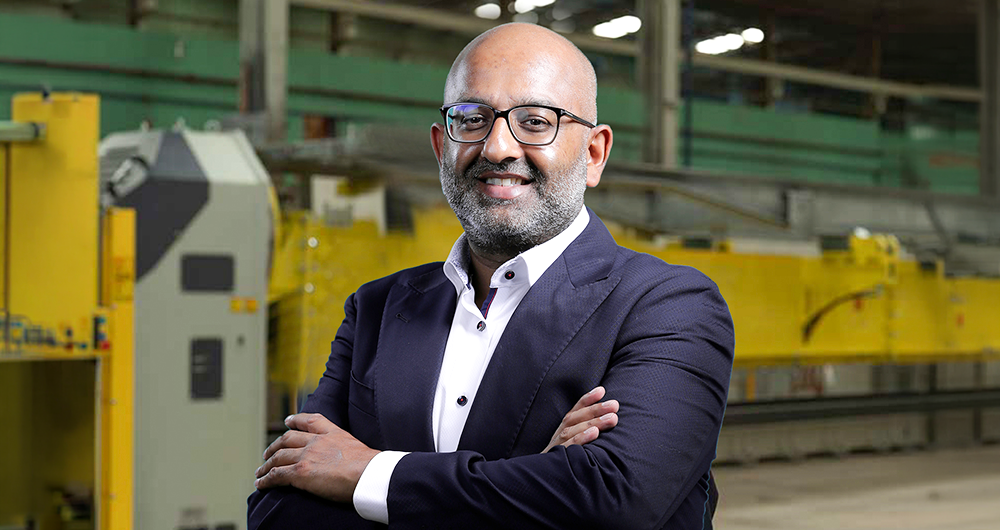
Ruban Bilen, CEO of Consolidated Grunenfelder Saady Holding Co. (CGS)
Ruban Bilen, CEO of Consolidated Grunenfelder Saady Holding Co. (CGS), said the company’s backlog stood at SAR 259 million by the end of September 2026, down from SAR 309 million by the end of the previous quarter. 
The decline was attributable to the execution of a significant number of previously accumulated projects and their conversion into completed work during the second quarter, he added.
In an interview with Argaam, Bilen explained that the current backlog provides clear visibility into business activity across the main segments for the remainder of the year. “Meanwhile, the Automotive segment is a short cycle business; so we don’t have backlog secured for H2 entirely. Part of the revenue will be through orders we will secure in H2,” he said.
He highlighted the importance of workforce accommodation projects within the Customized Solutions segment in particular, given their ability to generate sustainable and repeatable revenue streams.
Customized Solutions Supports Revenue Growth
Commenting on the financial results, Bilen said the company delivered strong second-quarter performance despite uncertainty in the operating environment.
The Customized Solutions segment was the main growth driver, with its revenue rising to SAR 22.9 million and its contribution to group revenue increasing to 19%, up from 3%. This was supported by the execution of the backlog of workforce accommodation projects in the oil and gas sector and telecommunications solutions, according to Bilen.
He added that after-sales services grew by around 25%, while stationary cooling revenue increased by 5.5%. Automotive Solutions revenue, meanwhile, declined by 7.4% YoY due to limited chassis availability for customers and their cautious approach to purchasing and investment decisions.
Bilen also pointed out that net profit remained broadly stable at SAR 9.5 million, mainly due to a decline in the gross profit margin. “The pressure was concentrated in the automotive segment as a result of price competition and higher input costs. We chose to absorb part of these increases rather than pass the full cost on to customers, in order to preserve our strong relationships with key customers and our market position,” he continued.
Bilen added that lower market volumes had intensified competition for available orders, limiting opportunities to raise prices.
Performance in the other segments was in line with expectations, while Customized Solutions recorded higher-than-expected margins alongside volume growth. Cost-control measures helped mitigate the impact of these pressures.
Regarding cash flows, Bilen stressed that improving cash conversion is a management priority. He explained that operating cash flow was negative during the quarter due to an increase in contract assets and receivables associated with revenue growth and the execution of stationary cooling projects.
Looking ahead, Bilen said the company remains cautious about a significant near-term improvement in margins, given the continued impact of geopolitical tensions on customers’ investment decisions, project execution schedules and supply chains. He also expects competitive pressures and higher input costs to persist in some activities, while stationary refrigeration revenue is likely to moderate in the second half after its strong first-half performance.
On the positive side, he pointed to signs of improvement in automotive orders ahead of the pre-Ramadan period, expansion in Customized Solutions at better margins, and after-sales services contributing to recurring revenue and profitability. The company’s priority is to protect profitability through careful order selection, cost control and stronger working capital management.
Cost Pressures and Competition Partially Offset Margin Recovery
The company holds a leading position in the automotive solutions market, while the segment’s business model is based on purchase orders that allow prices to be reviewed for new orders. However, the company has opted to absorb part of the cost increases and share the burden with key customers in order to protect its market position and long-standing relationships with them, which have helped establish its leadership over several decades. The decline in market volumes has also intensified competition for available orders, according to the CEO.
Bilen said that raising prices alone is not the appropriate solution at this stage, and the company does not expect an immediate return to previous margin levels. However, it may review prices in coordination with key customers if inflationary increases prove to have established a new cost baseline for the sector.
He added that the other three segments performed in line with expectations, while Customized Solutions margins improved alongside growth in its backlog.
“Our response to current conditions focuses on improving business quality and execution efficiency through selective order acceptance, stronger cost controls, close monitoring of working capital and disciplined overhead spending,” said the top executive.
He indicated that CGS is also working to increase the contributions of the Customized Solutions and After-Sales Services segments, given their more favorable business mix and higher profit margins. This is expected to help protect profitability despite continued competitive and cost pressures in some activities.
Automotive Solutions Improves Despite Chassis Availability Challenges
Regarding chassis availability, customer demand and the return of the refrigerated transport segment to growth, Bilen said the company had recorded consecutive improvements in Automotive Solutions volumes, with revenue increasing on the back of orders from key customers.
Despite this improvement, segment revenue remained down 7.4% YoY and 14.8% in the first half, amid continued limited chassis availability and customer caution due to regional uncertainty, he added.
Customer activity is improving as companies prepare for the pre-Ramadan period, he said, although it is still too early to determine when chassis availability will recover.
The top executive also noted that the company currently lacks clear visibility on when the segment will return to annual growth, as this depends largely on the recovery of domestic chassis inventories, the restoration of customer confidence and the resumption of investment decisions.
Bilen described the sequential improvement as a positive sign, explaining that the company had strengthened its inventory to mitigate supply chain disruptions and continues to monitor orders and customer delivery schedules to assess the sustainability of the recovery.
New Opportunities and Project Execution
Regarding future opportunities, Bilen said the company is leveraging its engineering and manufacturing expertise in the Customized Solutions segment to expand into adjacent applications and sectors, including defense solutions, workforce accommodation and prefabricated telecommunications solutions, among others, while maintaining its project selection criteria and protecting margins.
In the Stationary Refrigeration segment, opportunities are concentrated in food retail, storage, cold-chain logistics and healthcare, in line with the Kingdom’s investment priorities, including food security, he added.
The company is also continuing to execute several major projects, while its expanding installed project base provides additional opportunities to grow after-sales services.
Cautious Outlook for H2 2026 Performance
Regarding his expectations for the company’s performance in the coming period, Bilen expressed cautious optimism heading into the second half, citing record revenue in the first half, a debt-free balance sheet, cash liquidity of SAR 67.7 million, and an improvement in the working capital cycle to 68 days from 82 days in Q1, despite ongoing liquidity challenges and the importance of improving cash conversion.
Performance drivers are expected to vary over the coming quarters. Cooling segment revenue is expected to moderate in H2 2026, after 68.9% growth in the first half, supported by major project execution and the company’s progress in completing its current project cycle, Bilen said.
Meanwhile, the Automotive Solutions segment has shown sequential improvement in performance, although the pace of its recovery remains linked to chassis availability and customer confidence levels. Customized Solutions segment will continue to benefit from its backlog of workforce accommodation projects, while after-sales services will support revenue growth through the expanding base of completed projects, he added.
Bilen also considered the localization of defense industries a clear additional opportunity for the company, expecting regional developments to accelerate this trend and provide sustainable support for the company and other local manufacturers.
He explained that the company’s focus in the second half will be on efficiently executing its existing backlog, strengthening cost discipline, and improving cash conversion.
Regarding profitability, he said that CGS does not expect a rapid recovery in margins, given continued price competition and input cost pressures, particularly in the Automotive Solutions segment.
He indicated that continued cost increases across the sector could make price reviews necessary in the future, with their timing and extent depending on market conditions.
“We are closely monitoring our orders pipeline and potential opportunities in the cooling segment for fiscal year 2028”, said Bilen. He explained that performance in 2027 will largely depend on existing orders and projects under execution.
He added that delays in project award decisions, particularly in industrial cooling, could affect revenue visibility for the following year, as some customers are postponing investment decisions due to liquidity pressures rather than canceling projects altogether.
“We are monitoring these opportunities and working to convert them into confirmed orders,” said Bilen “Our priorities for the remainder of the year are to protect profit margins, convert working capital into cash flows, and ensure efficient project execution.”
According to Argaam data, CGS’s profit declined by 5% to SAR 17.99 million in the first half ended September 2026, compared with SAR 18.89 million in the same period of 2025. Second-quarter profit amounted to SAR 9.5 million, down 2%.
Ruban Bilen, CEO of Consolidated Grunenfelder Saady Holding Co. (CGS)
Ruban Bilen, CEO of Consolidated Grunenfelder Saady Holding Co. (CGS), said the company’s backlog stood at SAR 259 million by the end of September 2026, down from SAR 309 million by the end of the previous quarter.
The decline was attributable to the execution of a significant number of previously accumulated projects and their conversion into completed work during the second quarter, he added.
In an interview with Argaam, Bilen explained that the current backlog provides clear visibility into business activity across the main segments for the remainder of the year. “Meanwhile, the Automotive segment is a short cycle business; so we don’t have backlog secured for H2 entirely. Part of the revenue will be through orders we will secure in H2,” he said.
He highlighted the importance of workforce accommodation projects within the Customized Solutions segment in particular, given their ability to generate sustainable and repeatable revenue streams.
Customized Solutions Supports Revenue Growth
Commenting on the financial results, Bilen said the company delivered strong second-quarter performance despite uncertainty in the operating environment.
The Customized Solutions segment was the main growth driver, with its revenue rising to SAR 22.9 million and its contribution to group revenue increasing to 19%, up from 3%. This was supported by the execution of the backlog of workforce accommodation projects in the oil and gas sector and telecommunications solutions, according to Bilen.
He added that after-sales services grew by around 25%, while stationary cooling revenue increased by 5.5%. Automotive Solutions revenue, meanwhile, declined by 7.4% YoY due to limited chassis availability for customers and their cautious approach to purchasing and investment decisions.
Bilen also pointed out that net profit remained broadly stable at SAR 9.5 million, mainly due to a decline in the gross profit margin. “The pressure was concentrated in the automotive segment as a result of price competition and higher input costs. We chose to absorb part of these increases rather than pass the full cost on to customers, in order to preserve our strong relationships with key customers and our market position,” he continued.
Bilen added that lower market volumes had intensified competition for available orders, limiting opportunities to raise prices.
Performance in the other segments was in line with expectations, while Customized Solutions recorded higher-than-expected margins alongside volume growth. Cost-control measures helped mitigate the impact of these pressures.
Regarding cash flows, Bilen stressed that improving cash conversion is a management priority. He explained that operating cash flow was negative during the quarter due to an increase in contract assets and receivables associated with revenue growth and the execution of stationary cooling projects.
Looking ahead, Bilen said the company remains cautious about a significant near-term improvement in margins, given the continued impact of geopolitical tensions on customers’ investment decisions, project execution schedules and supply chains. He also expects competitive pressures and higher input costs to persist in some activities, while stationary refrigeration revenue is likely to moderate in the second half after its strong first-half performance.
On the positive side, he pointed to signs of improvement in automotive orders ahead of the pre-Ramadan period, expansion in Customized Solutions at better margins, and after-sales services contributing to recurring revenue and profitability. The company’s priority is to protect profitability through careful order selection, cost control and stronger working capital management.
Cost Pressures and Competition Partially Offset Margin Recovery
The company holds a leading position in the automotive solutions market, while the segment’s business model is based on purchase orders that allow prices to be reviewed for new orders. However, the company has opted to absorb part of the cost increases and share the burden with key customers in order to protect its market position and long-standing relationships with them, which have helped establish its leadership over several decades. The decline in market volumes has also intensified competition for available orders, according to the CEO.
Bilen said that raising prices alone is not the appropriate solution at this stage, and the company does not expect an immediate return to previous margin levels. However, it may review prices in coordination with key customers if inflationary increases prove to have established a new cost baseline for the sector.
He added that the other three segments performed in line with expectations, while Customized Solutions margins improved alongside growth in its backlog.
“Our response to current conditions focuses on improving business quality and execution efficiency through selective order acceptance, stronger cost controls, close monitoring of working capital and disciplined overhead spending,” said the top executive.
He indicated that CGS is also working to increase the contributions of the Customized Solutions and After-Sales Services segments, given their more favorable business mix and higher profit margins. This is expected to help protect profitability despite continued competitive and cost pressures in some activities.
Automotive Solutions Improves Despite Chassis Availability Challenges
Regarding chassis availability, customer demand and the return of the refrigerated transport segment to growth, Bilen said the company had recorded consecutive improvements in Automotive Solutions volumes, with revenue increasing on the back of orders from key customers.
Despite this improvement, segment revenue remained down 7.4% YoY and 14.8% in the first half, amid continued limited chassis availability and customer caution due to regional uncertainty, he added.
Customer activity is improving as companies prepare for the pre-Ramadan period, he said, although it is still too early to determine when chassis availability will recover.
The top executive also noted that the company currently lacks clear visibility on when the segment will return to annual growth, as this depends largely on the recovery of domestic chassis inventories, the restoration of customer confidence and the resumption of investment decisions.
Bilen described the sequential improvement as a positive sign, explaining that the company had strengthened its inventory to mitigate supply chain disruptions and continues to monitor orders and customer delivery schedules to assess the sustainability of the recovery.
New Opportunities and Project Execution
Regarding future opportunities, Bilen said the company is leveraging its engineering and manufacturing expertise in the Customized Solutions segment to expand into adjacent applications and sectors, including defense solutions, workforce accommodation and prefabricated telecommunications solutions, among others, while maintaining its project selection criteria and protecting margins.
In the Stationary Refrigeration segment, opportunities are concentrated in food retail, storage, cold-chain logistics and healthcare, in line with the Kingdom’s investment priorities, including food security, he added.
The company is also continuing to execute several major projects, while its expanding installed project base provides additional opportunities to grow after-sales services.
Cautious Outlook for H2 2026 Performance
Regarding his expectations for the company’s performance in the coming period, Bilen expressed cautious optimism heading into the second half, citing record revenue in the first half, a debt-free balance sheet, cash liquidity of SAR 67.7 million, and an improvement in the working capital cycle to 68 days from 82 days in Q1, despite ongoing liquidity challenges and the importance of improving cash conversion.
Performance drivers are expected to vary over the coming quarters. Cooling segment revenue is expected to moderate in H2 2026, after 68.9% growth in the first half, supported by major project execution and the company’s progress in completing its current project cycle, Bilen said.
Meanwhile, the Automotive Solutions segment has shown sequential improvement in performance, although the pace of its recovery remains linked to chassis availability and customer confidence levels. Customized Solutions segment will continue to benefit from its backlog of workforce accommodation projects, while after-sales services will support revenue growth through the expanding base of completed projects, he added.
Bilen also considered the localization of defense industries a clear additional opportunity for the company, expecting regional developments to accelerate this trend and provide sustainable support for the company and other local manufacturers.
He explained that the company’s focus in the second half will be on efficiently executing its existing backlog, strengthening cost discipline, and improving cash conversion.
Regarding profitability, he said that CGS does not expect a rapid recovery in margins, given continued price competition and input cost pressures, particularly in the Automotive Solutions segment.
He indicated that continued cost increases across the sector could make price reviews necessary in the future, with their timing and extent depending on market conditions.
“We are closely monitoring our orders pipeline and potential opportunities in the cooling segment for fiscal year 2028”, said Bilen. He explained that performance in 2027 will largely depend on existing orders and projects under execution.
He added that delays in project award decisions, particularly in industrial cooling, could affect revenue visibility for the following year, as some customers are postponing investment decisions due to liquidity pressures rather than canceling projects altogether.
“We are monitoring these opportunities and working to convert them into confirmed orders,” said Bilen “Our priorities for the remainder of the year are to protect profit margins, convert working capital into cash flows, and ensure efficient project execution.”
According to Argaam data, CGS’s profit declined by 5% to SAR 17.99 million in the first half ended September 2026, compared with SAR 18.89 million in the same period of 2025. Second-quarter profit amounted to SAR 9.5 million, down 2%.