SAMA Governor Ayman Al-Sayari said Saudi banks have strong liquidity and capital levels
Ayman Al-Sayari, Governor of the Saudi Central Bank (SAMA), said the Saudi banking sector has maintained its strength and stability despite geopolitical tensions in the region. 
He noted that about 87% of Saudi banks’ liabilities come from domestic sources, helping limit the impact of fluctuations in foreign capital flows on the sector.
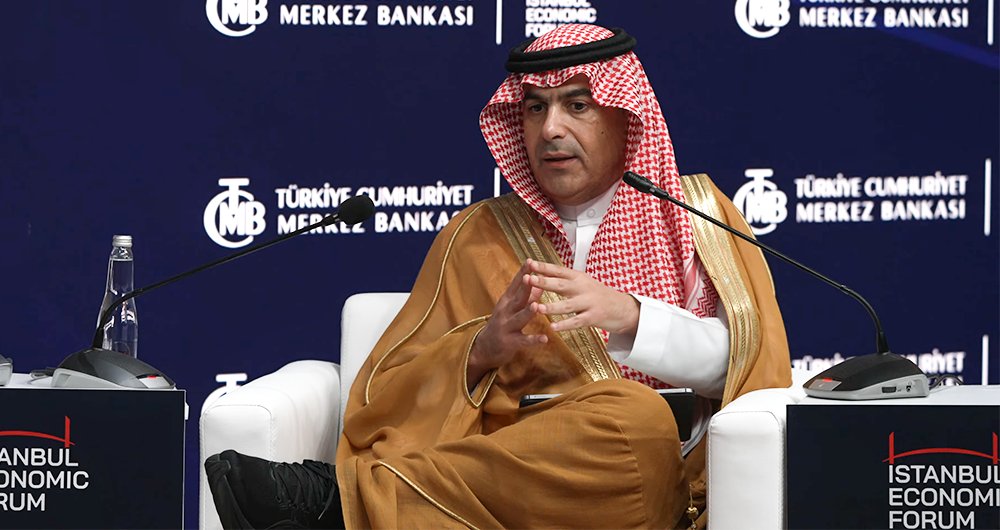
Speaking today, Oct. 8, at the Istanbul Economic Forum 2026, Al-Sayari said Saudi banks have strong liquidity and capital levels, with the liquidity coverage ratio exceeding 170%, while the net stable funding ratio stood at 114.6%.
He said these levels demonstrate the sector’s ability to withstand challenges and continue financing economic activity.
He added that Saudi banks have maintained access to funding and borrowing markets, while continuing to finance projects despite challenges facing global markets, supported by the stability of their domestic funding base.
The Governor said the Saudi economy has demonstrated resilience in the face of shocks stemming from regional conflicts, disruptions to trade flows and energy supplies, supported by available reserves and fiscal buffers, long-term infrastructure investments and economic reforms.
He said the Kingdom’s investments in energy infrastructure have proved important during the current disruptions, particularly amid developments in the Strait of Hormuz and the Red Sea.
Al-Sayari highlighted the role of the East-West Oil Pipeline in maintaining the continuity of oil supplies to customers, with a capacity of about 5.8 million barrels per day, in addition to additional capacity for transporting and exporting oil. This helped the Kingdom offset a significant portion of the decline caused by disruptions to traditional shipping routes.
He said the experience highlights the importance of investing in infrastructure during periods of stability and building reserves and operational capacities that enable economies to absorb shocks when crises occur.
The Governor said reforms linked to Saudi Vision 2030 have begun to bear fruit, noting that non-oil activities continued to post positive growth despite the economy contracting for two consecutive quarters in 2026 due to a decline in the oil sector’s contribution.
Non-oil activity growth approached 3%, supported by continued domestic demand, record-low unemployment among Saudis and economic reforms implemented by the Kingdom over the past years, he said.
Inflation in the Kingdom remained moderate compared with global developments, supported by government policies, rent-related measures and the exchange-rate policy, as well as infrastructure investments that helped ease supply bottlenecks, said Al-Sayari.
SAMA Governor Ayman Al-Sayari said Saudi banks have strong liquidity and capital levels
Ayman Al-Sayari, Governor of the Saudi Central Bank (SAMA), said the Saudi banking sector has maintained its strength and stability despite geopolitical tensions in the region.
He noted that about 87% of Saudi banks’ liabilities come from domestic sources, helping limit the impact of fluctuations in foreign capital flows on the sector.
Speaking today, Oct. 8, at the Istanbul Economic Forum 2026, Al-Sayari said Saudi banks have strong liquidity and capital levels, with the liquidity coverage ratio exceeding 170%, while the net stable funding ratio stood at 114.6%.
He said these levels demonstrate the sector’s ability to withstand challenges and continue financing economic activity.
He added that Saudi banks have maintained access to funding and borrowing markets, while continuing to finance projects despite challenges facing global markets, supported by the stability of their domestic funding base.
The Governor said the Saudi economy has demonstrated resilience in the face of shocks stemming from regional conflicts, disruptions to trade flows and energy supplies, supported by available reserves and fiscal buffers, long-term infrastructure investments and economic reforms.
He said the Kingdom’s investments in energy infrastructure have proved important during the current disruptions, particularly amid developments in the Strait of Hormuz and the Red Sea.
Al-Sayari highlighted the role of the East-West Oil Pipeline in maintaining the continuity of oil supplies to customers, with a capacity of about 5.8 million barrels per day, in addition to additional capacity for transporting and exporting oil. This helped the Kingdom offset a significant portion of the decline caused by disruptions to traditional shipping routes.
He said the experience highlights the importance of investing in infrastructure during periods of stability and building reserves and operational capacities that enable economies to absorb shocks when crises occur.
The Governor said reforms linked to Saudi Vision 2030 have begun to bear fruit, noting that non-oil activities continued to post positive growth despite the economy contracting for two consecutive quarters in 2026 due to a decline in the oil sector’s contribution.
Non-oil activity growth approached 3%, supported by continued domestic demand, record-low unemployment among Saudis and economic reforms implemented by the Kingdom over the past years, he said.
Inflation in the Kingdom remained moderate compared with global developments, supported by government policies, rent-related measures and the exchange-rate policy, as well as infrastructure investments that helped ease supply bottlenecks, said Al-Sayari.