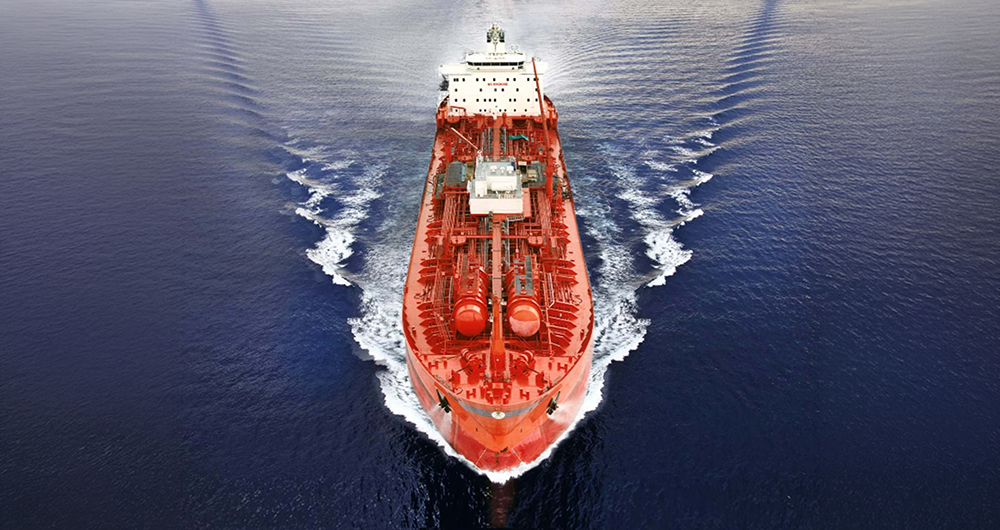
A very large crude carrier at sea. Ships of this class can carry about two million barrels of crude.
Business is booming at Bahri. The Saudi shipping group made a net profit of SAR5.09 billion in the third quarter, almost ten times the SAR513 million of a year earlier, as freight rates rose and trade patterns shifted with disruption in the Gulf and the Red Sea. 
It is also ordering new ships. Bahri has commissioned three supertankers, known in the trade as very large crude carriers, from International Maritime Industries (IMI), the shipyard at Ras Al-Khair.
Each can carry about two million barrels of crude, a capacity the industry rates at 320,000 deadweight tonnes.
The contract is worth SAR1.69 billion, and the ships will arrive in batches in 2029 and 2030.
The stock market values Bahri at about three times what it earned over the past year, a price that treats its profits as a windfall.
At the end of October, the whole company was worth about SAR33 billion, against profits of SAR11 billion in the four quarters to September.
If profits stayed at last quarter’s level, Bahri would earn as much as the whole company is worth in six and a half quarters.
Investors rarely value a company this cheaply unless they expect its profits to fall. That is our reading of the share price, not a forecast from Bahri.
The company itself is looking further ahead. Its new tankers are due in 2029 and 2030, so they will not start earning until then.
They will not be the only new tankers. By mid-2026, VLCCs on order worldwide equalled about a third of the existing fleet, up from 12% a year earlier. How much of that will arrive alongside Bahri’s ships is not yet clear.
The price is agreed now, at about a third of one quarter’s profit. That shows the order’s scale, not how easily Bahri can pay for it, which depends on its cash generation, its financing and the payment schedule.
What the ships earn will depend on freight rates from 2029, and those will turn on cargo demand, how many old tankers are retired and whether deliveries slip.
The contract works out at about $150 million a ship: SAR1.69 billion, or $451 million, divided by three.
Brokers put a standard new VLCC at $131.5 million (Clarksons) to $135 million (Braemar), which would mean Bahri is paying $15 million–$19 million a ship more.
Ships that can also burn liquefied natural gas cost more to build. Allied, another broker, puts the extra at $19 million –$20 million.
Add that, and the benchmark rises to $150.5 million –$155 million, with Bahri’s price in line with the bottom of the range.
This is only a rough comparison. If Bahri’s ships can run on both oil and gas, that extra building cost could explain much or all of the higher price.
But two things are not yet known. One is whether Bahri’s new ships will be built to use liquefied natural gas as fuel, as well as oil.
The other is whether the extra cost would be the same at IMI, because Allied’s estimate was for ships built at another shipyard.
Whether the apparent premium is a real one depends on two things: what Bahri is buying, and how closely the brokers’ benchmarks match it.
Bahri’s disclosure says the ships will feature “energy-efficiency technologies”, but not which fuel they will use.
For context, Bahri’s earlier order at IMI, six bulk carriers signed in October 2025 for SAR762 million, came to about $33.9 million a ship, when Clarksons priced that class at about $33.25 million, a gap of under 2%.
That order was for a different type of ship, so it is context, not a guide to what the tankers should cost.
The benefit to the Kingdom is easier to see. With this order, Bahri has nine vessels on order from a Saudi yard.
The order brings work to IMI and its suppliers, and gives the yard experience in building very large crude carriers. Bahri also owns 19.9% of IMI, so it shares in the yard’s overall results, good or bad.
The risk from freight rates stays with Bahri and its shareholders. Unless the ships are hired out on long-term charters at fixed rates, their earnings from 2029 will rise and fall with the market. No such charter has been announced.
What we do not know
Bahri has not disclosed the ships’ fuel type, any charter or the payment schedule. Prices for new ships also vary with the yard, the timing and the specification, and the benchmarks above are brokers’ estimates, not prices quoted by a yard.
What to watch
First, whether Bahri discloses the ships’ specification or a charter for them. Second, how many tankers are on order worldwide compared with the existing fleet. Third, whether IMI keeps the building work on schedule. Finally, Bahri’s valuation. If the company is still worth about three times its annual profit while profits hold up, investors are still expecting the boom to end.
Editorial Note
We publish without bylines. Our research is produced collectively — analysts, editors and data specialists working on the same questions — and the findings reflect the judgement of the team rather than of any individual.
This is a deliberate choice. It keeps the argument, rather than its author, as the thing a reader weighs.
Every figure here was computed by Argaam analysts from the sources cited, and is reproducible from them. The analysis and conclusions are the team’s own. Charts were rendered with AI assistance. Methodology and workbook available to subscribers; questions to intelligence@argaam.com.
A very large crude carrier at sea. Ships of this class can carry about two million barrels of crude.
Business is booming at Bahri. The Saudi shipping group made a net profit of SAR5.09 billion in the third quarter, almost ten times the SAR513 million of a year earlier, as freight rates rose and trade patterns shifted with disruption in the Gulf and the Red Sea.
It is also ordering new ships. Bahri has commissioned three supertankers, known in the trade as very large crude carriers, from International Maritime Industries (IMI), the shipyard at Ras Al-Khair.
Each can carry about two million barrels of crude, a capacity the industry rates at 320,000 deadweight tonnes.
The contract is worth SAR1.69 billion, and the ships will arrive in batches in 2029 and 2030.
The stock market values Bahri at about three times what it earned over the past year, a price that treats its profits as a windfall.
At the end of October, the whole company was worth about SAR33 billion, against profits of SAR11 billion in the four quarters to September.
If profits stayed at last quarter’s level, Bahri would earn as much as the whole company is worth in six and a half quarters.
Investors rarely value a company this cheaply unless they expect its profits to fall. That is our reading of the share price, not a forecast from Bahri.
The company itself is looking further ahead. Its new tankers are due in 2029 and 2030, so they will not start earning until then.
They will not be the only new tankers. By mid-2026, VLCCs on order worldwide equalled about a third of the existing fleet, up from 12% a year earlier. How much of that will arrive alongside Bahri’s ships is not yet clear.
The price is agreed now, at about a third of one quarter’s profit. That shows the order’s scale, not how easily Bahri can pay for it, which depends on its cash generation, its financing and the payment schedule.
What the ships earn will depend on freight rates from 2029, and those will turn on cargo demand, how many old tankers are retired and whether deliveries slip.
The contract works out at about $150 million a ship: SAR1.69 billion, or $451 million, divided by three.
Brokers put a standard new VLCC at $131.5 million (Clarksons) to $135 million (Braemar), which would mean Bahri is paying $15 million–$19 million a ship more.
Ships that can also burn liquefied natural gas cost more to build. Allied, another broker, puts the extra at $19 million –$20 million.
Add that, and the benchmark rises to $150.5 million –$155 million, with Bahri’s price in line with the bottom of the range.
This is only a rough comparison. If Bahri’s ships can run on both oil and gas, that extra building cost could explain much or all of the higher price.
But two things are not yet known. One is whether Bahri’s new ships will be built to use liquefied natural gas as fuel, as well as oil.
The other is whether the extra cost would be the same at IMI, because Allied’s estimate was for ships built at another shipyard.
Whether the apparent premium is a real one depends on two things: what Bahri is buying, and how closely the brokers’ benchmarks match it.
Bahri’s disclosure says the ships will feature “energy-efficiency technologies”, but not which fuel they will use.
For context, Bahri’s earlier order at IMI, six bulk carriers signed in October 2025 for SAR762 million, came to about $33.9 million a ship, when Clarksons priced that class at about $33.25 million, a gap of under 2%.
That order was for a different type of ship, so it is context, not a guide to what the tankers should cost.
The benefit to the Kingdom is easier to see. With this order, Bahri has nine vessels on order from a Saudi yard.
The order brings work to IMI and its suppliers, and gives the yard experience in building very large crude carriers. Bahri also owns 19.9% of IMI, so it shares in the yard’s overall results, good or bad.
The risk from freight rates stays with Bahri and its shareholders. Unless the ships are hired out on long-term charters at fixed rates, their earnings from 2029 will rise and fall with the market. No such charter has been announced.
What we do not know
Bahri has not disclosed the ships’ fuel type, any charter or the payment schedule. Prices for new ships also vary with the yard, the timing and the specification, and the benchmarks above are brokers’ estimates, not prices quoted by a yard.
What to watch
First, whether Bahri discloses the ships’ specification or a charter for them. Second, how many tankers are on order worldwide compared with the existing fleet. Third, whether IMI keeps the building work on schedule. Finally, Bahri’s valuation. If the company is still worth about three times its annual profit while profits hold up, investors are still expecting the boom to end.
Editorial Note
We publish without bylines. Our research is produced collectively — analysts, editors and data specialists working on the same questions — and the findings reflect the judgement of the team rather than of any individual.
This is a deliberate choice. It keeps the argument, rather than its author, as the thing a reader weighs.
Every figure here was computed by Argaam analysts from the sources cited, and is reproducible from them. The analysis and conclusions are the team’s own. Charts were rendered with AI assistance. Methodology and workbook available to subscribers; questions to intelligence@argaam.com.