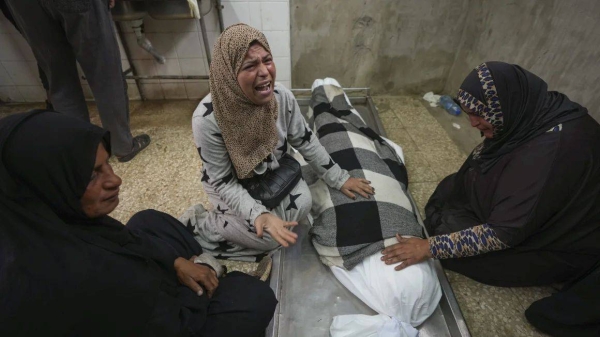
ADEN — Internal displacement inside Yemen could swell to more than 230,000 while renewed fighting in the country could drive 10,000 across the Red Sea to Djibouti, the United Nations has warned.The Iran-aligned Houthi rebels seized control of Yemen’s Red Sea coastline earlier this month in a dramatic offensive that has left hundreds of people on both sides dead, threatened global trade, and pushed up energy prices.Fighting raged in Yemen with the Houthis battling government forces for control of the strategic Kahboub Mountains near the Red Sea coast. The clashes on Monday followed a report by The New York Times that US President Donald Trump had ordered air attacks against the Houthis on Sunday, only to call them off at the last minute.According to witnesses, the Houthis are now battling to take the Kahboub Mountains in Taiz and Lahj provinces. Control of the strategic heights, which overlook the Bab al-Mandeb strait and Mayyun Island in the Red Sea, would allow the Houthis to sever the coast from the remaining government-held south.The New York Times said on Monday that the Trump administration had prepared to launch air attacks on Sunday against the Houthis, but it said Trump called off the attacks at the last minute.Houthi leader Abdel-Malik al-Houthi warned the US against escalation, saying “whoever sympathises with the oppressor … bears all consequences morally, legally, humanely.”Analysts said Trump’s reported reversal underscored his administration’s reluctance to take on a new military commitment in a region where US forces were already stretched thin.The US military has already “expended a good amount of higher-end munitions” and many “interceptors need to be replenished”, said Jason Campbell, a senior fellow at the Middle East Institute.Yemeni government forces, meanwhile, said they struck Houthi fighters and supply lines near the Bab al-Mandeb strait and in al-Bayda governorate, and shot down a Houthi drone in southwestern Taiz.Major General Abdulaziz al-Majidi, chief of staff of the Taiz military force, told the state-run Saba news agency that soldiers and allied tribal fighters “liberated a number of areas” on the outskirts of Taiz after battling Houthi ground forces.The Houthis said Saudi Arabia carried out at least 157 air attacks in the provinces of al-Jawf, Taiz, Saada and Marib on Monday, killing at least one civilian. Another attack in Mocha late on Monday killed six civilians, including two children and a woman, the Houthi-affiliated Al Masirah TV reported.As fighting intensified, the World Health Organization said 674 people had been killed and almost 3,000 injured since August 6, including 164 deaths and 516 injuries between September 13 and 18 alone.The conflict is also driving hunger across Yemen, where more than 18 million people, roughly half of the population, already face acute food shortages.Carl Skau, the acting executive director of the World Food Programme, said “tens of thousands” of people are arriving in “overstretched” camps “with nothing”. He noted that Yemen imports 90 percent of its food, so when ports or airports are not working, “that’s having an impact on food security.”More than 100,000 civilians have been uprooted inside Yemen, while others have risked dangerous sea crossings to escape the violence.“Intensifying fighting in Yemen could drive more mass displacement,” United Nations refugee agency (UNHCR) spokesperson Babar Baloch told reporters in Geneva on Tuesday.More than 3,000 people fled across the Red Sea to Djibouti over several days earlier this month, Djibouti state media reported. The UNHCR said it was bracing for that number to rise significantly, especially after mid-October when the current difficult sea conditions are expected to improve.The agency and its partners are now “planning for more than 10,000 arrivals in Djibouti” in the coming months, Baloch said.At the same time, the number of people displaced within Yemen by the recent fighting could swell from more than 130,000 today to more than 230,000, he said.That comes on top of the more than 5.2 million people who were already internally displaced in Yemen before the fighting resumed.Baloch warned that the renewed conflict was deepening an already dire crisis in the country, where an estimated 22 million people require humanitarian assistance.He warned that a severe funding shortfall was hampering the response to the emergency, with the UNHCR’s Yemen operation currently just 18 percent funded for 2026.The agency estimated that $25 million is urgently needed to provide approximately 231,000 people with immediate aid.Meanwhile, the UNHCR’s Djibouti operations are only 15 percent funded, with the agency appealing for $13.5m “to ensure arrivals can access registration, reception, protection, and other essential services”.A spokesperson for United Nations Secretary-General Antonio Guterres warned that continued fighting risked further damage to Yemen and its people, and said the UN special envoy for Yemen, Hans Grundberg, remained in contact with all parties to the conflict.
Keep Up to Date with our Weekly Newsletter