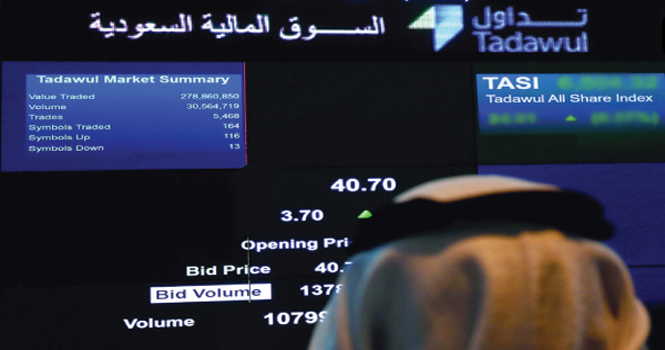
Tadawul trading screen
Saudi Arabia’s Tadawul All Share Index (TASI) ended Q1 2026 up 759 points, or 7.2%, closing at 11,250 points, compared to 10,491 points at the end of Q4 2025. 
In the first three months of 2026, the benchmark index registered the strongest percentage increase since Q4 2023 when it had gained over 8%.
Several key developments shaped Saudi equities during the period. The most prominent is the ongoing US-Israel-Iran war that spooked global oil and equity markets.
Oil prices sloshed across a wide range of $59.7-$119.4 per barrel during Q1 as the Strait of Hormuz shut, cutting global supply.
Separately, Saudi Arabia opened its capital market to all categories of foreign investors, allowing direct investment. The Capital Market Authority (CMA) approved a regulatory framework to enable non-resident foreign investors to access the Main Market.
Meanwhile, the Federal Reserve held interest rates unchanged at 3.50%-3.75% for a second consecutive meeting.
In addition, listed companies posted their annual financial results for 2025 during the three months.
The Finance Ministry published the Kingdom’s 2025 fiscal outturn, with revenues at SAR 1.11 trillion and expenditures at SAR 1.39 trillion, resulting in a deficit of SAR 276.6 billion.
Over the past decade, the market’s quarterly performance has shown sharp swings between gains and losses, reflecting the impact of both domestic and global developments.
Tadawul trading screen
Saudi Arabia’s Tadawul All Share Index (TASI) ended Q1 2026 up 759 points, or 7.2%, closing at 11,250 points, compared to 10,491 points at the end of Q4 2025.
In the first three months of 2026, the benchmark index registered the strongest percentage increase since Q4 2023 when it had gained over 8%.
Several key developments shaped Saudi equities during the period. The most prominent is the ongoing US-Israel-Iran war that spooked global oil and equity markets.
Oil prices sloshed across a wide range of $59.7-$119.4 per barrel during Q1 as the Strait of Hormuz shut, cutting global supply.
Separately, Saudi Arabia opened its capital market to all categories of foreign investors, allowing direct investment. The Capital Market Authority (CMA) approved a regulatory framework to enable non-resident foreign investors to access the Main Market.
Meanwhile, the Federal Reserve held interest rates unchanged at 3.50%-3.75% for a second consecutive meeting.
In addition, listed companies posted their annual financial results for 2025 during the three months.
The Finance Ministry published the Kingdom’s 2025 fiscal outturn, with revenues at SAR 1.11 trillion and expenditures at SAR 1.39 trillion, resulting in a deficit of SAR 276.6 billion.
Over the past decade, the market’s quarterly performance has shown sharp swings between gains and losses, reflecting the impact of both domestic and global developments.