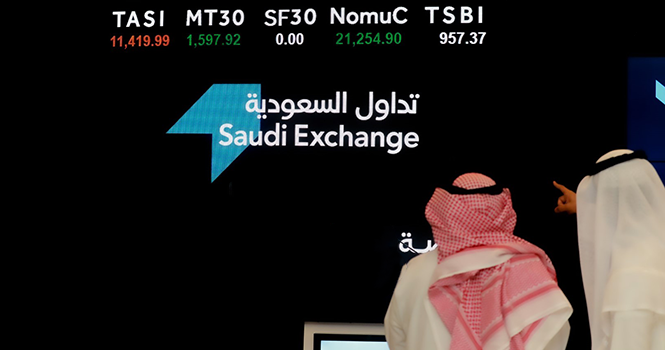
Tadawul All Share Index (TASI) ended the holy month of Ramadan this year down by 1.4%, or 152 points, closing at 10,946 points compared to its opening at 11,098 points. 
Data on the Saudi market’s performance during Ramadan since 2006 show varying trends between rises and declines, with a relative tendency toward positive performance in most years.
The index recorded gains in several seasons, most notably in 2014 (+6.8%), 2017 (+8.1%), and 2023 (+7.9%), along with strong performances in 2020 and 2022.
Conversely, some periods saw notable declines, including 2008 (-14.8%)and 2019 (-7.2%), in addition to modest drops in 2025 (-0.7%) and 2026 (-1.4%).
This indicates that market performance during Ramadan does not follow a fixed pattern but is influenced by economic conditions and global markets each year.
This year, the holy month coincided with the period when listed companies in the Saudi market announced their financial results for 2025, which will end on March 31.
Markets during Ramadan experienced clear pressure amid escalating tensions between the US, Israel, and Iran, pushing oil prices up about 40% since the start of strikes and Brent crude above $100 per barrel.
This is in addition to global stock fluctuations amid fears of supply disruptions through the Strait of Hormuz and rising inflationary pressures.
Tadawul All Share Index (TASI) ended the holy month of Ramadan this year down by 1.4%, or 152 points, closing at 10,946 points compared to its opening at 11,098 points.
Data on the Saudi market’s performance during Ramadan since 2006 show varying trends between rises and declines, with a relative tendency toward positive performance in most years.
The index recorded gains in several seasons, most notably in 2014 (+6.8%), 2017 (+8.1%), and 2023 (+7.9%), along with strong performances in 2020 and 2022.
Conversely, some periods saw notable declines, including 2008 (-14.8%)and 2019 (-7.2%), in addition to modest drops in 2025 (-0.7%) and 2026 (-1.4%).
This indicates that market performance during Ramadan does not follow a fixed pattern but is influenced by economic conditions and global markets each year.
This year, the holy month coincided with the period when listed companies in the Saudi market announced their financial results for 2025, which will end on March 31.
Markets during Ramadan experienced clear pressure amid escalating tensions between the US, Israel, and Iran, pushing oil prices up about 40% since the start of strikes and Brent crude above $100 per barrel.
This is in addition to global stock fluctuations amid fears of supply disruptions through the Strait of Hormuz and rising inflationary pressures.