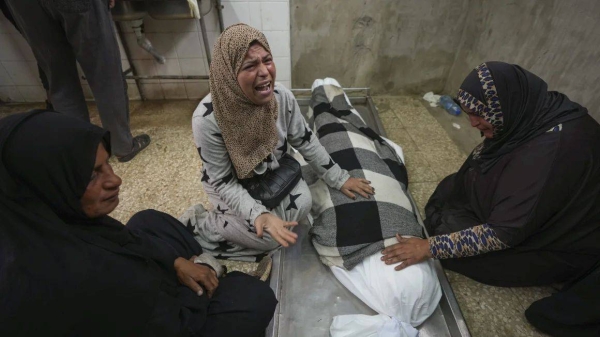
WASHINGTON — US President Donald Trump pledged $10 billion for his new “Board of Peace” as he hosted the first meeting of the amorphous new institution, which was first focused on rebuilding Gaza but has since expanded its scope.The US president also announced that nine other nations have agreed to pledge $7 billion toward a Gaza reconstruction fund and five countries have agreed to deploy troops as part of an international stabilization force for the war-battered Palestinian territory.Although the pledged donations represent a substantial sum, they remain a far cry from the estimated $70 billion needed to rebuild the Palestinian territory, which was reduced to rubble after more than two years of Israel’s offensive in Gaza.The meeting in Washington came amid a broader push by Trump to build a reputation as a peacemaker. It also took place as the United States threatens war against Iran and has embarked on a massive military buildup in the region in case Tehran refuses to give up its nuclear program.In a flurry of announcements at the end of a long, winding speech to representatives from 47 nations, Trump said the United States will contribute $10 billion to the Board of Peace. He did not say where the money would come from or whether he would seek it from the US Congress.The other donors include Saudi Arabia, Bahrain, Qatar, the UAE, Kuwait, Morocco, Kazakhstan, Azerbaijan, and Uzbekistan.The Board’s founding membership does not include some of America’s key Western allies concerned about the scope of the initiative.“Every dollar spent is an investment in stability and the hope of new and harmonious (region),” Trump said during Thursday’s inaugural address.Trump did not go into specifics of how or when the money would be invested. It is also unclear what the $10 billion US contribution to the board will be specifically used for, though a US official said it would be contributed over the coming years.The disarmament of Hamas militants and accompanying withdrawal of Israeli troops, the size of the reconstruction fund and the flow of humanitarian aid to the war-battered populace of Gaza are among the major questions likely to test the effectiveness of the board in the months ahead.Trump faces the unresolved challenge of disarming Hamas, a sticking point that threatens to delay or even derail the Gaza ceasefire plan that his administration notched as a major foreign policy win.Now, there are major questions of how these lofty ambitions will comport with the realities on the ground in Gaza. There have been repeated violations of Trump’s ceasefire, and the humanitarian situation there remains precarious.A member of the board’s executive committee outlined the development potential of the enclave, even as the vast majority of Gaza lies in ruins after nearly two years of Israeli bombardment. FIFA, complete with a flashy and seemingly AI-generated video, previewed “a complete football ecosystem.”In his remarks, Trump, who has sought to lean into the role of peacemaker, did little to assuage concerns about the board’s efforts to supersede the United Nations.“The Board of Peace is going to almost be looking over the United Nations and making sure it runs properly,” he said, adding that the UN has “tremendous potential.”“We’re also going to maybe take it a step further, where we see hot spots around the world, we can probably do that very easily,” Trump said at the conclusion of the Board of Peace meeting, which comes as he considers military action against Iran.Though the UN Security Council resolution that empowered the Board of Peace dealt specifically with Gaza, the founding charter for the group claims its own authority to deal with any theoretical conflict.Roughly four dozen countries had representatives at Thursday’s meeting, but only half of those are members of the board. The other half, including the majority of participants from Europe, were there as observers.“It is clear there are issues with the Board of Peace,” A senior European Union diplomat told reporters in Brussels on Thursday. But in the absence of another mechanism or international organization to shape the future of Gaza, there is no other choice.Many of the traditional US allies have turned down membership on the board amid concerns about its broad mission. There are also concerns about some potential members. Trump added later on Thursday he would like to see Russia and China join the board.Aaron David Miller, a former Middle East negotiator for the US, told CNN that the meeting seemed detached from reality, noting that the demilitarization plan is not ready for “prime time.”There is an understanding among US officials and regional allies that demilitarization will be a long-term process, CNN reported.One US official said the expectation is that the technocratic Palestinian government will facilitate conversations with Hamas on the matter, and although there are efforts ongoing, there is no timeline for it actually taking place.In a statement on Thursday evening, Hamas made no mention at all of disarmament or the demilitarization of Gaza. Instead, it called on the international community to compel Israel fully open the crossings into Gaza and begin reconstruction.It is unclear if the International Stabilization Force (ISF) will deploy before there is demilitarization. According to Trump, Morocco, Albania, Kosovo, and Kazakhstan “have all committed troops and police to stabilize Gaza.”Egypt and Jordan, he added, “are likewise providing very, very substantial help, troops, training and support for a very trustworthy Palestinian police force.”And the board-affiliated National Committee for the Administration of Gaza aims to “restore security via professional civilian police under one authority … including training and developing 5,000 Gazan police to be deployed in 60 days,” committee chair Ali Shaath said at the meeting Thursday.But the committee has been unable to enter Gaza, stuck in Cairo with little power to implement its decisions or govern the enclave in any meaningful way.High Representative Nickolay Mladenov, who serves as the key link between the board and the Palestinian technocratic committee, noted on Thursday that in order to begin reconstruction, “there is no other option” than the full demilitarization of Gaza and the decommissioning of weaponry in the enclave.The initiative has drawn widespread criticism for its vague nature, including on how it would operate alongside, or potentially seek to compete with, existing institutions such as the United Nations.Trump would hold a veto power over most of the Board’s decisions, a level of centralized control that is unprecedented in international institutions, and can remain head of the initiative even after leaving office. Other countries, meanwhile, would have to pay $1 billion if they want to stay on permanently.The inaugural meeting of the “Board of Peace” came as Trump issued fresh threats towards Iran. Also on Thursday, multiple US media reports said US officials estimate the military will be ready to strike Iran within days, as Trump weighs out his next move.Any US military operation would likely be a massive, weeks-long campaign conducted jointly with Israel, sources told US media outlets, and the Trump administration was “closer than most Americans realise” to a major war in the Middle East.Most countries sent high-level officials to the Board’s meeting, but a few world leaders including Indonesian President Prabowo Subianto, Argentinian President Javier Milei, and Hungarian President Viktor Orbán, attended the inauguration in Washington themselves. FIFA President Gianni Infantino was also in attendance.EU Commissioner for the Mediterranean Dubravka Šuica was in Washington as an observer, which drew the ire of many in Europe who warned that her presence risked being interpreted as a collective endorsement of the controversial body.France led calls for the European Commission to explain Šuica’s presence, with Belgium, Spain, Ireland, Slovenia, Sweden and Portugal also raising objections. — Agencies
Keep Up to Date with our Weekly Newsletter