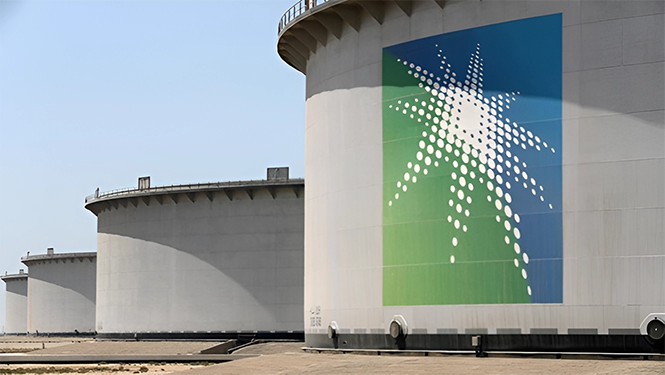
Saudi Aramco’s oil tanks
Saudi Aramco has started production at the Jafurah field, the largest unconventional gas field in the Middle East, and launched operations at the Tanajib gas plant, one of the world’s largest gas processing facilities. 
Aramco aims to increase sales gas production by about 80% by 2030 versus 2021, targeting nearly 6 million barrels of oil equivalent per day from total gas and associated liquids output.
The expansion could generate $12–15 billion in additional operational cash flow by 2030, depending on future gas demand and liquids pricing.
“Starting production at Jafurah and commissioning Tanajib significantly strengthens Aramco’s gas portfolio and expands our capacity at scale,” said Amin Nasser, Aramco President and CEO. “These projects are a major step forward for the company and the Kingdom’s energy future. They are expected to generate substantial earnings, meet rising domestic gas demand, support development across key sectors, and produce large volumes of high-value liquids.”
Jafurah
Gas from Jafurah will support Saudi Arabia’s growth in energy, AI, heavy industry, and petrochemicals, boosting the economy and reinforcing the Kingdom’s position among the world’s top 10 gas producers.
Production of unconventional shale gas began in December 2025, with advanced technology unlocking the field’s potential, reducing drilling costs, improving well productivity, and setting a global benchmark while strengthening economic prospects.
Jafurah spans 17,000 km², with reserves of 229 trillion standard cubic feet of gas and 75 billion barrels of condensates. By 2030, it aims to produce 2 billion standard cubic feet per day (scfd) of sales gas, 420 million standard cubic feet (scf) of ethane per day, and 630,000 barrels per day (bpd) of gas liquids and condensates.
Tanajib
Tanajib is central to Aramco’s plan to expand gas processing and diversify its energy portfolio, supporting long-term economic growth; operations began in December 2025, with capacity set to reach 2.6 billion standard cubic feet per day in 2026, coinciding with production at the Marjan field expansion, and the plant features digital integration, high efficiency, complex project execution, optimized resource use, and processes associated gas from the Marjan and Zuluf offshore fields.
Growth and Opportunities
Aramco’s gas expansion is expected to create thousands of direct and indirect jobs. It also supports Saudi Arabia’s move toward an optimal electricity fuel mix and replacing liquid fuels.
In October 2025, Aramco signed an $11 billion lease-and-leaseback investment for Jafurah gas facilities with a consortium led by Global Infrastructure Partners (GIP), affiliated with BlackRock.
Phase 1 of the Jafurah gas plant, producing 450 million standard cubic feet per day, has been completed. Sustainable output is expected to reach 2 billion scfd by 2030.
Saudi Aramco’s oil tanks
Saudi Aramco has started production at the Jafurah field, the largest unconventional gas field in the Middle East, and launched operations at the Tanajib gas plant, one of the world’s largest gas processing facilities.
Aramco aims to increase sales gas production by about 80% by 2030 versus 2021, targeting nearly 6 million barrels of oil equivalent per day from total gas and associated liquids output.
The expansion could generate $12–15 billion in additional operational cash flow by 2030, depending on future gas demand and liquids pricing.
“Starting production at Jafurah and commissioning Tanajib significantly strengthens Aramco’s gas portfolio and expands our capacity at scale,” said Amin Nasser, Aramco President and CEO. “These projects are a major step forward for the company and the Kingdom’s energy future. They are expected to generate substantial earnings, meet rising domestic gas demand, support development across key sectors, and produce large volumes of high-value liquids.”
Jafurah
Gas from Jafurah will support Saudi Arabia’s growth in energy, AI, heavy industry, and petrochemicals, boosting the economy and reinforcing the Kingdom’s position among the world’s top 10 gas producers.
Production of unconventional shale gas began in December 2025, with advanced technology unlocking the field’s potential, reducing drilling costs, improving well productivity, and setting a global benchmark while strengthening economic prospects.
Jafurah spans 17,000 km², with reserves of 229 trillion standard cubic feet of gas and 75 billion barrels of condensates. By 2030, it aims to produce 2 billion standard cubic feet per day (scfd) of sales gas, 420 million standard cubic feet (scf) of ethane per day, and 630,000 barrels per day (bpd) of gas liquids and condensates.
Tanajib
Tanajib is central to Aramco’s plan to expand gas processing and diversify its energy portfolio, supporting long-term economic growth; operations began in December 2025, with capacity set to reach 2.6 billion standard cubic feet per day in 2026, coinciding with production at the Marjan field expansion, and the plant features digital integration, high efficiency, complex project execution, optimized resource use, and processes associated gas from the Marjan and Zuluf offshore fields.
Growth and Opportunities
Aramco’s gas expansion is expected to create thousands of direct and indirect jobs. It also supports Saudi Arabia’s move toward an optimal electricity fuel mix and replacing liquid fuels.
In October 2025, Aramco signed an $11 billion lease-and-leaseback investment for Jafurah gas facilities with a consortium led by Global Infrastructure Partners (GIP), affiliated with BlackRock.
Phase 1 of the Jafurah gas plant, producing 450 million standard cubic feet per day, has been completed. Sustainable output is expected to reach 2 billion scfd by 2030.