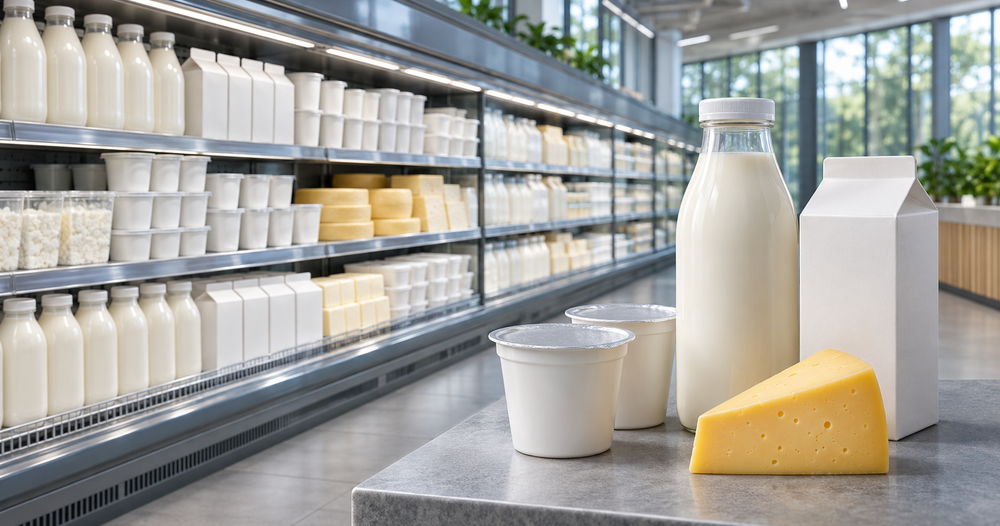
Dairy products for display at a supermarket.
Saudia Dairy and Foodstuff Company (SADAFCO) is raising the price of its long-life milk by the same half riyal on three pack sizes. 
That flat rise is steep on a small pack and modest on a large one: 14.3% on the 500ml pack, but only 4.3% on the two-litre.
Whether it pays for the company’s higher freight bill depends on two things: which packs shoppers buy, and how much of the higher shelf price SADAFCO keeps after discounts and rebates.
The 500ml pack goes from SAR3.50 to SAR4.00, the one-litre from SAR6.00 to SAR6.50, an 8.3% rise, and the two-litre from SAR11.50 to SAR12.00. Per litre, that adds SAR1.00 on the smallest pack and SAR0.25 on the largest.
SADAFCO says the products whose prices are rising make up about 40% of its range by value. Some smaller packs and flavoured milks keep their current prices.
Why it matters
Saudi Arabia is where this decision counts. Saudi customers accounted for 81.5% of SADAFCO’s revenue in the first nine months of 2026, and the company puts its share of the Kingdom’s plain long-life milk market at about 60%.
Its pricing therefore shapes most of that market.
The timing matters too. SADAFCO expects to carry three full months of higher sea freight in the fourth quarter, before the new prices fully apply in the first quarter of 2027.
Results over the next two quarters will show how much of the extra cost it recovers, and whether shoppers move to larger packs or switch brands.
When higher freight costs reach earnings
SADAFCO is heavily exposed to shipping costs. It bought 83% of its raw materials from abroad, according to its 2024 sustainability report, and shipping surcharges have ranged from $2,000 to $6,000 a container, depending on where the goods come from.
The company estimates the extra sea freight at SAR15 million to SAR20 million for each full quarter.
Those costs reach profits with a delay. Freight paid on raw materials stays in the value of stock until the finished milk is sold.
Stock already on hand and shipments already at sea softened the first months. SADAFCO says the higher freight began feeding into its costs in June and weighed more heavily in the third quarter.
Prices will catch up gradually. SADAFCO is phasing in the increases through the fourth quarter, as its agreements with retailers and distributors allow.
It describes them as permanent and expects them to offset part of a wider rise in costs, including operating and energy expenses.
How big a rise is needed
On our sums, a full quarter of extra freight would equal 2.2% to 2.9% of SADAFCO’s third-quarter revenue of SAR678.5 million.
The cost falls on a narrower base, though, because only some products are getting dearer.
Taking SADAFCO’s 40% figure as a rough guide to their share of sales gives a base of about SAR271.4 million.
To cover the freight from those products alone, what SADAFCO receives for them, after discounts and rebates, would need to rise by 5.5% to 7.4%, assuming it sells the same volumes and the same mix of pack sizes.
Measured that way, the rises on the 500ml and one-litre packs clear the bar, and the rise on the two-litre pack falls short.
That is not proof the costs will be recovered. These are shelf prices, and what SADAFCO actually receives may differ. The outcome also depends on which packs shoppers buy.
Margins before the price increases
Before the price rises, the margin on SADAFCO’s main business was already slipping.
Leaving out Mlekoma, its Polish subsidiary, gross margin, the share of revenue left after the cost of the goods sold, edged down from 33.4% to 33.2% in the third quarter.
Metric
Q3 2025
Q3 2026
YoY change
Group revenue (SAR million)
790.35
678.51
−14.2%
Group gross profit (SAR million)
223.42
207.74
−7.0%
Group gross margin
28.3%
30.6%
+2.3 pp
Gross margin excluding Mlekoma
33.4%
33.2%
−0.2 pp
The group figure points the other way, mostly because of Mlekoma. Group gross margin rose from 28.3% to 30.6%, because revenue fell faster than gross profit. Mlekoma moved towards higher-margin products, and its share of group revenue fell from roughly 16% to 9%, so its lower margin counted for less in the group total.
SADAFCO put the fall in gross profit down to higher costs for raw materials, freight and fuel, and to sales disruption after it introduced new company-wide management software from SAP in September.
It estimates the disruption cut third-quarter revenue by SAR80 million to SAR100 million. Adding that back would give SAR758.5 million to SAR778.5 million, still 1.5% to 4.0% below a year earlier. These are illustrative figures, not reported revenue.
How competitors’ pricing shapes the outcome
Much depends on what rivals do. Almarai said on its second-quarter earnings call in July that it had raised prices for fresh dairy.
SADAFCO said in August that rivals in long-life milk had cut back on promotions, but by November it had yet to see them raise list prices.
Past episodes show how much competitors’ pricing matters. In 2021, NADEC could not pass on higher feed, fuel and logistics costs while the largest competitors held their prices, according to its 2023 rights issue prospectus.
In 2022, it raised average prices by 15% for dairy products and fresh juices, and by 20% for long-life dairy products.
SADAFCO raised prices once in 2021 and twice in 2022 to cover higher input costs, and in October 2022 its chief executive said the increases, then at 20%, were in line with competitors’. Its margin later recovered.
In the nine months to 31 December 2023, gross profit rose 20.8% on sales growth of 6.7%, lifting gross margin to 35.6% from 31.4%. SADAFCO credited lower raw material costs, a better product and category mix, and factory efficiencies.
What to watch
Pack sizes matter. If shoppers move to larger packs, the new prices would offset less of the freight cost, even if SADAFCO sells as many litres.
The first quarter of 2027, when the new prices should be fully in place, will give a clearer picture. Three figures will show it: what SADAFCO receives per unit after discounts, the volumes it sells, and gross margin excluding Mlekoma.
Any easing in freight costs will take time to show, because stock bought at higher cost has to be sold first.
Editorial Note
We publish without bylines. Our research is produced collectively — analysts, editors and data specialists working on the same questions — and the findings reflect the judgement of the team rather than of any individual.
This is a deliberate choice. It keeps the argument, rather than its author, as the thing a reader weighs.
Every figure here was computed by Argaam analysts from the sources cited, and is reproducible from them. The analysis and conclusions are the team’s own. Charts were rendered with AI assistance. Methodology and workbook available to subscribers; questions to intelligence@argaam.com.
Dairy products for display at a supermarket.
Saudia Dairy and Foodstuff Company (SADAFCO) is raising the price of its long-life milk by the same half riyal on three pack sizes.
That flat rise is steep on a small pack and modest on a large one: 14.3% on the 500ml pack, but only 4.3% on the two-litre.
Whether it pays for the company’s higher freight bill depends on two things: which packs shoppers buy, and how much of the higher shelf price SADAFCO keeps after discounts and rebates.
The 500ml pack goes from SAR3.50 to SAR4.00, the one-litre from SAR6.00 to SAR6.50, an 8.3% rise, and the two-litre from SAR11.50 to SAR12.00. Per litre, that adds SAR1.00 on the smallest pack and SAR0.25 on the largest.
SADAFCO says the products whose prices are rising make up about 40% of its range by value. Some smaller packs and flavoured milks keep their current prices.
Why it matters
Saudi Arabia is where this decision counts. Saudi customers accounted for 81.5% of SADAFCO’s revenue in the first nine months of 2026, and the company puts its share of the Kingdom’s plain long-life milk market at about 60%.
Its pricing therefore shapes most of that market.
The timing matters too. SADAFCO expects to carry three full months of higher sea freight in the fourth quarter, before the new prices fully apply in the first quarter of 2027.
Results over the next two quarters will show how much of the extra cost it recovers, and whether shoppers move to larger packs or switch brands.
When higher freight costs reach earnings
SADAFCO is heavily exposed to shipping costs. It bought 83% of its raw materials from abroad, according to its 2024 sustainability report, and shipping surcharges have ranged from $2,000 to $6,000 a container, depending on where the goods come from.
The company estimates the extra sea freight at SAR15 million to SAR20 million for each full quarter.
Those costs reach profits with a delay. Freight paid on raw materials stays in the value of stock until the finished milk is sold.
Stock already on hand and shipments already at sea softened the first months. SADAFCO says the higher freight began feeding into its costs in June and weighed more heavily in the third quarter.
Prices will catch up gradually. SADAFCO is phasing in the increases through the fourth quarter, as its agreements with retailers and distributors allow.
It describes them as permanent and expects them to offset part of a wider rise in costs, including operating and energy expenses.
How big a rise is needed
On our sums, a full quarter of extra freight would equal 2.2% to 2.9% of SADAFCO’s third-quarter revenue of SAR678.5 million.
The cost falls on a narrower base, though, because only some products are getting dearer.
Taking SADAFCO’s 40% figure as a rough guide to their share of sales gives a base of about SAR271.4 million.
To cover the freight from those products alone, what SADAFCO receives for them, after discounts and rebates, would need to rise by 5.5% to 7.4%, assuming it sells the same volumes and the same mix of pack sizes.
Measured that way, the rises on the 500ml and one-litre packs clear the bar, and the rise on the two-litre pack falls short.
That is not proof the costs will be recovered. These are shelf prices, and what SADAFCO actually receives may differ. The outcome also depends on which packs shoppers buy.
Margins before the price increases
Before the price rises, the margin on SADAFCO’s main business was already slipping.
Leaving out Mlekoma, its Polish subsidiary, gross margin, the share of revenue left after the cost of the goods sold, edged down from 33.4% to 33.2% in the third quarter.
Metric
Q3 2025
Q3 2026
YoY change
Group revenue (SAR million)
790.35
678.51
−14.2%
Group gross profit (SAR million)
223.42
207.74
−7.0%
Group gross margin
28.3%
30.6%
+2.3 pp
Gross margin excluding Mlekoma
33.4%
33.2%
−0.2 pp
The group figure points the other way, mostly because of Mlekoma. Group gross margin rose from 28.3% to 30.6%, because revenue fell faster than gross profit. Mlekoma moved towards higher-margin products, and its share of group revenue fell from roughly 16% to 9%, so its lower margin counted for less in the group total.
SADAFCO put the fall in gross profit down to higher costs for raw materials, freight and fuel, and to sales disruption after it introduced new company-wide management software from SAP in September.
It estimates the disruption cut third-quarter revenue by SAR80 million to SAR100 million. Adding that back would give SAR758.5 million to SAR778.5 million, still 1.5% to 4.0% below a year earlier. These are illustrative figures, not reported revenue.
How competitors’ pricing shapes the outcome
Much depends on what rivals do. Almarai said on its second-quarter earnings call in July that it had raised prices for fresh dairy.
SADAFCO said in August that rivals in long-life milk had cut back on promotions, but by November it had yet to see them raise list prices.
Past episodes show how much competitors’ pricing matters. In 2021, NADEC could not pass on higher feed, fuel and logistics costs while the largest competitors held their prices, according to its 2023 rights issue prospectus.
In 2022, it raised average prices by 15% for dairy products and fresh juices, and by 20% for long-life dairy products.
SADAFCO raised prices once in 2021 and twice in 2022 to cover higher input costs, and in October 2022 its chief executive said the increases, then at 20%, were in line with competitors’. Its margin later recovered.
In the nine months to 31 December 2023, gross profit rose 20.8% on sales growth of 6.7%, lifting gross margin to 35.6% from 31.4%. SADAFCO credited lower raw material costs, a better product and category mix, and factory efficiencies.
What to watch
Pack sizes matter. If shoppers move to larger packs, the new prices would offset less of the freight cost, even if SADAFCO sells as many litres.
The first quarter of 2027, when the new prices should be fully in place, will give a clearer picture. Three figures will show it: what SADAFCO receives per unit after discounts, the volumes it sells, and gross margin excluding Mlekoma.
Any easing in freight costs will take time to show, because stock bought at higher cost has to be sold first.
Editorial Note
We publish without bylines. Our research is produced collectively — analysts, editors and data specialists working on the same questions — and the findings reflect the judgement of the team rather than of any individual.
This is a deliberate choice. It keeps the argument, rather than its author, as the thing a reader weighs.
Every figure here was computed by Argaam analysts from the sources cited, and is reproducible from them. The analysis and conclusions are the team’s own. Charts were rendered with AI assistance. Methodology and workbook available to subscribers; questions to intelligence@argaam.com.