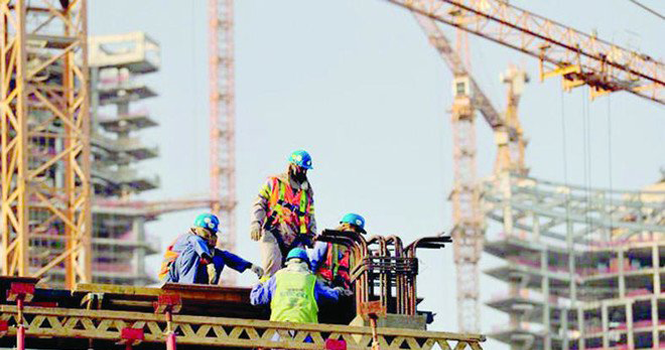
Workers at a high-rise construction site in Saudi Arabia
For developers in Makkah and Madinah, the new property ownership law has already brought non-Saudi demand. 
What it will add to their revenue is not yet clear, and that is the question their shareholders need answered.
Between a buyer’s deposit and a developer’s profit sit three more steps. The buyer must sign a formal contract.
The developer then counts the sale in its results, often a portion at a time as the home is built, rather than all at once.
And the buyer pays what is still owed after the deposit, often in instalments while the home is being built.
These steps run on different timetables, so a reservation made today can take months, or longer, to show up fully in a developer’s revenue and cash.
That demand follows a change in the rules. A new property ownership law, in force since 22 January 2026, gives eligible non-Saudis more ways to own property across the Kingdom. The Cabinet approved the regulations that put it into practice on 23 June, and they were published on 3 July.
In designated areas of Makkah and Madinah, non-Saudi individuals must be Muslim and meet further conditions. For them, the law opens the door to a home or a hotel residence near the holy sites.
The clearest sign of that demand so far is in Madinah. On 23 July, three weeks after the regulations were published, Knowledge Economic City (KEC) said non-Saudi customers had paid deposits to reserve 231 homes at its Al-Alya project, priced at SAR547.7 million in total.
That was about 22% of the 1,052 homes then licensed for sale before completion. None of those buyers had yet signed a formal contract.
KEC’s third-quarter results, published in November, are the first chance to see how far that demand has moved through those steps. In Makkah, the story is at an earlier stage: Jabal Omar is preparing to sell hotel residences it has already built.
Behind KEC’s doubled revenue
KEC’s headline figure says less about homes than it seems to. Third-quarter revenue nearly doubled from a year earlier, to SAR245.1 million from SAR123.3 million.
But a single land sale to a real estate fund brought in SAR169.6 million, or 69% of the total. That sale tells shareholders nothing about non-Saudi demand for homes.
The figure that matters is residential revenue. In a 10 November release, KEC reported SAR65.8 million for the quarter, up from SAR16.8 million in the second quarter, and most of what remains once the land sale is taken out.
Management linked the recovery to the new law. A newly opened hotel added revenue too. That is the first sign of the new demand reaching KEC’s revenue. It is not yet proof.
The residential figure is a total, and it does not show how much came from non-Saudi buyers. The July update left the same gap.
It listed 351 homes worth SAR520.7 million as sold, with all sale procedures complete, but did not say how many of those sales went to non-Saudi buyers, how much any buyer had paid, or how many of the customers who reserved homes had only just become eligible.
Nor do the results show how many of the 231 reservations had become contracts by the end of September.
KEC’s September update repeated the July figures. In October, it signed agreements with brokers to market about 368 homes, but gave no new sales count.
Shareholders know the demand was there in July. They do not yet know how much of it has become signed sales.
Why the accounts lag the demand
KEC’s own accounts show why the answer will take time to reach its results. Its 2025 financial statements say it records revenue from residential sales in stages as construction progresses, once a contract meets its accounting criteria.
That revenue can appear before buyers take possession of their homes, and before they make their final payment.
A reservation made in July can therefore reach KEC’s revenue gradually, as the homes are built, and its cash on a different timetable again.
Two ways to sell property in Makkah
In Makkah, Umm Al Qura for Development and Construction (Masar), the developer of Masar Destination, sits one step further from the new buyers.
Its third-quarter revenue rose 29.4% to SAR1.64 billion, which it attributed to land sales. It also named non-Saudi ownership as a source of future growth.
Its land sales cannot yet show that growth. Masar was selling plots before the implementing regulations were approved in June, and its customers include developers that will build on the land, not the people who will eventually buy the homes and hotel residences.
Its latest deal follows the same pattern. On 1 November, it signed sale agreements for three plots reserved in July, worth SAR441.1 million, with a real estate fund vehicle as the buyer.
For Masar, any non-Saudi demand would show up indirectly, in what developers are willing to pay for its land.
Jabal Omar Development is taking the most direct route of the three. It is selling hotel residences that already exist, so there is no construction to wait for.
In June, it said it aimed, subject to approvals, to offer 400 of them in 2026 and use most of the proceeds to pay down debt. For its shareholders, the sales would matter in two ways: as revenue, and as a way to reduce debt.
None of that is in the numbers yet. Jabal Omar’s third-quarter revenue growth came mainly from hotel and commercial operations, including the new Rotana hotel.
On 8 November, it announced its first agreement with a broker to sell selected luxury hotel units, starting with Address Jabal Omar Makkah. That gives it a way to reach buyers, but the announcement gave no figures for completed sales or proceeds.
What the next results will show
The law has brought demand. How much it will add to earnings is not yet visible. Al-Alya’s paid reservations are the strongest sign in these disclosures that non-Saudi buyers are willing to put money down.
But the third-quarter figures do not show how much the law will add to any of the three developers’ earnings, and each will find out at a different pace. KEC will record its sales gradually, as it builds.
Masar would feel the law mainly through what developers pay for its land. Jabal Omar, selling finished residences, could see the effect soonest, but has yet to report a sale.
The coming disclosures will show how much of that demand becomes contracts, revenue and cash, and how quickly.
By the end of the year, watch for Jabal Omar’s first completed sales of hotel residences, and for an update on how many Al-Alya reservations have become signed contracts.
The full-year results, due by 31 March 2027, will be the first place to look for the value of signed Al-Alya sales and the cash KEC has collected, any detail on who is buying Masar’s land, and whether Jabal Omar has used sale proceeds to cut debt.
After that, keep following Al-Alya. KEC is building it in phases and plans to hand over homes in batches.
Editorial Note
We publish without bylines. Our research is produced collectively — analysts, editors and data specialists working on the same questions — and the findings reflect the judgement of the team rather than of any individual.
This is a deliberate choice. It keeps the argument, rather than its author, as the thing a reader weighs.
Every figure here was computed by Argaam analysts from the sources cited, and is reproducible from them. The analysis and conclusions are the team’s own, and we take responsibility for them. Charts were rendered with AI assistance. Methodology and workbook available to subscribers; questions to intelligence@argaam.com.
Workers at a high-rise construction site in Saudi Arabia
For developers in Makkah and Madinah, the new property ownership law has already brought non-Saudi demand.
What it will add to their revenue is not yet clear, and that is the question their shareholders need answered.
Between a buyer’s deposit and a developer’s profit sit three more steps. The buyer must sign a formal contract.
The developer then counts the sale in its results, often a portion at a time as the home is built, rather than all at once.
And the buyer pays what is still owed after the deposit, often in instalments while the home is being built.
These steps run on different timetables, so a reservation made today can take months, or longer, to show up fully in a developer’s revenue and cash.
That demand follows a change in the rules. A new property ownership law, in force since 22 January 2026, gives eligible non-Saudis more ways to own property across the Kingdom. The Cabinet approved the regulations that put it into practice on 23 June, and they were published on 3 July.
In designated areas of Makkah and Madinah, non-Saudi individuals must be Muslim and meet further conditions. For them, the law opens the door to a home or a hotel residence near the holy sites.
The clearest sign of that demand so far is in Madinah. On 23 July, three weeks after the regulations were published, Knowledge Economic City (KEC) said non-Saudi customers had paid deposits to reserve 231 homes at its Al-Alya project, priced at SAR547.7 million in total.
That was about 22% of the 1,052 homes then licensed for sale before completion. None of those buyers had yet signed a formal contract.
KEC’s third-quarter results, published in November, are the first chance to see how far that demand has moved through those steps. In Makkah, the story is at an earlier stage: Jabal Omar is preparing to sell hotel residences it has already built.
Behind KEC’s doubled revenue
KEC’s headline figure says less about homes than it seems to. Third-quarter revenue nearly doubled from a year earlier, to SAR245.1 million from SAR123.3 million.
But a single land sale to a real estate fund brought in SAR169.6 million, or 69% of the total. That sale tells shareholders nothing about non-Saudi demand for homes.
The figure that matters is residential revenue. In a 10 November release, KEC reported SAR65.8 million for the quarter, up from SAR16.8 million in the second quarter, and most of what remains once the land sale is taken out.
Management linked the recovery to the new law. A newly opened hotel added revenue too. That is the first sign of the new demand reaching KEC’s revenue. It is not yet proof.
The residential figure is a total, and it does not show how much came from non-Saudi buyers. The July update left the same gap.
It listed 351 homes worth SAR520.7 million as sold, with all sale procedures complete, but did not say how many of those sales went to non-Saudi buyers, how much any buyer had paid, or how many of the customers who reserved homes had only just become eligible.
Nor do the results show how many of the 231 reservations had become contracts by the end of September.
KEC’s September update repeated the July figures. In October, it signed agreements with brokers to market about 368 homes, but gave no new sales count.
Shareholders know the demand was there in July. They do not yet know how much of it has become signed sales.
Why the accounts lag the demand
KEC’s own accounts show why the answer will take time to reach its results. Its 2025 financial statements say it records revenue from residential sales in stages as construction progresses, once a contract meets its accounting criteria.
That revenue can appear before buyers take possession of their homes, and before they make their final payment.
A reservation made in July can therefore reach KEC’s revenue gradually, as the homes are built, and its cash on a different timetable again.
Two ways to sell property in Makkah
In Makkah, Umm Al Qura for Development and Construction (Masar), the developer of Masar Destination, sits one step further from the new buyers.
Its third-quarter revenue rose 29.4% to SAR1.64 billion, which it attributed to land sales. It also named non-Saudi ownership as a source of future growth.
Its land sales cannot yet show that growth. Masar was selling plots before the implementing regulations were approved in June, and its customers include developers that will build on the land, not the people who will eventually buy the homes and hotel residences.
Its latest deal follows the same pattern. On 1 November, it signed sale agreements for three plots reserved in July, worth SAR441.1 million, with a real estate fund vehicle as the buyer.
For Masar, any non-Saudi demand would show up indirectly, in what developers are willing to pay for its land.
Jabal Omar Development is taking the most direct route of the three. It is selling hotel residences that already exist, so there is no construction to wait for.
In June, it said it aimed, subject to approvals, to offer 400 of them in 2026 and use most of the proceeds to pay down debt. For its shareholders, the sales would matter in two ways: as revenue, and as a way to reduce debt.
None of that is in the numbers yet. Jabal Omar’s third-quarter revenue growth came mainly from hotel and commercial operations, including the new Rotana hotel.
On 8 November, it announced its first agreement with a broker to sell selected luxury hotel units, starting with Address Jabal Omar Makkah. That gives it a way to reach buyers, but the announcement gave no figures for completed sales or proceeds.
What the next results will show
The law has brought demand. How much it will add to earnings is not yet visible. Al-Alya’s paid reservations are the strongest sign in these disclosures that non-Saudi buyers are willing to put money down.
But the third-quarter figures do not show how much the law will add to any of the three developers’ earnings, and each will find out at a different pace. KEC will record its sales gradually, as it builds.
Masar would feel the law mainly through what developers pay for its land. Jabal Omar, selling finished residences, could see the effect soonest, but has yet to report a sale.
The coming disclosures will show how much of that demand becomes contracts, revenue and cash, and how quickly.
By the end of the year, watch for Jabal Omar’s first completed sales of hotel residences, and for an update on how many Al-Alya reservations have become signed contracts.
The full-year results, due by 31 March 2027, will be the first place to look for the value of signed Al-Alya sales and the cash KEC has collected, any detail on who is buying Masar’s land, and whether Jabal Omar has used sale proceeds to cut debt.
After that, keep following Al-Alya. KEC is building it in phases and plans to hand over homes in batches.
Editorial Note
We publish without bylines. Our research is produced collectively — analysts, editors and data specialists working on the same questions — and the findings reflect the judgement of the team rather than of any individual.
This is a deliberate choice. It keeps the argument, rather than its author, as the thing a reader weighs.
Every figure here was computed by Argaam analysts from the sources cited, and is reproducible from them. The analysis and conclusions are the team’s own, and we take responsibility for them. Charts were rendered with AI assistance. Methodology and workbook available to subscribers; questions to intelligence@argaam.com.