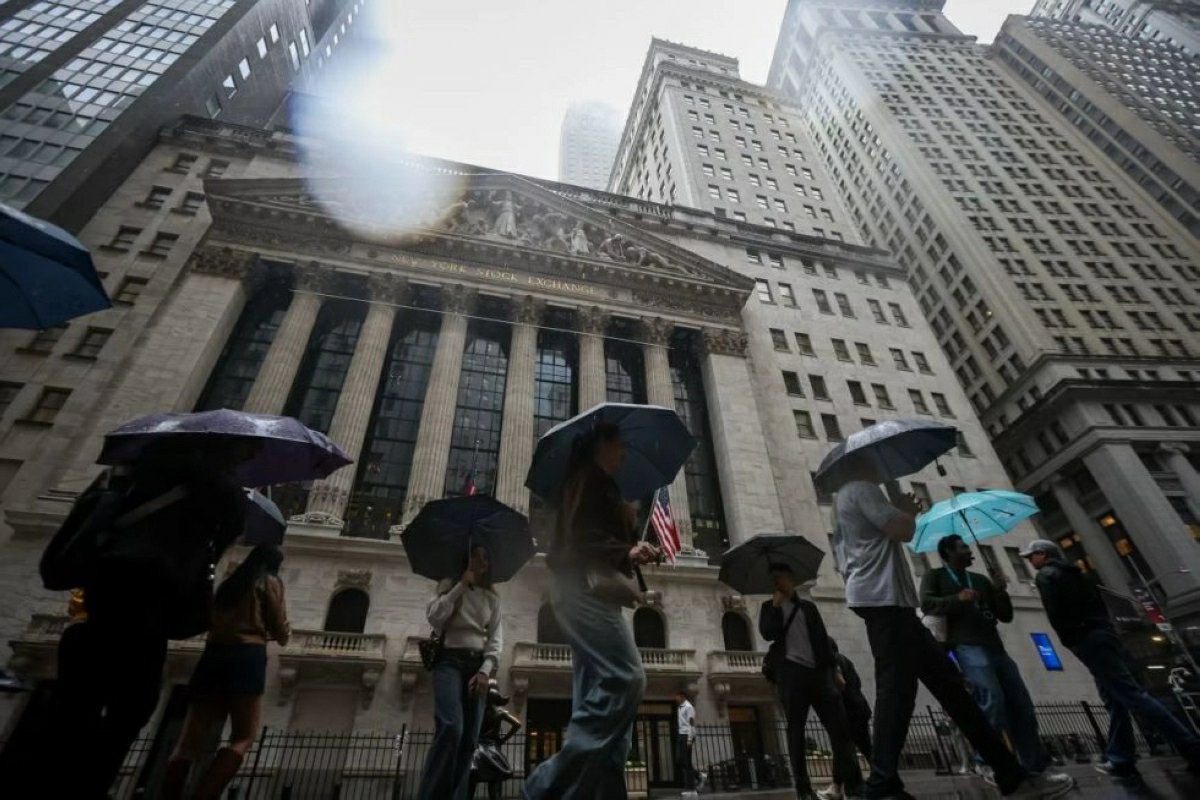
NEW YORK —The artificial intelligence boom is a bubble that will likely burst and cause a recession prior to the 2028 presidential election in the United States, according to Gary Gensler, a former head of the US Securities and Exchange Commission (SEC).“It’s already a bubble,” Gensler, who was the point person overseeing US capital markets during the Biden administration, told CNN in an interview.Gensler’s warning comes at a precarious moment for the AI industry following a cascading series of shocks in recent weeks.Democrats’ stunning midterm victories raised fears among investors of a looming crackdown on the data centers at the heart of the AI buildout.Washington and Wall Street are still feeling the shockwaves caused by the stunning downfall of Nvidia’s Jensen Huang, the most important person in the industry. And now a critical test looms: Anthropic is attempting to pull off a record-shattering IPO in the face of these headwinds.Gensler, who led the SEC from 2021 until 2025, pointed to the mind-boggling amounts of money – by some estimates $800 billion a year – being plowed into building AI infrastructure.“History tells us that when you have a new technology and a significant investment…you come to a point where it plateaus. It retrenches,” said Gensler. “The only question is if it’s a soft recession or something more dramatic.”The comments appear to make Gensler the most senior former federal regulator to publicly warn that an AI-fueled recession may be on the way.But his words of caution echo similar AI bubble-bursting warnings from prominent individuals on Wall Street and academics, including hedge fund billionaire Ray Dalio, Harvard economist Kenneth Rogoff and investor Mike Novogratz.Gensler, now a professor at MIT, pointed to past examples of transformative technologies over centuries that experienced powerful downturns after infrastructure was funded in anticipation of revenue.“That railroad boom-to-bubble was quite an adventure, and it led to really deep recessions, depressions. The 1920s with electricity, the 1990s with the internet,” Gensler said.With AI, companies have scrambled to sink enormous sums of money into building data centers, buying cutting-edge computer chips and other equipment.There is a race to build the smartest models and the best chips to cash in on an epic gold rush on Wall Street and to beat China in a high-stakes arms race for tech superiority.But money is pouring in to this space faster than the ability to turn a profit – an unsustainable mismatch that must eventually come into balance, one way or another.All of this raises the specter of companies overinvesting and piling on too much debt.“The Big Tech companies are spending five times more in 2026 than they were just three years ago…It’s just the extraordinary size of it all,” Gensler said.Nvidia’s financial tentacles reach almost every corner of the AI ecosystem, to the point that the company has been dubbed the central bank of AI, with Huang its chairman – until his sudden exit last week.It’s not just the spending that worries AI skeptics. It’s how this binge is being funded.Gensler, who served as chairman of the Commodity Futures Trading Commission during the Obama administration, expressed concern that some of this spending has been hidden from view. He pointed to circular financing and complex, off-balance sheet financing that make it difficult to understand just how much risk is being taken on.“One might question why all the lenders are lending all this money,” Gensler said. “I think history will show that they loaned too much money, too fast. And that’s the nature of these types of booms that become bursted bubbles.”Gensler pointed to neoclouds, the specialized cloud-based platforms that lease out massive amounts of specialized supercomputing brainpower to AI developers.The problem is that some of these companies have built their businesses on a mountain of debt and their business models are vulnerable to sudden shifts.“The major companies will survive. It’s these neocloud companies where we’re going to see some breakage and bankruptcies,” Gensler said.Elon Musk ominously warned that the 200-plus existing neoclouds will experience “guppy-level death and consolidation.”“Some will make it through, but not many,” Musk said in a post on X last month.Of course, not all bursted bubbles cause recessions – and not all of them are severe.Gensler said he expects the magnitude of this potential downturn to be “as significant as” the dot-com bubble bursting in the early 2000s but not “as harsh as” the subprime mortgage meltdown that led to the 2008 financial crisis.And just as the Great Recession served as a powerful backdrop to the 2008 race for the White House, Gensler said this potential downturn could arrive at a critical time in the political calendar.“I think we’re going to have this repricing and a softening of the economy that happens before November 2028,” he said.Of course, many on Wall Street believe the past few weeks prove how durable the AI boom really is.AI stocks have lost significant altitude but they have not imploded and investors have not panicked – despite the recent shocks.“What we’re seeing here is the air coming out of the bubble. It doesn’t have to burst,” said Ed Yardeni, president of Yardeni Research. “I don’t see this as a bubble that bursts. It’s a self-correcting bubble. Every now and then you get a swoon in the AI trade.”Yardeni, who was the top economist at Deutsche Bank during the bursting of the dot-com bubble, conceded that Gensler’s warning is a “plausible scenario” but added that bubble fears are preventing an unsustainable melt-up.“If everyone is convinced that AI is a bubble, it probably isn’t. It’s good that people like Gensler are keeping us all grounded because in some ways that reduces the downside,” Yardeni said.Some of these concerns have helped deflate once-lofty valuation metrics, lowering the risk that stocks become untethered to reality.Yardeni pointed to how price-to-earnings ratios for chipmakers have tumbled below that of the broader market.“We’re not looking at 1999-2000 all over again. There is no irrational exuberance in valuations,” he said.The former SEC chairman said he believes in the “underlying technology” powering AI but still worries capital markets are mispricing it.Gensler, who grew up on the Chesapeake Bay, likened the current moment to sailing with ominous clouds on the horizon.“I can’t say exactly when and how stormy,” he said, “but I would be battening down some hatches and making sure you have some proper rain gear.”
Keep Up to Date with our Weekly Newsletter