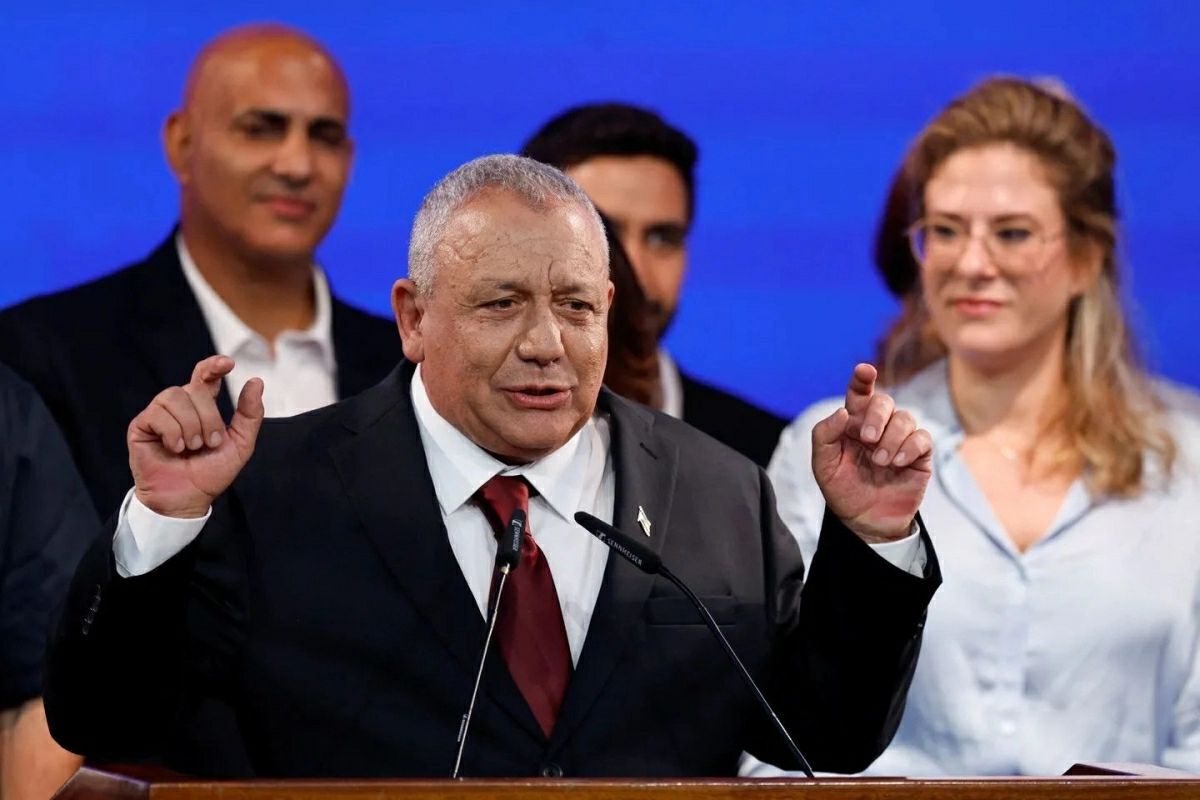
JERUSALEM — Israeli opposition parties have decided to recommend that President Isaac Herzog task Yashar leader Gadi Eisenkot with forming the next government during consultations scheduled for Wednesday and Thursday.Eisenkot has ruled out joining a governing coalition led by Prime Minister Benjamin Netanyahu, even at the personal request of US President Donald Trump, public broadcaster KAN reported.”I will not sit in a government led by Netanyahu,” he was quoted as saying at a closed-door gathering.”If Trump invites me, I will respect the president and attend, but I will stress that this concerns internal Israeli affairs, and I will prevent any interference.”The stance follows Netanyahu’s insistence on heading any broad government whilst firmly rejecting any coalition dependent on the two main Arab factions, the United Arab List (Ra’am) and the Joint List.The Democrats, led by Yair Golan, announced their decision on Monday in a statement carried by KAN, following similar announcements by former Prime Minister Naftali Bennett’s Together party on Sunday and Avigdor Lieberman’s Yisrael Beytenu on Monday.According to Turkish news agency Anadolu, the Joint List, a three-party Arab alliance led by Yousef Jabareen, and the United Arab List, led by Mansour Abbas, are expected to announce similar recommendations.If all opposition and Arab parties back Eisenkot, he could receive recommendations from 67 lawmakers in the 120-member Knesset, compared with 53 for Prime Minister Benjamin Netanyahu’s bloc.Golan, meanwhile, warned that “Israel’s security is in grave and immediate danger,” accusing Prime Minister Netanyahu of seeking to cling to power by force despite losing the election.In a video posted on US social media company X, Golan said that Netanyahu was “prepared to manufacture a security crisis” and endanger Israeli civilians and soldiers to obstruct the democratic process and prolong his rule.Golan accused Netanyahu of conducting a failed campaign against Hamas, deliberately obstructing the release of hostages and fueling disorder in governance across the occupied West Bank.He warned that Netanyahu “will not hesitate to push Israel toward a security escalation and declare a state of emergency to obstruct the transfer of power,” describing such a move as a disregard for voters’ wishes.Earlier, Lieberman said that he would recommend Eisenkot to form the next government, ruling out joining a coalition with Netanyahu or supporting a minority administration following last week’s inconclusive parliamentary elections.Speaking at a news conference Monday in central Israel, Lieberman said his Yisrael Beiteinu party would recommend Eisenkot for prime minister and support Yair Lapid for Knesset speaker, according to The Jerusalem Post.“I will not sit in a government with Netanyahu,” Lieberman said, expressing opposition to forming a minority government.He warned that such an administration could collapse within a year and pave the way for Netanyahu’s return to power.Lieberman also acknowledged that opposition parties had performed significantly worse than expected in the elections.“The opposition suffered a resounding failure in the elections. Winning 48 seats was far below our expectations,” he said, placing responsibility on Eisenkot and his team.Lieberman announced that his party would support Lapid for Knesset speaker when the newly elected parliament convenes on Nov. 10.“We will support Yair Lapid’s candidacy for Knesset speaker,” he said.He said opposition lawmakers would seek to replace incumbent Speaker Amir Ohana, a member of Netanyahu’s Likud party, accusing him of violating parliamentary rules.Although the opposition and Arab parties together hold 67 seats, they have not agreed to form a governing coalition.Lieberman’s rejection of a minority government and his hope for defections from Likud underscore the difficulties facing opposition parties in assembling a coalition capable of replacing Netanyahu.Under Israel’s parliamentary system, voters elect members of the Knesset rather than directly choosing a prime minister.Following the elections, the president consults representatives of the elected parties before assigning a lawmaker with the task of forming a government.The president is not required to select the leader of the largest party. Instead, the mandate can be given to a lawmaker considered capable of forming a government that can secure the Knesset’s confidence.The designated lawmaker initially has 28 days to form a government, with a possible extension of up to 14 days.If the attempt fails, the president can assign the task to another lawmaker, who receives 28 days without an extension.If efforts to form a government remain unsuccessful, additional parliamentary procedures may follow, potentially leading to another election.On Sunday, the Together bloc, led by former PM Bennett, announced that it would recommend Eisenkot.Arab lawmakers have signaled that they may recommend Eisenkot to prevent Netanyahu from forming another government.If all 48 opposition lawmakers and 19 Arab lawmakers recommend Eisenkot, he could receive 67 recommendations, compared with 53 for Netanyahu’s bloc.Such an outcome could strengthen Eisenkot’s position during Herzog’s consultations, despite Netanyahu’s Likud remaining the largest individual party in parliament.However, receiving the mandate would not automatically make Eisenkot prime minister or guarantee that he could establish a government.The distinction is significant because Lieberman has rejected a minority administration, while opposition parties have not reached an agreement with Arab parties on forming a governing coalition.Without such an agreement, Eisenkot would need to secure support from additional lawmakers, including possible defections from Netanyahu’s bloc, to establish an alternative government.
Keep Up to Date with our Weekly Newsletter