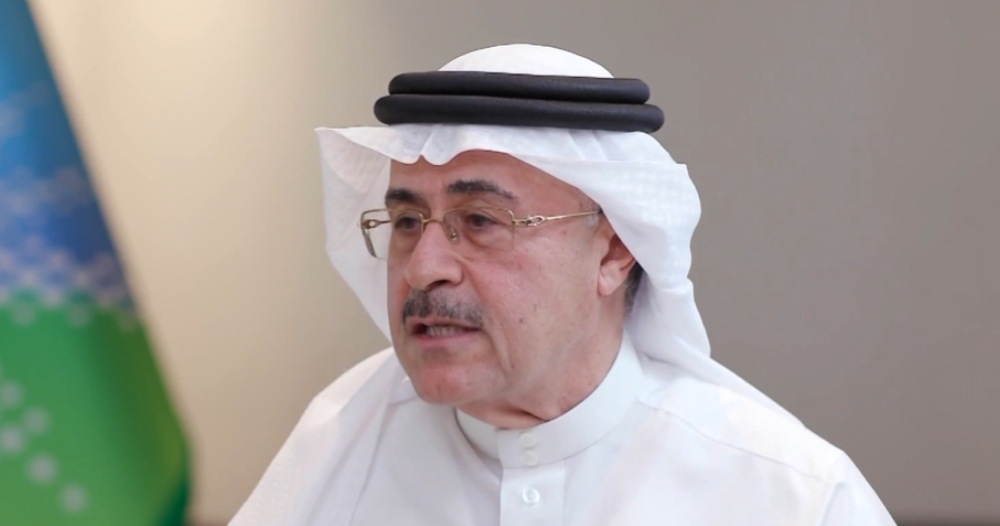
Amin Nasser, President and CEO of Saudi Aramco
Saudi Aramco CEO Amin Nasser expects oil demand to rise by about 3 million barrels per day (mbpd) once conditions in the region return to normal, comprising 2 mbpd in consumption growth and 1 mbpd to replenish inventories depleted during the crisis. 
In an interview with Al Arabiya, Nasser said the current crisis, triggered by the war in the region, is unprecedented in its impact on markets. About 3 billion barrels of supply have been lost since it began, while global inventories were already low relative to the five-year average.
Oil prices could have climbed much higher without drawdowns from global strategic reserves, lower China seaborne oil imports and the East-West Pipeline’s role in maintaining supply flows, he said.
China’s seaborne oil imports fell from about 11 mbpd to between 5 and 6 mbpd in June, helping ease market pressure, Nasser said.
Aramco is working to raise the East-West Pipeline’s capacity to 10 mbpd from 7 mbpd currently, while studying additional export routes. Engineering work on these projects began in the early days of the crisis, he said.
The company is also working with partners to double its storage capacity outside the Kingdom, particularly in Asia, its largest market, to strengthen supply resilience.
All gas expansion projects remain on track, including Jafurah, whose first phase was completed at the end of 2025. The second phase is expected to be completed in 2027 without delays, Nasser said.
Aramco aims to increase gas production by 80% by 2030 from 2021 levels, allowing gas to replace liquid fuels in power generation and freeing up about 1 mbpd of oil for export, he said.
Aramco is studying future gas export opportunities with the Ministry of Energy, but its priority remains meeting domestic demand and supporting industrial expansion in the Kingdom, alongside international investments in liquefied natural gas projects through MidOcean Energy, Nasser said.
More than 90% of materials required during the crisis were sourced locally, while Aramco’s local content reached about 70%, helping it maintain operations despite logistical challenges.
Aramco generated more than $11 billion in value from technology and AI applications in 2023-2025, with annual value creation expected to reach $2 billion to $4 billion in the coming years, Nasser said.
The company’s oil production costs have remained at around $3 per barrel for roughly 20 years despite global inflation, supported by technological advances and improved operational efficiency, he said.
Amin Nasser, President and CEO of Saudi Aramco
Saudi Aramco CEO Amin Nasser expects oil demand to rise by about 3 million barrels per day (mbpd) once conditions in the region return to normal, comprising 2 mbpd in consumption growth and 1 mbpd to replenish inventories depleted during the crisis.
In an interview with Al Arabiya, Nasser said the current crisis, triggered by the war in the region, is unprecedented in its impact on markets. About 3 billion barrels of supply have been lost since it began, while global inventories were already low relative to the five-year average.
Oil prices could have climbed much higher without drawdowns from global strategic reserves, lower China seaborne oil imports and the East-West Pipeline’s role in maintaining supply flows, he said.
China’s seaborne oil imports fell from about 11 mbpd to between 5 and 6 mbpd in June, helping ease market pressure, Nasser said.
Aramco is working to raise the East-West Pipeline’s capacity to 10 mbpd from 7 mbpd currently, while studying additional export routes. Engineering work on these projects began in the early days of the crisis, he said.
The company is also working with partners to double its storage capacity outside the Kingdom, particularly in Asia, its largest market, to strengthen supply resilience.
All gas expansion projects remain on track, including Jafurah, whose first phase was completed at the end of 2025. The second phase is expected to be completed in 2027 without delays, Nasser said.
Aramco aims to increase gas production by 80% by 2030 from 2021 levels, allowing gas to replace liquid fuels in power generation and freeing up about 1 mbpd of oil for export, he said.
Aramco is studying future gas export opportunities with the Ministry of Energy, but its priority remains meeting domestic demand and supporting industrial expansion in the Kingdom, alongside international investments in liquefied natural gas projects through MidOcean Energy, Nasser said.
More than 90% of materials required during the crisis were sourced locally, while Aramco’s local content reached about 70%, helping it maintain operations despite logistical challenges.
Aramco generated more than $11 billion in value from technology and AI applications in 2023-2025, with annual value creation expected to reach $2 billion to $4 billion in the coming years, Nasser said.
The company’s oil production costs have remained at around $3 per barrel for roughly 20 years despite global inflation, supported by technological advances and improved operational efficiency, he said.