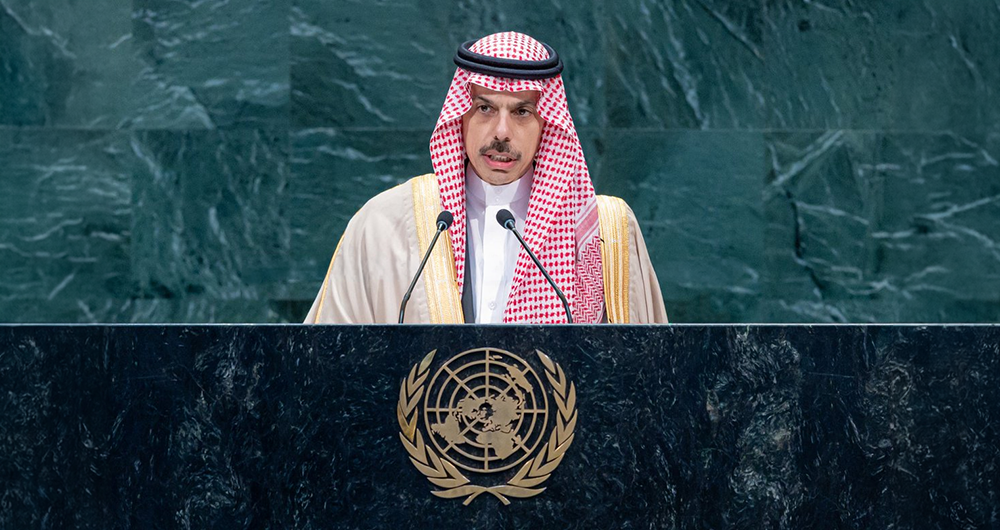
Saudi Arabia’s Minister of Foreign Affairs, Prince Faisal bin Farhan.
Prince Faisal bin Farhan, Minister of Foreign Affairs, said energy security rests on the strength and resilience of the energy system and its ability to withstand and adapt to disruptions. 
Ensuring the stability of energy supplies, protecting critical infrastructure, diversifying supply routes, and safeguarding freedom of navigation are shared responsibilities that require continued international cooperation, he added.
In the Kingdom word at the 81st session of the United Nations General Assembly, he said the Kingdom demonstrated this commitment in practice during disruptions to maritime traffic through the Strait of Hormuz, maintaining the continuity of energy supplies through its long-term investments in infrastructure.
He said the East-West pipeline, along with its petroleum inventories outside the region, helped mitigate the impact of those disruptions and enhance the reliability of supplies to global markets.
He added that protecting international navigation and sustaining global supply chains are shared responsibilities that require serious international cooperation to prevent the global economy from being exposed to risks that affect the world as a whole. In this regard, the Kingdom stressed the importance of ensuring freedom of navigation in all international waterways, particularly the Strait of Hormuz, the Bab el-Mandeb, the Red Sea and the Gulf of Aden, and called for conditions in the Strait of Hormuz to return to what they were before Feb. 28, with no fees or restrictions imposed. The Kingdom also rejected any party’s use of these vital waterways as a tool to exert pressure, issue threats or harm the interests of states, in line with international law and relevant UN resolutions.
He stressed that energy security and climate action are complementary goals. Based on this approach, the Kingdom underscored the importance of not excluding any energy source and of pursuing realistic and comprehensive transition pathways that ensure energy security, protect the climate and support economic development. This approach has contributed to making the Kingdom one of the countries with the lowest carbon and methane emissions intensity globally from hydrocarbon resource production.
The minister added that the Kingdom continues to develop a more efficient and sustainable energy system by implementing emissions-reduction management technologies, including carbon capture, utilization, storage and removal, expanding renewable energy, leveraging innovation, and producing sustainable fuels, including clean hydrogen. These efforts support energy security, enhance resource-use efficiency and contribute to sustainability.
Saudi Arabia’s Minister of Foreign Affairs, Prince Faisal bin Farhan.
Prince Faisal bin Farhan, Minister of Foreign Affairs, said energy security rests on the strength and resilience of the energy system and its ability to withstand and adapt to disruptions.
Ensuring the stability of energy supplies, protecting critical infrastructure, diversifying supply routes, and safeguarding freedom of navigation are shared responsibilities that require continued international cooperation, he added.
In the Kingdom word at the 81st session of the United Nations General Assembly, he said the Kingdom demonstrated this commitment in practice during disruptions to maritime traffic through the Strait of Hormuz, maintaining the continuity of energy supplies through its long-term investments in infrastructure.
He said the East-West pipeline, along with its petroleum inventories outside the region, helped mitigate the impact of those disruptions and enhance the reliability of supplies to global markets.
He added that protecting international navigation and sustaining global supply chains are shared responsibilities that require serious international cooperation to prevent the global economy from being exposed to risks that affect the world as a whole. In this regard, the Kingdom stressed the importance of ensuring freedom of navigation in all international waterways, particularly the Strait of Hormuz, the Bab el-Mandeb, the Red Sea and the Gulf of Aden, and called for conditions in the Strait of Hormuz to return to what they were before Feb. 28, with no fees or restrictions imposed. The Kingdom also rejected any party’s use of these vital waterways as a tool to exert pressure, issue threats or harm the interests of states, in line with international law and relevant UN resolutions.
He stressed that energy security and climate action are complementary goals. Based on this approach, the Kingdom underscored the importance of not excluding any energy source and of pursuing realistic and comprehensive transition pathways that ensure energy security, protect the climate and support economic development. This approach has contributed to making the Kingdom one of the countries with the lowest carbon and methane emissions intensity globally from hydrocarbon resource production.
The minister added that the Kingdom continues to develop a more efficient and sustainable energy system by implementing emissions-reduction management technologies, including carbon capture, utilization, storage and removal, expanding renewable energy, leveraging innovation, and producing sustainable fuels, including clean hydrogen. These efforts support energy security, enhance resource-use efficiency and contribute to sustainability.