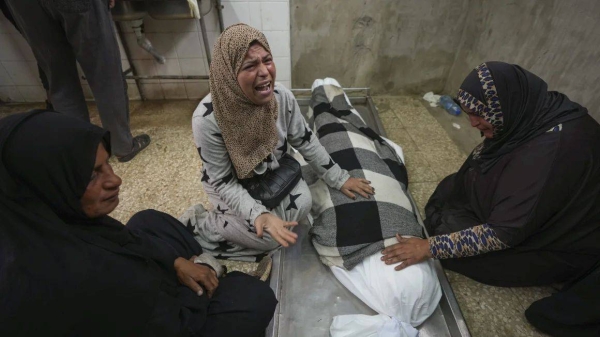
KATHMANDU — Nearly a week on from the devastating floods on the Nepal-China border, search efforts are continuing for the thousands of people missing in the catastrophe.The death toll from the disaster that struck on Wednesday has crossed 1,000, with more than 4,400 people still unaccounted for on both sides of the border, according to officials.Contact has still not been established with some parts of Nepal’s hardest-hit areas, according to the United Nations. Major road and bridge damage — which may take weeks to fix — is restricting access, a UN report said..The report, published Monday and produced by the Office of the UN Resident Coordinator in Nepal, sets out various humanitarian needs across the country’s north in the aftermath of the deadly flash flooding.“Access challenges persist across affected areas due to erosion along riverbanks, damaged bridges, road failures and disruptions to electricity and communication services,” the report said.More than 3,900 people remain missing in Nepal alone— of whom more than 600 are workers believed to be trapped in a vast network of mud-filled tunnels at hydropower sites along Trishuli River.Engineers have been pumping air into the tunnels — and while a team did manage to gain entry to one of them, it withdrew after finding no one there.”I wish we could find him. I wish he would come home,” Anushila Bhandari, wife of Aurus Bhandari, a 33-year-old engineer missing on a project site, told BBC Nepali.Nepalese Prime Minister Balendra Shah said on Monday that 279 people had been rescued from the sites.The rescue operation is being spearheaded by an international team made up of Chinese and Nepalese military personnel, while experts from India, Korea and Australia are also involved.Nepal relies heavily on hydropower and has spent years developing the projects along its mountainous river systems. At least 11 projects either completed or under construction were damaged in the floods, authorities said.Rescuers began pumping air into a tunnel over the weekend, but the families of those trapped say that should have been done earlier.”The longer it takes, the more our hope dies. This operation must move much faster because every second is meaningful to us,” Jiban Khadka, whose relative is also trapped inside the plant, told Kantipur.”It’s a frustratingly slow operation,” Khadka added.Rescue operations had been “intensified”, Nepalese leader Shah said, noting that the floods were “not an ordinary” event.”This incident indicates that the risks we face in the Himalayan region are increasing alongside climate change.”It is now time for us to strongly raise with the international community the issue of the disasters we are experiencing as a result of climate change,” Shah wrote in a Facebook post late on Monday.Australian engineer Arnold Dix, who has been helping Nepalese authorities with the underground search operations remotely, said rescuers had been struggling to find the tunnels.”The actual signature of them has gone – everything is just missing. It looks like a lunar landscape,” he told BBC Radio 4’s World at One.Once rescuers knew where the power stations were, Dix said they could then decide the best way to access them, which typically involves digging and “blasting boulders”.”There are boulders bigger than houses. I’ve never seen that before in my life. It’s just an extraordinary operation,” the former head of the International Tunnelling Association said.He said he still has some hope for those trapped underground, given the protection the subterranean environment might have offered from the deluge above.Only 4% of the 900 bodies that have been found so far have been identified, a spokesperson from the Ministry of Health said.In Chitwan, a district far downstream from where the floods first hit, makeshift burials were taking place after the Himalayan nation’s river systems brought nearly 300 dead bodies to its banks.The air was thick with the smell of decay, as men wearing white Personal Protective Equipment (PPE) including masks carried unidentified corpses into trucks.Over the weekend, a large portion of the forest outside the city was dug up. Medical staff and volunteers worked to extract DNA from the unidentified remains.Ganesh Aryaal, the chief district officer, said relatives will still be able to extricate the remains of their loved ones, once they are identified through DNA testing.”We don’t have enough freezers here… We had to choose this last alternative of temporary burial system. We are really overwhelmed,” he said.In Tibet, the Chinese-appointed Panchen Lama, who is the second-highest spiritual leader in Tibetan Buddhism , held a memorial service as search teams continued to wade through waist-high mud.The official death toll on the Tibetan side is 16, with 546 reported missing, according to Chinese state media. Footage of the floods has been heavily censored in China.The base of a single water tower is the only structure still standing in the once bustling border crossing with Nepal, state media report.Glaciers surrounding an impact crater in Nepal “may still collapse, posing significant potential risks,” according to Chinese state broadcaster CCTV, citing China’s Ministry of Water Resources.The warning marks the second consecutive day that the ministry has raised the possibility of the glaciers collapsing.The Chinese state broadcaster previously reported that areas of standing water near the mountainside impact crater, which was formed by the glacial collapse last week, were “in a state of overflow.”Based on new drone footage taken Tuesday morning, the Chinese ministry assessed that the water accumulated in the impact crater of Nepal’s Chhochen Khola River has “basically drained,” and the downstream river is flowing normally. However, the risk of glacier collapse remains, the ministry warned.
Keep Up to Date with our Weekly Newsletter