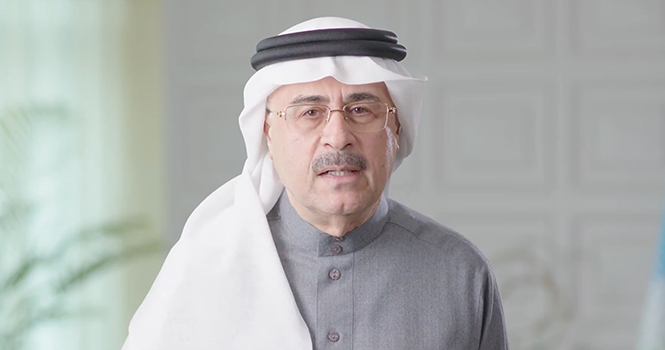
Amin Nasser, President and CEO of Saudi Aramco
Nasser highlighted that the company successfully leveraged its integrated operational infrastructure to reroute supply paths and meet domestic and international demand. Aramco exported roughly 5 million barrels per day (bpd) via Yanbu Port, while supplying western region refineries with approximately 2 million bpd. 
Refining margins surged by over 130% during the second quarter, Nasser noted, stressing that despite prevailing challenges and reduced sales volumes, the company’s net income increased.
He stated that the downstream sector (refining, chemicals, and marketing) recorded stellar performance, doubling its income compared to Q2 2025, supported by stronger refining and petrochemical margins.
Nasser dismissed market misconceptions that Aramco relies solely on the Arabian Gulf and Red Sea, noting that the company can also export via the Suez Canal and SUMED pipeline to the Mediterranean, supported by strategic storage facilities in Japan, South Korea, Egypt, and the Netherlands.
Long-term investments in the East-West Pipeline enabled Aramco to pump up to 7 million bpd to its facilities on the Kingdom’s western coast. This provides substantial flexibility to export via Bab al-Mandab strait or through the Suez Canal to the Mediterranean—both of which remain viable pathways to support global supply continuity.
According to data compiled by Argaam, Saudi Aramco reported a 33% year-on-year (YoY) increase in net profit to SAR 241.64 billion for H1 2026, up from SAR 181.31 billion in H1 2025. Second-quarter net profit stood at SAR 121.51 billion.
Amin Nasser, President and CEO of Saudi Aramco
Nasser highlighted that the company successfully leveraged its integrated operational infrastructure to reroute supply paths and meet domestic and international demand. Aramco exported roughly 5 million barrels per day (bpd) via Yanbu Port, while supplying western region refineries with approximately 2 million bpd.
Refining margins surged by over 130% during the second quarter, Nasser noted, stressing that despite prevailing challenges and reduced sales volumes, the company’s net income increased.
He stated that the downstream sector (refining, chemicals, and marketing) recorded stellar performance, doubling its income compared to Q2 2025, supported by stronger refining and petrochemical margins.
Nasser dismissed market misconceptions that Aramco relies solely on the Arabian Gulf and Red Sea, noting that the company can also export via the Suez Canal and SUMED pipeline to the Mediterranean, supported by strategic storage facilities in Japan, South Korea, Egypt, and the Netherlands.
Long-term investments in the East-West Pipeline enabled Aramco to pump up to 7 million bpd to its facilities on the Kingdom’s western coast. This provides substantial flexibility to export via Bab al-Mandab strait or through the Suez Canal to the Mediterranean—both of which remain viable pathways to support global supply continuity.
According to data compiled by Argaam, Saudi Aramco reported a 33% year-on-year (YoY) increase in net profit to SAR 241.64 billion for H1 2026, up from SAR 181.31 billion in H1 2025. Second-quarter net profit stood at SAR 121.51 billion.