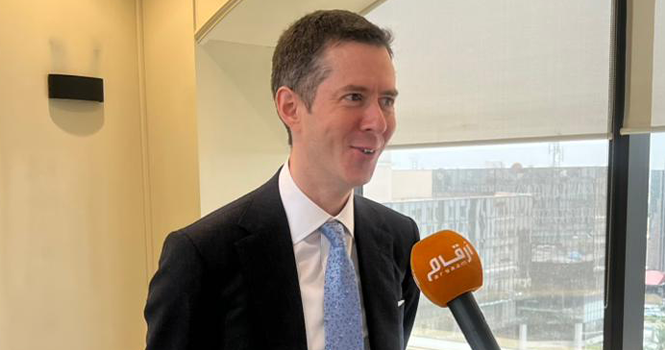
Leo Lester, Senior Vice President of the University of New Haven
Leo Lester, Senior Vice President of the University of New Haven, Senior Vice President of the University of New Haven, said Saudi Arabia is one of the most attractive markets for foreign universities due to regulatory changes that allow international institutions to enter the Kingdom. However, he stated that still there is a widening gap between university seats and the rising demand for higher education. 
Speaking to Argaam, Lester said the Ministry of Education highlighted a major capacity gap at the start of discussions in 2024, noting that around 200,000 high school graduates each year are unable to secure university placements.
He added that this shortfall was a key factor behind regulatory changes allowing foreign universities to enter the Saudi market.
Lester said Saudi Arabia differs from markets such as Dubai and Qatar, which host large numbers of international universities. He described the Kingdom as a relatively untapped and promising growth market for higher education.
He added that the university has long-standing experience with Saudi students, having enrolled many through scholarship programs. The institution has also delivered academic programs for Saudi government entities.
The university will begin operations in Saudi Arabia through three colleges: Business and Digital Innovation, Applied Sciences, and Engineering and Advanced Manufacturing. It will also offer undergraduate, postgraduate, and short professional programs, he added.
Leo Lester, Senior Vice President of the University of New Haven
Leo Lester, Senior Vice President of the University of New Haven, Senior Vice President of the University of New Haven, said Saudi Arabia is one of the most attractive markets for foreign universities due to regulatory changes that allow international institutions to enter the Kingdom. However, he stated that still there is a widening gap between university seats and the rising demand for higher education.
Speaking to Argaam, Lester said the Ministry of Education highlighted a major capacity gap at the start of discussions in 2024, noting that around 200,000 high school graduates each year are unable to secure university placements.
He added that this shortfall was a key factor behind regulatory changes allowing foreign universities to enter the Saudi market.
Lester said Saudi Arabia differs from markets such as Dubai and Qatar, which host large numbers of international universities. He described the Kingdom as a relatively untapped and promising growth market for higher education.
He added that the university has long-standing experience with Saudi students, having enrolled many through scholarship programs. The institution has also delivered academic programs for Saudi government entities.
The university will begin operations in Saudi Arabia through three colleges: Business and Digital Innovation, Applied Sciences, and Engineering and Advanced Manufacturing. It will also offer undergraduate, postgraduate, and short professional programs, he added.