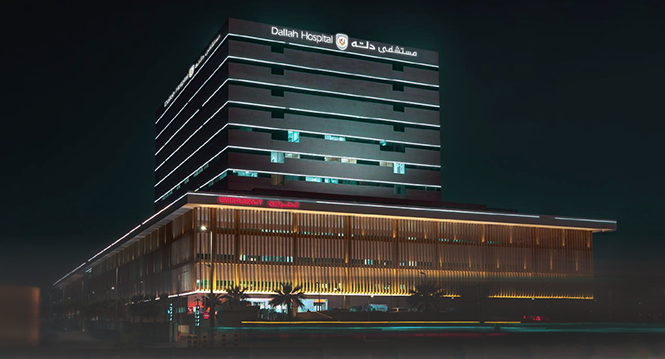
One of Dallah Health Company’s hospitals
Dallah Healthcare’s Q1 2026 profit decline was driven by seasonal factors, Chief Financial Officer (CFO) Amin bin Abdul Raouf Hariz told Argaam. 
Hariz explained that school holidays during Ramadan were extended by an additional week compared with last year, in addition to differences in the timing of Ramadan and Eid Al Fitr versus the prior year.
Actual working days dropped by around 20% between Q4 2025 and Q1 2026, falling from about 69.5 days to roughly 56 days, due to Ramadan, Eid holidays, and travel, which weighed on patient traffic and revenues.
Hariz said there is no material slowdown in core operations, pointing out that Dallah Al-Khobar Hospital continues to deliver strong performance and is expected to support profitability and growth in the coming years.
He added that visits across the group’s facilities continue to rise, reflecting sustainable growth despite short-term seasonal pressures.
Dallah Health initiated, for the first time, unified negotiations with a major insurance provider, expected to benefit the group, especially Al Khobar and Al Ahsa hospitals.
Negotiations led to upgrading some hospitals’ insurance coverage from level 6 to level 7, with the impact expected to be more reflected in pricing and profitability than in patient volumes.
Hariz highlighted that selling Dr Mohammed bin Rashed Al-Faqih Partners Co. stake is strategically positive, driven by an attractive sale price and liquidity that will help reduce financing costs and enhance profitability.
He confirmed that the company remains focused on expansion in Riyadh and other major cities, while continuing to evaluate potential investment and acquisition opportunities.
On the Q2 2026 outlook, the CFO reaffirmed Dallah Healthcare’s commitment to its 2026 operational and financial objectives without changes, noting that performance to date is in line with plans.
He indicated that there are no signs of weakness in market demand, highlighting strong revenues in April and the first 10 days of May, reinforcing management’s view that the Q1 2026 revenue decline versus Q4 2025 was mainly seasonal.
One of Dallah Health Company’s hospitals
Dallah Healthcare’s Q1 2026 profit decline was driven by seasonal factors, Chief Financial Officer (CFO) Amin bin Abdul Raouf Hariz told Argaam.
Hariz explained that school holidays during Ramadan were extended by an additional week compared with last year, in addition to differences in the timing of Ramadan and Eid Al Fitr versus the prior year.
Actual working days dropped by around 20% between Q4 2025 and Q1 2026, falling from about 69.5 days to roughly 56 days, due to Ramadan, Eid holidays, and travel, which weighed on patient traffic and revenues.
Hariz said there is no material slowdown in core operations, pointing out that Dallah Al-Khobar Hospital continues to deliver strong performance and is expected to support profitability and growth in the coming years.
He added that visits across the group’s facilities continue to rise, reflecting sustainable growth despite short-term seasonal pressures.
Dallah Health initiated, for the first time, unified negotiations with a major insurance provider, expected to benefit the group, especially Al Khobar and Al Ahsa hospitals.
Negotiations led to upgrading some hospitals’ insurance coverage from level 6 to level 7, with the impact expected to be more reflected in pricing and profitability than in patient volumes.
Hariz highlighted that selling Dr Mohammed bin Rashed Al-Faqih Partners Co. stake is strategically positive, driven by an attractive sale price and liquidity that will help reduce financing costs and enhance profitability.
He confirmed that the company remains focused on expansion in Riyadh and other major cities, while continuing to evaluate potential investment and acquisition opportunities.
On the Q2 2026 outlook, the CFO reaffirmed Dallah Healthcare’s commitment to its 2026 operational and financial objectives without changes, noting that performance to date is in line with plans.
He indicated that there are no signs of weakness in market demand, highlighting strong revenues in April and the first 10 days of May, reinforcing management’s view that the Q1 2026 revenue decline versus Q4 2025 was mainly seasonal.