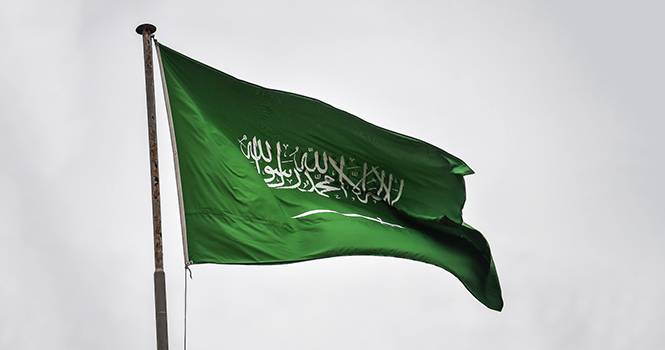
The Kingdom of Saudi Arabia’s flag
The Saudi government’s net asset position provides substantial credit flexibility, SP Global Ratings said. 
The agency noted that Saudi Arabia is implementing a costly economic transformation program that has begun to reduce its reliance on oil and gas. As a result, spending related to this program has increased, leading to wider fiscal deficits.
In a recent report, the agency said Saudi Arabia exports around 6.5 million barrels of oil per day, approximately 80% of which passes through the Strait of Hormuz.
It added that the East–West pipeline system has spare capacity of 3.3 million barrels per day, bringing its total capacity to 5 million barrels per day. This infrastructure could play a significant role in preserving export revenues.
SP expects that any potential escalation between Iran and the United States would have a limited impact on Gulf countries’ credit ratings, similar to June 2025, when military activity was confined to specific targets and remained limited in scope and duration.
The agency added that its outlook on the sovereign ratings of GCC countries remains stable. However, rising domestic instability in Iran and the possibility of continued military activity in the region have increased the risk of prolonged negative pressure on regional sovereign credit ratings.
It further noted that while short-term geopolitical tensions may intensify, the transmission channels it has identified could affect countries in the region differently.
Some countries are more vulnerable to certain pressures than others, particularly those with weaker financial reserves or greater exposure to prolonged disruption in the Strait of Hormuz.
SP also stated that its credit ratings for sovereign governments and banks in the Gulf region are closely linked. If sovereign ratings across the region were downgraded by one notch, approximately 43% of the rated local banks would likely face corresponding downgrades.
The Kingdom of Saudi Arabia’s flag
The Saudi government’s net asset position provides substantial credit flexibility, SP Global Ratings said.
The agency noted that Saudi Arabia is implementing a costly economic transformation program that has begun to reduce its reliance on oil and gas. As a result, spending related to this program has increased, leading to wider fiscal deficits.
In a recent report, the agency said Saudi Arabia exports around 6.5 million barrels of oil per day, approximately 80% of which passes through the Strait of Hormuz.
It added that the East–West pipeline system has spare capacity of 3.3 million barrels per day, bringing its total capacity to 5 million barrels per day. This infrastructure could play a significant role in preserving export revenues.
SP expects that any potential escalation between Iran and the United States would have a limited impact on Gulf countries’ credit ratings, similar to June 2025, when military activity was confined to specific targets and remained limited in scope and duration.
The agency added that its outlook on the sovereign ratings of GCC countries remains stable. However, rising domestic instability in Iran and the possibility of continued military activity in the region have increased the risk of prolonged negative pressure on regional sovereign credit ratings.
It further noted that while short-term geopolitical tensions may intensify, the transmission channels it has identified could affect countries in the region differently.
Some countries are more vulnerable to certain pressures than others, particularly those with weaker financial reserves or greater exposure to prolonged disruption in the Strait of Hormuz.
SP also stated that its credit ratings for sovereign governments and banks in the Gulf region are closely linked. If sovereign ratings across the region were downgraded by one notch, approximately 43% of the rated local banks would likely face corresponding downgrades.