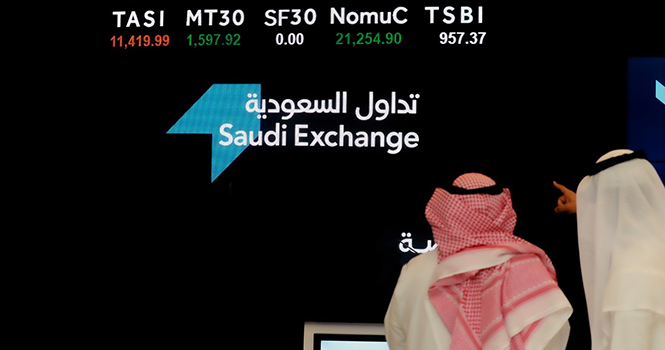
Tadawul trading screen
The Saudi Exchange (Tadawul) witnessed a strong rally during trading today, Sept. 24, driven by expectations of an imminent decision that will raise the cap on foreign ownership in listed companies. 
This move could pave the way for additional cash inflows, estimated at more than $10.5 billion from funds tracking global indices.
Analysts surveyed by Argaam believe that raising foreign ownership cap in Saudi-listed companies — if endorsed by the Capital Market Authority (CMA) — is a decision seen to boost market liquidity besides driving further depth to the Saudi market.
The banking sector, according to study participants, will likely be the “top” beneficiary of this planned decision, led by Al Rajhi Bank, Saudi National Bank (SNB), and Alinma Bank, in addition to some listed telecom companies and others.
The market capitalization of Tadawul-listed companies is currently estimated at $2.3 trillion, representing roughly 3.3% of the MSCI Emerging Markets Index.
Impact on Liquidity
Mohamed Abu Basha, Head of Macroeconomic Analysis at EFG Hermes
Mohamed Abu Basha, Head of Macroeconomic Analysis at EFG Hermes, said that raising the cap on foreign ownership in the Saudi market will likely promote additional capital inflows of about $10.5 billion from funds that track global indices (passive investors).
Mohammed Al-Suwaid, CEO of Razeen Capital
For his part, Mohammed Al-Suwaid, CEO of Razeen Capital, stated that if approved by the CMA, the decision would boost market liquidity through additional inflows estimated at around $10 billion, thus boosting market depth, narrowing the gap between buy and sell orders, and bolstering pricing efficiency.
Potential Impact on Classification Global Indices
The move is expected to strengthen Tadawul’s position among emerging market indices such as MSCI and FTSE Russell. It is also bound to step up the Kingdom’s weight in these indices, which would translate into automatic inflows from global index-tracking funds, according to Al-Suwaid.
Possible Volatility
As for the impact of the decision on market stability, Abu Basha said that the entry of active investors seeking to preempt confirmed inflows from these funds could cause some volatility.
“Most of the expected inflows will likely come from index funds, but lifting restrictions might also attract active investors looking to seize short-term opportunities,” said the research head.
This could in turn fuel short-term volatility; however, greater market depth and rising liquidity should reinforce the Saudi capital market’s ability to absorb such fluctuations, he added.
Companies Expected to Be Targeted
As for the companies set to attract the interest of foreign investors, Abu Basha said that the banking sector will likely benefit the most, led by Al Rajhi Bank, SNB and Alinma Bank, along with several companies including Mobily, Dar Al Arkan, and Jabal Omar.
Al-Suwaid also expected that investor focus will be on companies with large index weights and high liquidity, particularly Saudi banks as well as some telecom and petrochemical players, given their aptitude to absorb substantial inflows without impacting trading stability.
Tadawul trading screen
The Saudi Exchange (Tadawul) witnessed a strong rally during trading today, Sept. 24, driven by expectations of an imminent decision that will raise the cap on foreign ownership in listed companies.
This move could pave the way for additional cash inflows, estimated at more than $10.5 billion from funds tracking global indices.
Analysts surveyed by Argaam believe that raising foreign ownership cap in Saudi-listed companies — if endorsed by the Capital Market Authority (CMA) — is a decision seen to boost market liquidity besides driving further depth to the Saudi market.
The banking sector, according to study participants, will likely be the “top” beneficiary of this planned decision, led by Al Rajhi Bank, Saudi National Bank (SNB), and Alinma Bank, in addition to some listed telecom companies and others.
The market capitalization of Tadawul-listed companies is currently estimated at $2.3 trillion, representing roughly 3.3% of the MSCI Emerging Markets Index.
Impact on Liquidity
Mohamed Abu Basha, Head of Macroeconomic Analysis at EFG Hermes
Mohamed Abu Basha, Head of Macroeconomic Analysis at EFG Hermes, said that raising the cap on foreign ownership in the Saudi market will likely promote additional capital inflows of about $10.5 billion from funds that track global indices (passive investors).
Mohammed Al-Suwaid, CEO of Razeen Capital
For his part, Mohammed Al-Suwaid, CEO of Razeen Capital, stated that if approved by the CMA, the decision would boost market liquidity through additional inflows estimated at around $10 billion, thus boosting market depth, narrowing the gap between buy and sell orders, and bolstering pricing efficiency.
Potential Impact on Classification Global Indices
The move is expected to strengthen Tadawul’s position among emerging market indices such as MSCI and FTSE Russell. It is also bound to step up the Kingdom’s weight in these indices, which would translate into automatic inflows from global index-tracking funds, according to Al-Suwaid.
Possible Volatility
As for the impact of the decision on market stability, Abu Basha said that the entry of active investors seeking to preempt confirmed inflows from these funds could cause some volatility.
“Most of the expected inflows will likely come from index funds, but lifting restrictions might also attract active investors looking to seize short-term opportunities,” said the research head.
This could in turn fuel short-term volatility; however, greater market depth and rising liquidity should reinforce the Saudi capital market’s ability to absorb such fluctuations, he added.
Companies Expected to Be Targeted
As for the companies set to attract the interest of foreign investors, Abu Basha said that the banking sector will likely benefit the most, led by Al Rajhi Bank, SNB and Alinma Bank, along with several companies including Mobily, Dar Al Arkan, and Jabal Omar.
Al-Suwaid also expected that investor focus will be on companies with large index weights and high liquidity, particularly Saudi banks as well as some telecom and petrochemical players, given their aptitude to absorb substantial inflows without impacting trading stability.