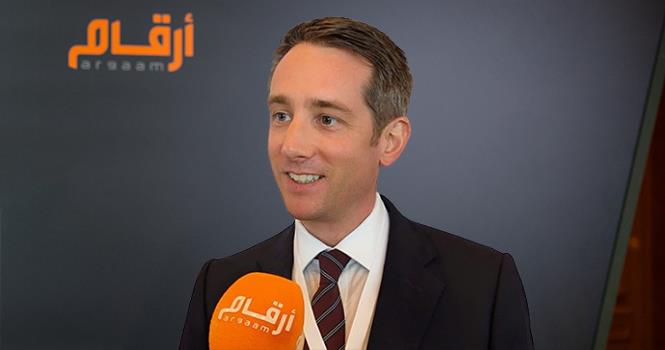
Andrew Naylor, Head of Middle East and Public Policy at the World Gold Council (WGC)
Gold investment soared 78% year-on-year (YoY) in Q2 2025, nearing record levels, said Andrew Naylor, Head of Middle East and Public Policy at the World Gold Council (WGC). 
Speaking to Argaam, Naylor said the surge was driven by institutional flows, particularly gold-backed exchange-traded funds (ETFs), the Fed’s rate cuts starting late last year, and heightened geopolitical tensions.
Central banks remain key players, having maintained net purchases since 2010. Over the past three years, they’ve added over 1,000 tonnes annually to diversify reserves and reduce dependence on the US dollar.
Central bank demand increased last quarter but at a slower pace, while a June WGC survey showed 85% of central banks plan to boost gold reserves over the next 12 months.
In Saudi Arabia, jewelry demand dropped 15% YoY in H1 2025, while retail investment also fell as individuals sold gold for recycling to benefit from high prices.
Naylor noted that Saudi demand spans beyond the wealthy, making the market more price-sensitive. Gold coin demand saw a notable drop due to this sensitivity.
While the WGC doesn’t issue price targets, Naylor expects gold to stay high and resilient in H2 2025, supported by geopolitical risks, slower rate cuts, and rising global debt concerns, particularly in the West and Japan.
Andrew Naylor, Head of Middle East and Public Policy at the World Gold Council (WGC)
Gold investment soared 78% year-on-year (YoY) in Q2 2025, nearing record levels, said Andrew Naylor, Head of Middle East and Public Policy at the World Gold Council (WGC).
Speaking to Argaam, Naylor said the surge was driven by institutional flows, particularly gold-backed exchange-traded funds (ETFs), the Fed’s rate cuts starting late last year, and heightened geopolitical tensions.
Central banks remain key players, having maintained net purchases since 2010. Over the past three years, they’ve added over 1,000 tonnes annually to diversify reserves and reduce dependence on the US dollar.
Central bank demand increased last quarter but at a slower pace, while a June WGC survey showed 85% of central banks plan to boost gold reserves over the next 12 months.
In Saudi Arabia, jewelry demand dropped 15% YoY in H1 2025, while retail investment also fell as individuals sold gold for recycling to benefit from high prices.
Naylor noted that Saudi demand spans beyond the wealthy, making the market more price-sensitive. Gold coin demand saw a notable drop due to this sensitivity.
While the WGC doesn’t issue price targets, Naylor expects gold to stay high and resilient in H2 2025, supported by geopolitical risks, slower rate cuts, and rising global debt concerns, particularly in the West and Japan.