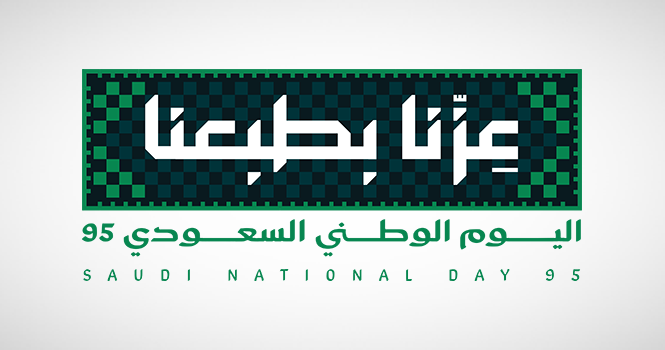
The slogan of the 95th Saudi National Day: Our Pride is in Our Nature
Saudi Arabia observes its National Day on Sept. 23 every year. The occasion commemorates the unification of the Kingdom on Sept. 23, 1932, under the leadership of its founder, King Abdulaziz bin Abdul Rahman Al Saud. 
King Abdulaziz bin Abdulrahman Al Saud
Reign: (Sept. 23, 1932 – Nov. 9, 1953)
King Saud bin Abdulaziz Al Saud
Reign: (Nov. 9, 1953 – Nov. 2, 1964)
King Faisal bin Abdulaziz Al Saud
Reign: (Nov. 2, 1964 – March 25, 1975)
King Khalid bin Abdulaziz Al Saud
Reign: (March 25, 1975 – June 13, 1982)
King Fahd bin Abdulaziz Al Saud
Reign: (June 13, 1982 – Aug. 1, 2005)
King Abdullah bin Abdulaziz Al Saud
Reign: (Aug. 1, 2005 – Jan. 23, 2015)
King Salman bin Abdulaziz Al Saud
Reign: (Jan. 23, 2015 to date)
The identity of the 95th Saudi National Day came under the slogan, “Our Pride is in Our Nature”, a sincere expression of the values that define our character and national identity. We have always been — and will continue to be — marked by our authentic nature, carrying the qualities we were raised with, which have become deeply rooted in our way of life. These values are reflected in our daily interactions and attitudes. Saudis are renowned for inherent traits that have accompanied them since birth, such as generosity, ambition, readiness to help, authenticity, and benevolence, along with a vision aimed at achieving success.
The National Day identity also includes “Our Pride is in Our Vision”, referring to Saudi Vision 2030, led by Crown Prince Mohammed bin Salman bin Abdulaziz. The vision encompasses several key projects, foremost among them are The Red Sea projects, NEOM, The Line, AMAALA, Trojena, Saudi Green Initiative, Riyadh Metro, National Renewable Energy Program, Qiddiya, the Shaheen Sat, the Historic Diriyah Development Program, railway projects, the establishment of Riyadh Air, and others — all of which have solidified the Kingdom’s strength and position to continue playing its pivotal role across all sectors.
The identity projects also include The Mukaab, the Saudi Space Program, CEER electric vehicle project, Shuaibah Solar Power Plant, King Salman Park, Sports Boulevard, Soudah Development Project, The Line, AlUla development, Diriyah Gate project, and Sindalah Island project.
As the nation commemorates its 95th National Day, this report by Argaam covers the key breakthroughs and milestones achieved by Saudi Arabia in different sectors to boost economic growth, enhance the standard of living, make balanced development across the Kingdom, develop human resources, diversify its economic base in terms of production and income sources, and support the private sector.
On April 25, 2016, the Saudi Cabinet, headed by King Salman, approved Vision 2030, which was presented by the Council of Economic and Development Affairs (CEDA).
At that time, King Salman said: “We hope that citizens will work together to achieve this ambitious vision.”
Crown Prince Mohammed bin Salman had revealed the key features of Vision 2030, including several plans and objectives, such as building a diversified solid economy away from oil, promoting various sectors, transforming the Public Investment Fund (PIF) into an investment institution with SAR 7 trillion assets, and transforming Saudi Aramco from being an oil producer to an industrial giant that operates worldwide.
The Saudi Vision 2030 is based on three pillars to execute sustainable development programs and a more robust economy. Several action plans were designed to turn this vision into reality, such as the National Transformation Program (NTP), the PIF Program, the Housing Program, the Pilgrim Experience Program, the Fiscal Sustainability Program, the Human Capability Development Program, the Quality-of-Life Program (QOLP), the Privatization Program, the Heath Sector Transformation Program, the Financial Sector Development Program (FSDP), and the National Industrial Development and Logistics Program (NIDLP).
Crown Prince and Prime Minister, Mohammed bin Salman, recently stated that Saudi Arabia will be the greatest success story of the 21st century, being the fastest-growing nation. The country is poised to be one of the strongest economies globally.
Here’re the major developments witnessed by Saudi Arabia since Vision 2030 rollout:
-In 2022, Saudi Arabia’s gross domestic product (GDP) at current prices exceeded $1 trillion for the first time, reaching SAR 4.2 trillion at current prices.
– The PIF’s assets under management (AUMs) rose nearly six times from SAR 570 billion by the end of 2015 to about SAR 3.42 trillion by the end of 2024.
– The Kingdom launched mega projects, such as NEOM, Qiddiya, The Red Sea, ROSHN Co., Diriyah Gate Project, and RiyadhAir.
– Establishing companies in diverse sectors, such as entertainment, tourism, military industries, renewable energy and refinancing.
– In 2019, Saudi Aramco went public. A total of 1.5% of Aramco’s value began trading on the Saudi Exchange (Tadawul), the largest listing in the history of the Saudi market and globally. After that, the government floated a secondary public offering of ordinary shares, amounting to 1.545 billion shares, accounting for about 0.64% of the company’s shares issued during the current year.
– Home ownership percentage among Saudis increased from 47% in 2016 to 65.4% in 2024.
– The Kingdom established the OPEC+ group, which reached a historic achievement in 2020, by realizing the largest reduction in production ever known to the petroleum market. It contributed to restoring stability and balance to global markets and confronting the effects of the Corona pandemic on the worldwide economy.
– Saudi Arabia launched an anti-corruption campaign, recouping SAR 247 billion in the last three years, or 20% of total non-oil revenue.
– Achieving Vision 2030 target of reducing Saudi unemployment rate to 7%, marking the lowest level on record in the Kingdom; Ministry of Human Resources now aims to further lower it to 5% as a new target.
– Saudi Arabia also launched the PIF Strategy 2021-2025. In addition, it prevented government agencies from contracting with any foreign firm with a regional headquarters other than Saudi Arabia, as of 2024. It transferred 4% of Saudi Aramco’s shares to the PIF and 4% to Sanabil Investments.
Saudi Arabia launched BoutiqueGroup to develop historical palaces into luxuryboutiquehotels, and Trojena, the global destination for mountain tourism in NEOM.
Moreover, several strategies were issued, including the strategy of the National Development Fund (NDF) and the strategy of the Custodian of The Two Holy Mosques Scholarship Program.
During this period, the Diriyah project was included as the PIF’s fifth giga-project, and the Events Investment Fund (EIF) was launched.
The PIF invested in a bundle of national and international companies.
Saudi Arabia launched New Square Development Co. to develop the most updated downtown in the world in Riyadh. It also established Riyadh Air, the first phase of Riyadh buses, four special economic zones (SEZs), the general plan for logistics hubs, and a global water organization.
It launched the Sports Clubs Investment Privatization Project, while allocating $7.8 billion to Expo 2030.
It further transferred 8% of Saudi Aramco’s total issued shares from state ownership to wholly owned PIF subsidiaries. The government conducted secondary public offering of 1.545 billion ordinary shares, representing c0.64% of issued shares.
During the first quarter of this year, Saudi Arabia raised the valuation of mineral resources from SAR 4.9 trillion to SAR 9.4 trillion and launched a geographical survey project for renewable energy projects in Saudi Arabia.
Here are the major developments witnessed by Saudi Arabia since Vision 2030 rollout:
– Saudi Cabinet greenlit NTP 2020
In June 2016, the Saudi Cabinet greenlit the NTP 2020. Among its major goals is to generate 450,000 jobs, accelerate privatization and reduce government spending on initiatives by 40%.
It also aims to maximize local content through investing over SAR 270 billion in localization.
– Launch of Sakani Program
The program’s first phase started in January 2017. The total number of beneficiary households reached 1.4 million by 2022.
A total of 55,000 Saudi families benefited from the program during the first half of 2024 and 54,000 Saudi families in H1 2025. The program aimed to offer 95,000 housing units until 2025, focusing on the main regions that receive the most housing subsidies.
In 2023, the program announced the launch of an updated housing support scheme designed to address beneficiaries’ needs in line with their varying financing capacities and the demand for suitable home ownership.
Saudi Arabia aims to raise the home ownership rate to 70% by 2030, in line with the objectives of the Housing Program, one of Vision 2030’s key initiatives.
At the end of 2024, the Saudi home ownership rate reached 65.4%. The number of housing units occupied by Saudi families increased by c233,000 units (+2.7% YoY) to 4.4 million units, representing 50.6% of total occupied housing units.
In May 2025, amendments were introduced to the housing subsidy regulations, including lowering the eligibility age for applicants to 20 years (from 25 previously) and abolishing the dependency requirement for wives and divorced mothers to qualify for housing subsidy.
Qiddiya project
In April 2017, the Crown Prince launched the Kingdom’s largest qualitative cultural, sports and entertainment city project in Qiddiya City, southwest of Riyadh. This first-of-its-kind city spans 334 square kilometers.
The project aims to make Qiddiya an entertainment destination and a complex of activities, discovery and participation in the Kingdom. It also seeks to transform the concept of entertainment in the Kingdom and capitalize on the promising opportunities offered by the local market.
The slogan of the 95th Saudi National Day: Our Pride is in Our Nature
Saudi Arabia observes its National Day on Sept. 23 every year. The occasion commemorates the unification of the Kingdom on Sept. 23, 1932, under the leadership of its founder, King Abdulaziz bin Abdul Rahman Al Saud.
King Abdulaziz bin Abdulrahman Al Saud
Reign: (Sept. 23, 1932 – Nov. 9, 1953)
King Saud bin Abdulaziz Al Saud
Reign: (Nov. 9, 1953 – Nov. 2, 1964)
King Faisal bin Abdulaziz Al Saud
Reign: (Nov. 2, 1964 – March 25, 1975)
King Khalid bin Abdulaziz Al Saud
Reign: (March 25, 1975 – June 13, 1982)
King Fahd bin Abdulaziz Al Saud
Reign: (June 13, 1982 – Aug. 1, 2005)
King Abdullah bin Abdulaziz Al Saud
Reign: (Aug. 1, 2005 – Jan. 23, 2015)
King Salman bin Abdulaziz Al Saud
Reign: (Jan. 23, 2015 to date)
The identity of the 95th Saudi National Day came under the slogan, “Our Pride is in Our Nature”, a sincere expression of the values that define our character and national identity. We have always been — and will continue to be — marked by our authentic nature, carrying the qualities we were raised with, which have become deeply rooted in our way of life. These values are reflected in our daily interactions and attitudes. Saudis are renowned for inherent traits that have accompanied them since birth, such as generosity, ambition, readiness to help, authenticity, and benevolence, along with a vision aimed at achieving success.
The National Day identity also includes “Our Pride is in Our Vision”, referring to Saudi Vision 2030, led by Crown Prince Mohammed bin Salman bin Abdulaziz. The vision encompasses several key projects, foremost among them are The Red Sea projects, NEOM, The Line, AMAALA, Trojena, Saudi Green Initiative, Riyadh Metro, National Renewable Energy Program, Qiddiya, the Shaheen Sat, the Historic Diriyah Development Program, railway projects, the establishment of Riyadh Air, and others — all of which have solidified the Kingdom’s strength and position to continue playing its pivotal role across all sectors.
The identity projects also include The Mukaab, the Saudi Space Program, CEER electric vehicle project, Shuaibah Solar Power Plant, King Salman Park, Sports Boulevard, Soudah Development Project, The Line, AlUla development, Diriyah Gate project, and Sindalah Island project.
As the nation commemorates its 95th National Day, this report by Argaam covers the key breakthroughs and milestones achieved by Saudi Arabia in different sectors to boost economic growth, enhance the standard of living, make balanced development across the Kingdom, develop human resources, diversify its economic base in terms of production and income sources, and support the private sector.
On April 25, 2016, the Saudi Cabinet, headed by King Salman, approved Vision 2030, which was presented by the Council of Economic and Development Affairs (CEDA).
At that time, King Salman said: “We hope that citizens will work together to achieve this ambitious vision.”
Crown Prince Mohammed bin Salman had revealed the key features of Vision 2030, including several plans and objectives, such as building a diversified solid economy away from oil, promoting various sectors, transforming the Public Investment Fund (PIF) into an investment institution with SAR 7 trillion assets, and transforming Saudi Aramco from being an oil producer to an industrial giant that operates worldwide.
The Saudi Vision 2030 is based on three pillars to execute sustainable development programs and a more robust economy. Several action plans were designed to turn this vision into reality, such as the National Transformation Program (NTP), the PIF Program, the Housing Program, the Pilgrim Experience Program, the Fiscal Sustainability Program, the Human Capability Development Program, the Quality-of-Life Program (QOLP), the Privatization Program, the Heath Sector Transformation Program, the Financial Sector Development Program (FSDP), and the National Industrial Development and Logistics Program (NIDLP).
Crown Prince and Prime Minister, Mohammed bin Salman, recently stated that Saudi Arabia will be the greatest success story of the 21st century, being the fastest-growing nation. The country is poised to be one of the strongest economies globally.
Here’re the major developments witnessed by Saudi Arabia since Vision 2030 rollout:
-In 2022, Saudi Arabia’s gross domestic product (GDP) at current prices exceeded $1 trillion for the first time, reaching SAR 4.2 trillion at current prices.
– The PIF’s assets under management (AUMs) rose nearly six times from SAR 570 billion by the end of 2015 to about SAR 3.42 trillion by the end of 2024.
– The Kingdom launched mega projects, such as NEOM, Qiddiya, The Red Sea, ROSHN Co., Diriyah Gate Project, and RiyadhAir.
– Establishing companies in diverse sectors, such as entertainment, tourism, military industries, renewable energy and refinancing.
– In 2019, Saudi Aramco went public. A total of 1.5% of Aramco’s value began trading on the Saudi Exchange (Tadawul), the largest listing in the history of the Saudi market and globally. After that, the government floated a secondary public offering of ordinary shares, amounting to 1.545 billion shares, accounting for about 0.64% of the company’s shares issued during the current year.
– Home ownership percentage among Saudis increased from 47% in 2016 to 65.4% in 2024.
– The Kingdom established the OPEC+ group, which reached a historic achievement in 2020, by realizing the largest reduction in production ever known to the petroleum market. It contributed to restoring stability and balance to global markets and confronting the effects of the Corona pandemic on the worldwide economy.
– Saudi Arabia launched an anti-corruption campaign, recouping SAR 247 billion in the last three years, or 20% of total non-oil revenue.
– Achieving Vision 2030 target of reducing Saudi unemployment rate to 7%, marking the lowest level on record in the Kingdom; Ministry of Human Resources now aims to further lower it to 5% as a new target.
– Saudi Arabia also launched the PIF Strategy 2021-2025. In addition, it prevented government agencies from contracting with any foreign firm with a regional headquarters other than Saudi Arabia, as of 2024. It transferred 4% of Saudi Aramco’s shares to the PIF and 4% to Sanabil Investments.
Saudi Arabia launched BoutiqueGroup to develop historical palaces into luxuryboutiquehotels, and Trojena, the global destination for mountain tourism in NEOM.
Moreover, several strategies were issued, including the strategy of the National Development Fund (NDF) and the strategy of the Custodian of The Two Holy Mosques Scholarship Program.
During this period, the Diriyah project was included as the PIF’s fifth giga-project, and the Events Investment Fund (EIF) was launched.
The PIF invested in a bundle of national and international companies.
Saudi Arabia launched New Square Development Co. to develop the most updated downtown in the world in Riyadh. It also established Riyadh Air, the first phase of Riyadh buses, four special economic zones (SEZs), the general plan for logistics hubs, and a global water organization.
It launched the Sports Clubs Investment Privatization Project, while allocating $7.8 billion to Expo 2030.
It further transferred 8% of Saudi Aramco’s total issued shares from state ownership to wholly owned PIF subsidiaries. The government conducted secondary public offering of 1.545 billion ordinary shares, representing c0.64% of issued shares.
During the first quarter of this year, Saudi Arabia raised the valuation of mineral resources from SAR 4.9 trillion to SAR 9.4 trillion and launched a geographical survey project for renewable energy projects in Saudi Arabia.
Here are the major developments witnessed by Saudi Arabia since Vision 2030 rollout:
– Saudi Cabinet greenlit NTP 2020
In June 2016, the Saudi Cabinet greenlit the NTP 2020. Among its major goals is to generate 450,000 jobs, accelerate privatization and reduce government spending on initiatives by 40%.
It also aims to maximize local content through investing over SAR 270 billion in localization.
– Launch of Sakani Program
The program’s first phase started in January 2017. The total number of beneficiary households reached 1.4 million by 2022.
A total of 55,000 Saudi families benefited from the program during the first half of 2024 and 54,000 Saudi families in H1 2025. The program aimed to offer 95,000 housing units until 2025, focusing on the main regions that receive the most housing subsidies.
In 2023, the program announced the launch of an updated housing support scheme designed to address beneficiaries’ needs in line with their varying financing capacities and the demand for suitable home ownership.
Saudi Arabia aims to raise the home ownership rate to 70% by 2030, in line with the objectives of the Housing Program, one of Vision 2030’s key initiatives.
At the end of 2024, the Saudi home ownership rate reached 65.4%. The number of housing units occupied by Saudi families increased by c233,000 units (+2.7% YoY) to 4.4 million units, representing 50.6% of total occupied housing units.
In May 2025, amendments were introduced to the housing subsidy regulations, including lowering the eligibility age for applicants to 20 years (from 25 previously) and abolishing the dependency requirement for wives and divorced mothers to qualify for housing subsidy.
Qiddiya project
In April 2017, the Crown Prince launched the Kingdom’s largest qualitative cultural, sports and entertainment city project in Qiddiya City, southwest of Riyadh. This first-of-its-kind city spans 334 square kilometers.
The project aims to make Qiddiya an entertainment destination and a complex of activities, discovery and participation in the Kingdom. It also seeks to transform the concept of entertainment in the Kingdom and capitalize on the promising opportunities offered by the local market.