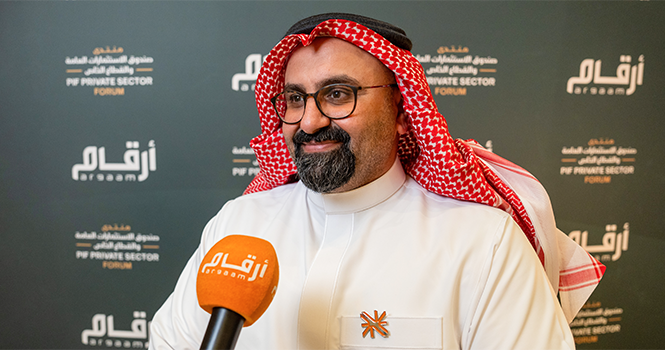
Ali Alfayez, CEO of National Lighting Co.
Ali Alfayez, CEO of National Lighting Co., stated that over 75% of the lighting market currently depends on imports, including raw materials such as aluminum, plastic, glass, and electronic panels, even though most raw materials are available locally. 
In an interview with Argaam during the 2026 Private Sector Forum of the Public Investment Fund (PIF), he said the Saudi lighting market is estimated at SAR 6–8 billion annually and is expected to grow over the next five years.
Alfayez noted that demand for lighting solutions is driven by the booming construction sector, especially major, mega, and giga projects linked to Vision 2030, as well as energy efficiency projects replacing traditional lighting with LED technologies in existing buildings.
He added that the company, with the Ministry of Industry and Mineral Resources, plans to establish the Kingdom’s first non-profit association for lighting manufacturers in the first quarter of 2026.
He highlighted that National Lighting is expanding production and boosting industrial localization, with its 20,000-square-meter Dammam facilities operating in lighting solutions, smart systems and integration, and energy and control.
Alfayez revealed that the company aims to achieve up to fivefold growth over the next three years to strengthen its position in the Saudi lighting market and support localization goals.
He said the company aims to help transform the Kingdom into a global lighting hub, leveraging local raw materials and competitive advantages to compete with markets including China.
He confirmed that localizing raw material processing is a key competitive edge over imports, with the main challenge being the development of domestic manufacturing industries.
Finally, he explained that the company invited local factories capable of converting aluminum, plastic, and iron into lighting components, supported by its RD center which provides designs and technical assistance to integrate them into the local supply network.
Ali Alfayez, CEO of National Lighting Co.
Ali Alfayez, CEO of National Lighting Co., stated that over 75% of the lighting market currently depends on imports, including raw materials such as aluminum, plastic, glass, and electronic panels, even though most raw materials are available locally.
In an interview with Argaam during the 2026 Private Sector Forum of the Public Investment Fund (PIF), he said the Saudi lighting market is estimated at SAR 6–8 billion annually and is expected to grow over the next five years.
Alfayez noted that demand for lighting solutions is driven by the booming construction sector, especially major, mega, and giga projects linked to Vision 2030, as well as energy efficiency projects replacing traditional lighting with LED technologies in existing buildings.
He added that the company, with the Ministry of Industry and Mineral Resources, plans to establish the Kingdom’s first non-profit association for lighting manufacturers in the first quarter of 2026.
He highlighted that National Lighting is expanding production and boosting industrial localization, with its 20,000-square-meter Dammam facilities operating in lighting solutions, smart systems and integration, and energy and control.
Alfayez revealed that the company aims to achieve up to fivefold growth over the next three years to strengthen its position in the Saudi lighting market and support localization goals.
He said the company aims to help transform the Kingdom into a global lighting hub, leveraging local raw materials and competitive advantages to compete with markets including China.
He confirmed that localizing raw material processing is a key competitive edge over imports, with the main challenge being the development of domestic manufacturing industries.
Finally, he explained that the company invited local factories capable of converting aluminum, plastic, and iron into lighting components, supported by its RD center which provides designs and technical assistance to integrate them into the local supply network.